
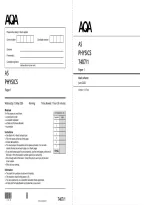
Please write clearly in block capitals.
Centre number Candidate number
AS
Surname
Forename(s) PHYSICS
Candidate signature
I declare this is my own work.
7407/1
Paper 1
AS
Mark scheme
PHYSICS June 2026
Paper 1 Version: 1.0 Final
Wednesday 13 May 2026 Morning Time allowed: 1 hour 30 minutes
Materials
For this paper you must have: For Examiner’s Use
• a pencil and a ruler Question Mark
• a scientific calculator 1
• a Data and Formulae Booklet
2
• a protractor.
3
Instructions
4
• Use black ink or black ball-point pen.
• Fill in the boxes at the top of this page. 5
• Answer all questions. 6
• You must answer the questions in the spaces provided. Do not write 7
outside the box around each page or on blank pages.
• If you need extra space for your answer(s), use the lined pages at the end of TOTAL
this book. Write the question number against your answer(s).
• Do all rough work in this book. Cross through any work you do not want
to be marked.
• Show all your working.
Information
• The marks for questions are shown in brackets.
• The maximum mark for this paper is 70.
• You are expected to use a scientific calculator where appropriate.
• A Data and Formulae Booklet is provided as a loose insert.
*jun *
IB/M/Jun26/G4004/V5 7407/1
, 2
MARK SCHEME – AS PHYSICS – 7407/1 – JUNE 2026
Do not write
outside the
Answer all questions in the spaces provided. box
Mark schemes are prepared by the Lead Assessment Writer and considered, together with the relevant
questions, by a panel of subject teachers. This mark scheme includes any amendments made at the
0 1 The proton number of lead is 82 standardisation events which all associates participate in and is the scheme which was used by them in
this examination. The standardisation process ensures that the mark scheme covers the students’
The mass of a nucleus of one isotope of lead is 3.45 × 10⁻²⁵ kg. responses to questions and that every associate understands and applies it in the same correct way.
As preparation for standardisation each associate analyses a number of students’ scripts. Alternative
0 1 . 1 The average mass of a nucleon in this nucleus is 1.7 × 10⁻²⁷ kg. answers not already covered by the mark scheme are discussed and legislated for. If, after the
standardisation process, associates encounter unusual answers which have not been raised they are
Calculate the number of neutrons in this nucleus. required to refer these to the Lead Examiner.
[2 marks]
It must be stressed that a mark scheme is a working document, in many cases further developed and
expanded on the basis of students’ reactions to a particular paper. Assumptions about future mark
schemes on the basis of one year’s document should be avoided; whilst the guiding principles of
assessment remain constant, details will change, depending on the content of a particular examination
paper.
No student should be disadvantaged on the basis of their gender identity and/or how they refer to the
gender identity of others in their exam responses.
A consistent use of ‘they/them’ as a singular and pronouns beyond ‘she/her’ or ‘he/him’ will be credited in
exam responses in line with existing mark scheme criteria.
Further copies of this mark scheme are available from
number of neutrons =
0 1 . 2 Calculate the specific charge of this nucleus.
[1 mark]
specific charge = C kg−1
information
retains the on all its publications. However, registered schools/colleges for are permitted to copy material from this booklet for their own internal
use, with the following important exception: cannot give permission to schools/colleges to photocopy any material that is acknowledged to a third party even for
internal use within the centre.
and its licensors. All rights reserved.
*02*
2
IB/M/Jun26/7407/1
, 3
MARK SCHEME – AS PHYSICS – 7407/1 – JUNE 2026
Do not write
outside the
0 1 . 3 This isotope of lead is unstable and undergoes a series of alpha and box
beta-minus decays.
Physics - Mark scheme instructions to examiners
The final product of this series of decays is a stable isotope of lead.
What is the number of alpha and beta-minus decays that occur? 1. General
Tick () one box. The mark scheme for each question shows:
[1 mark]
• the marks available for each part of the question
• the total marks available for the question
one alpha, one beta minus • the typical answer or answers which are expected
• extra information to help the Examiner make his or her judgement and help to delineate what is
acceptable or not worthy of credit or, in discursive answers, to give an overview of the area in which a
one alpha, two beta minus mark or marks may be awarded.
The extra information is aligned to the appropriate answer in the left-hand part of the mark scheme and
two alpha, one beta minus should only be applied to that item in the mark scheme.
At the beginning of a part of a question a reminder may be given, for example: where consequential
marking needs to be considered in a calculation; or the answer may be on the diagram or at a different
two alpha, two beta minus 4 place on the script.
In general the right-hand side of the mark scheme is there to provide those extra details which confuse
the main part of the mark scheme yet may be helpful in ensuring that marking is straightforward and
consistent.
2. Emboldening
Turn over for the next question
2.1
In a list of acceptable answers where more than one mark is available ‘any two from’ is used, with the
number of marks emboldened. Each of the following bullet points is a potential mark.
2.2
A bold and is used to indicate that both parts of the answer are required to award the mark.
2.3
Alternative answers acceptable for a mark are indicated by the use of or. Different terms in the mark
scheme are shown by a / ; eg allow smooth / free movement.
3. Marking points
3.1 Marking of lists
This applies to questions requiring a set number of responses, but for which candidates have provided
extra responses. The general principle to be followed in such a situation is that ‘right + wrong = wrong’.
Each error/contradiction negates each correct response. So, if the number of errors/contradictions
equals or exceeds the number of marks available for the question, no marks can be awarded.
However, responses considered to be neutral (often prefaced by ‘Ignore’ in the mark scheme) are not
penalised.
Turn over ►
*03*
3
IB/M/Jun26/7407/1
, 4
MARK SCHEME – AS PHYSICS – 7407/1 – JUNE 2026
Do not write
outside the
0 2 An unidentified particle X interacts with a proton to produce a neutron and a positron. box
The equation representing the interaction is
3.2 Marking procedure for calculations
Full marks can usually be given for a correct numerical answer without working shown unless the
X + p → n + e+ question states ‘Show your working’. However, if a correct numerical answer can be evaluated from
incorrect physics then working will be required. The mark scheme will indicate both this and the credit (if
0 2 . 1 State the quark structure of the neutral hadron that is involved in this interaction. any) that can be allowed for the incorrect approach.
[1 mark] However, if the answer is incorrect, mark(s) can usually be gained by correct substitution/working and
this is shown in the ‘extra information’ column or by each stage of a longer calculation.
A calculation must be followed through to answer in decimal form. An answer in surd form is never
acceptable for the final (evaluation) mark in a calculation and will therefore generally be denied one
0 2 . 2 mark.
Identify particle X.
Justify your answer by referring to appropriate conservation laws.
[3 marks] 3.3 Interpretation of ‘it’
Answers using the word ‘it’ should be given credit only if it is clear that the ‘it’ refers to the correct
subject.
3.4 Errors carried forward, consequential marking and arithmetic errors
Allowances for errors carried forward are likely to be restricted to calculation questions and should be
shown by the abbreviation ECF or conseq in the marking scheme.
An arithmetic error should be penalised for one mark only unless otherwise amplified in the marking
scheme. Arithmetic errors may arise from a slip in a calculation or from an incorrect transfer of a
X= numerical value from data given in a question.
3.5 Phonetic spelling
0 2 . 3 The total energy of an interaction consists of the kinetic energy and the mass-energy The phonetic spelling of correct scientific terminology should be credited (eg fizix) unless there is a
of the interacting particles. possible confusion (eg defraction/refraction) with another technical term.
A positron is moving very slowly when it interacts with a stationary electron. 3.6 Brackets
(…..) are used to indicate information which is not essential for the mark to be awarded but is included to
The total energy of this interaction is 1.64 × 10⁻¹³ J. help the examiner identify the sense of the answer required.
Calculate the maximum wavelength of the gamma radiation that is produced when the 3.7 Ignore / Insufficient / Do not allow
positron and electron annihilate. ‘Ignore’ or ‘insufficient’ is used when the information given is irrelevant to the question or not enough to
[2 marks] gain the marking point. Any further correct amplification could gain the marking point.
‘Do not allow’ means that this is a wrong answer which, even if the correct answer is given, will still
mean that the mark is not awarded.
3.8 Significant figure penalties
Answers to questions in the practical sections (7407/2 – Section A and 7408/3A) should display an
appropriate number of significant figures. For non-practical sections, an A-level paper may contain up to
2 marks (1 mark for AS) that are contingent on the candidate quoting the final answer in a calculation to
a specified number of significant figures (sf). This will generally be assessed to be the number of sf of
the datum with the least number of sf from which the answer is determined. The mark scheme will give
the range of sf that are acceptable but this will normally be the sf of the datum (or this sf −1).
An answer in surd form cannot gain the sf mark. An incorrect calculation following some working can
gain the sf mark. For a question beginning with the command word ‘Show that…’, the answer should be
6 quoted to one more sf than the sf quoted in the question eg ‘Show that X is equal to about 2.1 cm’ –
maximum wavelength = m answer should be quoted to 3 sf. An answer to 1 sf will not normally be acceptable, unless the answer is
an integer eg a number of objects. In non-practical sections, the need for a consideration will be
indicated in the question by the use of ‘Give your answer to an appropriate number of significant figures’.
*04*
4
IB/M/Jun26/7407/1
Centre number Candidate number
AS
Surname
Forename(s) PHYSICS
Candidate signature
I declare this is my own work.
7407/1
Paper 1
AS
Mark scheme
PHYSICS June 2026
Paper 1 Version: 1.0 Final
Wednesday 13 May 2026 Morning Time allowed: 1 hour 30 minutes
Materials
For this paper you must have: For Examiner’s Use
• a pencil and a ruler Question Mark
• a scientific calculator 1
• a Data and Formulae Booklet
2
• a protractor.
3
Instructions
4
• Use black ink or black ball-point pen.
• Fill in the boxes at the top of this page. 5
• Answer all questions. 6
• You must answer the questions in the spaces provided. Do not write 7
outside the box around each page or on blank pages.
• If you need extra space for your answer(s), use the lined pages at the end of TOTAL
this book. Write the question number against your answer(s).
• Do all rough work in this book. Cross through any work you do not want
to be marked.
• Show all your working.
Information
• The marks for questions are shown in brackets.
• The maximum mark for this paper is 70.
• You are expected to use a scientific calculator where appropriate.
• A Data and Formulae Booklet is provided as a loose insert.
*jun *
IB/M/Jun26/G4004/V5 7407/1
, 2
MARK SCHEME – AS PHYSICS – 7407/1 – JUNE 2026
Do not write
outside the
Answer all questions in the spaces provided. box
Mark schemes are prepared by the Lead Assessment Writer and considered, together with the relevant
questions, by a panel of subject teachers. This mark scheme includes any amendments made at the
0 1 The proton number of lead is 82 standardisation events which all associates participate in and is the scheme which was used by them in
this examination. The standardisation process ensures that the mark scheme covers the students’
The mass of a nucleus of one isotope of lead is 3.45 × 10⁻²⁵ kg. responses to questions and that every associate understands and applies it in the same correct way.
As preparation for standardisation each associate analyses a number of students’ scripts. Alternative
0 1 . 1 The average mass of a nucleon in this nucleus is 1.7 × 10⁻²⁷ kg. answers not already covered by the mark scheme are discussed and legislated for. If, after the
standardisation process, associates encounter unusual answers which have not been raised they are
Calculate the number of neutrons in this nucleus. required to refer these to the Lead Examiner.
[2 marks]
It must be stressed that a mark scheme is a working document, in many cases further developed and
expanded on the basis of students’ reactions to a particular paper. Assumptions about future mark
schemes on the basis of one year’s document should be avoided; whilst the guiding principles of
assessment remain constant, details will change, depending on the content of a particular examination
paper.
No student should be disadvantaged on the basis of their gender identity and/or how they refer to the
gender identity of others in their exam responses.
A consistent use of ‘they/them’ as a singular and pronouns beyond ‘she/her’ or ‘he/him’ will be credited in
exam responses in line with existing mark scheme criteria.
Further copies of this mark scheme are available from
number of neutrons =
0 1 . 2 Calculate the specific charge of this nucleus.
[1 mark]
specific charge = C kg−1
information
retains the on all its publications. However, registered schools/colleges for are permitted to copy material from this booklet for their own internal
use, with the following important exception: cannot give permission to schools/colleges to photocopy any material that is acknowledged to a third party even for
internal use within the centre.
and its licensors. All rights reserved.
*02*
2
IB/M/Jun26/7407/1
, 3
MARK SCHEME – AS PHYSICS – 7407/1 – JUNE 2026
Do not write
outside the
0 1 . 3 This isotope of lead is unstable and undergoes a series of alpha and box
beta-minus decays.
Physics - Mark scheme instructions to examiners
The final product of this series of decays is a stable isotope of lead.
What is the number of alpha and beta-minus decays that occur? 1. General
Tick () one box. The mark scheme for each question shows:
[1 mark]
• the marks available for each part of the question
• the total marks available for the question
one alpha, one beta minus • the typical answer or answers which are expected
• extra information to help the Examiner make his or her judgement and help to delineate what is
acceptable or not worthy of credit or, in discursive answers, to give an overview of the area in which a
one alpha, two beta minus mark or marks may be awarded.
The extra information is aligned to the appropriate answer in the left-hand part of the mark scheme and
two alpha, one beta minus should only be applied to that item in the mark scheme.
At the beginning of a part of a question a reminder may be given, for example: where consequential
marking needs to be considered in a calculation; or the answer may be on the diagram or at a different
two alpha, two beta minus 4 place on the script.
In general the right-hand side of the mark scheme is there to provide those extra details which confuse
the main part of the mark scheme yet may be helpful in ensuring that marking is straightforward and
consistent.
2. Emboldening
Turn over for the next question
2.1
In a list of acceptable answers where more than one mark is available ‘any two from’ is used, with the
number of marks emboldened. Each of the following bullet points is a potential mark.
2.2
A bold and is used to indicate that both parts of the answer are required to award the mark.
2.3
Alternative answers acceptable for a mark are indicated by the use of or. Different terms in the mark
scheme are shown by a / ; eg allow smooth / free movement.
3. Marking points
3.1 Marking of lists
This applies to questions requiring a set number of responses, but for which candidates have provided
extra responses. The general principle to be followed in such a situation is that ‘right + wrong = wrong’.
Each error/contradiction negates each correct response. So, if the number of errors/contradictions
equals or exceeds the number of marks available for the question, no marks can be awarded.
However, responses considered to be neutral (often prefaced by ‘Ignore’ in the mark scheme) are not
penalised.
Turn over ►
*03*
3
IB/M/Jun26/7407/1
, 4
MARK SCHEME – AS PHYSICS – 7407/1 – JUNE 2026
Do not write
outside the
0 2 An unidentified particle X interacts with a proton to produce a neutron and a positron. box
The equation representing the interaction is
3.2 Marking procedure for calculations
Full marks can usually be given for a correct numerical answer without working shown unless the
X + p → n + e+ question states ‘Show your working’. However, if a correct numerical answer can be evaluated from
incorrect physics then working will be required. The mark scheme will indicate both this and the credit (if
0 2 . 1 State the quark structure of the neutral hadron that is involved in this interaction. any) that can be allowed for the incorrect approach.
[1 mark] However, if the answer is incorrect, mark(s) can usually be gained by correct substitution/working and
this is shown in the ‘extra information’ column or by each stage of a longer calculation.
A calculation must be followed through to answer in decimal form. An answer in surd form is never
acceptable for the final (evaluation) mark in a calculation and will therefore generally be denied one
0 2 . 2 mark.
Identify particle X.
Justify your answer by referring to appropriate conservation laws.
[3 marks] 3.3 Interpretation of ‘it’
Answers using the word ‘it’ should be given credit only if it is clear that the ‘it’ refers to the correct
subject.
3.4 Errors carried forward, consequential marking and arithmetic errors
Allowances for errors carried forward are likely to be restricted to calculation questions and should be
shown by the abbreviation ECF or conseq in the marking scheme.
An arithmetic error should be penalised for one mark only unless otherwise amplified in the marking
scheme. Arithmetic errors may arise from a slip in a calculation or from an incorrect transfer of a
X= numerical value from data given in a question.
3.5 Phonetic spelling
0 2 . 3 The total energy of an interaction consists of the kinetic energy and the mass-energy The phonetic spelling of correct scientific terminology should be credited (eg fizix) unless there is a
of the interacting particles. possible confusion (eg defraction/refraction) with another technical term.
A positron is moving very slowly when it interacts with a stationary electron. 3.6 Brackets
(…..) are used to indicate information which is not essential for the mark to be awarded but is included to
The total energy of this interaction is 1.64 × 10⁻¹³ J. help the examiner identify the sense of the answer required.
Calculate the maximum wavelength of the gamma radiation that is produced when the 3.7 Ignore / Insufficient / Do not allow
positron and electron annihilate. ‘Ignore’ or ‘insufficient’ is used when the information given is irrelevant to the question or not enough to
[2 marks] gain the marking point. Any further correct amplification could gain the marking point.
‘Do not allow’ means that this is a wrong answer which, even if the correct answer is given, will still
mean that the mark is not awarded.
3.8 Significant figure penalties
Answers to questions in the practical sections (7407/2 – Section A and 7408/3A) should display an
appropriate number of significant figures. For non-practical sections, an A-level paper may contain up to
2 marks (1 mark for AS) that are contingent on the candidate quoting the final answer in a calculation to
a specified number of significant figures (sf). This will generally be assessed to be the number of sf of
the datum with the least number of sf from which the answer is determined. The mark scheme will give
the range of sf that are acceptable but this will normally be the sf of the datum (or this sf −1).
An answer in surd form cannot gain the sf mark. An incorrect calculation following some working can
gain the sf mark. For a question beginning with the command word ‘Show that…’, the answer should be
6 quoted to one more sf than the sf quoted in the question eg ‘Show that X is equal to about 2.1 cm’ –
maximum wavelength = m answer should be quoted to 3 sf. An answer to 1 sf will not normally be acceptable, unless the answer is
an integer eg a number of objects. In non-practical sections, the need for a consideration will be
indicated in the question by the use of ‘Give your answer to an appropriate number of significant figures’.
*04*
4
IB/M/Jun26/7407/1


