
N176 • COMPREHENSIVE REVIEW • 2026–2027
N176 Comprehensive Exam Review
2026–2027 | High-yield nursing concepts, clinical priorities, and practice questions
COURSE-SCOPE NOTE: N176 may cover different material across schools and nursing programs. This guide reviews
broad adult-health and practical-nursing concepts; it is not verified against a particular institution's syllabus and is not an
official, leaked, or actual course examination.
How to use this review
• Review the priority principles first, then study each system section and its red flags.
• Answer the practice questions without looking at the key. For every missed item, explain why the correct answer is
safest.
• Use your current syllabus, instructor guidance, assigned textbook, medication references, and facility protocols to
resolve course-specific differences.
• Practice prioritization: identify immediate threats, act within scope, notify the appropriate clinician, and reassess the
response.
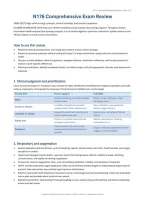
1. Clinical judgment and prioritization
Use a structured sequence: recognize cues, analyze the data, identify the most likely/most dangerous problem, plan safe
actions, implement, and evaluate the response. Prioritize actual instability over routine needs.
Priority lens How to apply it Examples
Airway, breathing, circulation before Stridor, severe dyspnea, major
ABCs
routine tasks. bleeding, shock.
A sudden change from baseline New confusion, new weakness,
Acute vs. chronic
usually needs earlier assessment. abrupt oxygen decline.
Assess the client with deterioration Hypotension with altered mental
Unstable vs. stable
before routine requests. status.
Prevent immediate harm and use Seizure precautions, choking,
Safety first
emergency protocols. medication error.
Check whether the intervention
Repeat respiratory assessment after
Reassess worked and whether escalation is
oxygen or bronchodilator.
needed.
2. Respiratory and oxygenation
• Assess respiratory rate and pattern, work of breathing, speech, mental status, skin color, breath sounds, and oxygen
saturation in context.
• Urgent warning signs include stridor, cyanosis, silent chest during severe asthma, inability to speak, declining
consciousness, and rapidly worsening oxygenation.
• Pneumonia: monitor oxygenation, fever, work of breathing, hydration, mobility, and response to treatment.
• COPD: use the prescribed oxygen target and orders; do not withhold needed oxygen or independently adjust beyond
protocol. New drowsiness may indicate hypercapnia or deterioration.
• Asthma: severe effort with reduced air movement can be more dangerous than loud wheezing. Follow the prescribed
rescue plan and escalate when symptoms are severe.
• Aspiration prevention: stop feeding if choking/coughing occurs, assess airway and breathing, and follow swallowing-
screen and diet orders.
Original educational review resource • Not an official or verified examination
, N176 • COMPREHENSIVE REVIEW • 2026–2027
• Tuberculosis: suspected infectious pulmonary TB generally requires airborne precautions and appropriate respiratory
protection per policy.
3. Cardiovascular and perfusion
• Possible acute coronary syndrome: chest pressure, diaphoresis, nausea, dyspnea, or unexplained weakness
warrants rapid assessment and emergency pathway activation.
• Heart failure: track daily weight, edema, lung sounds, orthopnea, intake/output, oxygenation, and trends. Rapid
weight gain with worsening dyspnea needs prompt reporting.
• Peripheral arterial disease often causes coolness, diminished pulses, and exertional pain relieved by rest; venous
insufficiency often causes dependent edema and brown ankle discoloration.
• DVT warning signs include new unilateral swelling, warmth, and pain. Do not massage a potentially thrombosed leg;
obtain prompt evaluation.
• Anticoagulants: report black tarry stool, vomiting blood, unexplained bruising, severe headache after trauma, or other
significant bleeding.
• Orthostatic assessment compares measurements across positions and includes symptoms; assist the client during
position changes.
4. Endocrine and glucose regulation
• Hypoglycemia may cause sweating, tremor, hunger, confusion, or behavior change. If alert and able to swallow, give
rapid-acting carbohydrate per protocol and recheck. If unconscious, do not give oral food or liquid; use emergency
protocol.
• DKA warning signs include dehydration, nausea/vomiting, abdominal pain, fruity breath, and deep rapid respirations.
Escalate promptly.
• NPO status requires an individualized diabetes medication and glucose-monitoring plan; do not give meal insulin
without accounting for food intake.
• Levothyroxine is generally taken consistently on an empty stomach; calcium and iron can interfere with absorption
and should be separated as instructed.
• Thyroid storm may involve high fever, marked tachycardia, agitation, and gastrointestinal symptoms; treat as an
emergency.
• Long-term corticosteroids should not be stopped abruptly without prescriber direction because adrenal suppression
may occur.
5. Renal function, fluids, and electrolytes
• Track urine output, daily weight, intake/output, edema, respiratory status, renal labs, and electrolytes. A falling urine
output with rising creatinine requires prompt review.
• Hyperkalemia can cause weakness and dangerous ECG changes such as peaked T waves; assess rhythm and
escalate urgently.
• Hypokalemia can cause weakness and dysrhythmias, particularly with diuretic use. Review potassium and relevant
renal data as ordered.
• Severe symptomatic hyponatremia can cause confusion or seizures. Treatment and sodium correction must be
carefully monitored.
• Hypernatremia requires assessment of cause and volume status with controlled correction; overly rapid correction
can cause harm.
• Dialysis clients with chest pain, hypotension, acute confusion, or breathing difficulty need immediate assessment
and the relevant emergency protocol.
Original educational review resource • Not an official or verified examination


