
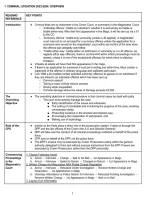
1. CRIMINAL LITIGATION 2023-2024: OVERVIEW
READING KEY POINTS
REFERENCE
Introduction ● Criminal trials are by indictment in the Crown Court, or summarily in the Magistrates’ Court:
○ ‘Indictable offence’: triable on indictment, whether it is exclusively so triable or
triable either-way. After their first appearance in the Mags, it will be sent up via s.51
to the CC.
○ ‘Summary offence’: triable only summarily (unless s.40 applies). A magistrates'
court may not try an accused for a summary offence unless the application for a
summons was served on the magistrates' court within six months of the time when
the offence was allegedly committed.
○ ‘Triable either way’: triable either on indictment or summarily or a s.40 offence. As
regards either way offences, there is no time-limit within which proceedings must be
started, unless it is one of the exceptional offences for which there is statutory
limitation.
● Virtually all adults will have their first appearance in the mags.
● If there is an application for summons it must be in writing and within time. Must contain a
statement of the offence in ordinary language and sufficient particulars.
● CJA 1988 s.40 enables certain specified summary offences to appear on an indictment if
they are linked to an indictable offence which has been sent up:
○ Common assault
○ Taking a motor vehicle without consent
○ Driving while disqualified
○ Criminal damage where the value of damage exceeds £5,000
The ● The overriding objective in criminal procedure is that criminal cases be dealt with justly.
Overriding ○ The court must actively manage the case
Objective ■ Early identification of the issues and witnesses;
■ The setting of a timetable and monitoring the progress of the case, avoiding
unnecessary delay;
■ Presenting evidence in the shortest and clearest way;
■ Encouraging the cooperation of participants; and
■ Making use of technology.
Role of the ● Insofar as the State plays a direct role in the prosecution system, it does so through the
CPS DPP and the law officers of the Crown (the A-G and Solicitor-General).
● DPP will take over the conduct of all criminal proceedings instituted on behalf of the police
force.
● CPR acts on behalf of the DPP, not the police force.
● The DPP’s powers may be exercised by Crown Prosecutors acting within the general
authority delegated to them and without express instructions from the DPP. Powers are
exercised by Crown Prosecutors rather than the DPP personally.
Commencing 1. Charge Following Arrest
Proceedings a. Arrest → Interview → Charge → Bail or No Bail → 1st Appearance in Mags
in the b. Arrest → Interview → Bailed to Return → Charged on Return → 1st Appearance in Mags
Magistrate’s 2. Written Charge and Requisition AKA Postal Charge Requisition
Court a. Arrest → Interview → Released Under Investigation → Receive Written Charge and
Requisition → 1st Appearance in Mags
b. Voluntary Attendance at Police Station for Interview → Released Pending Investigation →
Receive Written Charge → 1st Appearance in Mags → Bail or no Bail
3. Laying of an Information
1
,2. CRIMINAL LITIGATION 2023-2024: DOCUMENTS AND DISCLOSURE
READING KEY POINTS
REFERENCE
Duty to Retain ● Investigators must record all material which may be relevant. This is a widely drawn
Unused definition.
Material ○ the test of what are reasonable investigative steps in the circumstances is likely to
start from the position of a persistent prosecutor who does not readily take 'no' for
an answer
○ The disclosure officer must be independent of the investigation
● Material must be listed on a schedule containing sufficient detail.
● Prosecution advocates must ensure that all material which ought to be disclosed is
disclosed to the defence, this decision must be kept under review throughout all stages of
the case. This is a continuing duty.
○ Dip sample of digital material where there is too much to review. Disclose how the
dip sample came about.
● Unused material test:
○ Requires a prosecutor to disclose previously undisclosed material to the accused if
it ‘might reasonably be considered capable of undermining the case for the
prosecution against the accused, or of assisting the case for the accused.’
● If there is no disclosable material, the accused must be given a written statement to that
effect.
● Material must not be disclosed if it is not in the public interest or if disclosure is prohibited
by the IPA 2016, s. 56.
● In summary trials, a streamlined disclosure certificate should be used where a not guilty
plea is anticipated and which is reasonably expected to be suitable for summary trial.
● Drafts should be kept for disclosure, duplicates can be disposed of.
Time Limits ● Crown Court: No statutory time limit, the default position is that disclosure must be made as
for soon as reasonably practicable after the happening of a particular event, such as service of
Prosecution the prosecution case. For large and complex cases: Disclosure Management Document
Disclosure ● Magistrate’s Court: The schedule must be disclosed to the accused either at the hearing at
which a not guilty plea is entered, or as soon as possible following a formal indication from
the accused or the accused’s representative that a not guilty plea will be entered at the
hearing.
● At any other time, disclosure must be disclosed to the accused as soon as reasonably
practicable. Sometimes this may be before the first hearings e.g in the interest and fairness
and justice for bail.
● If the prosecution have not complied with further disclosure, an accused may apply for an
order of material which should have been disclosed.
● The duties terminate with conviction, acquittal or discontinuation of proceedings
Defence ● Once case is sent to the CC → defence statement within 28 days of prosecution disclosure
Duties of (may apply for an extension before the deadline expires):
Disclosure ○ Defence
○ Matters of fact which the accused takes issue with and why
○ What the accused intends to rely on
○ Any points of law
○ Alibi - names, addresses, DOB
○ Witnesses - identifying information. Notice of a witness 14 days (summary), 28 days
(CC) after disclosure. No witness information is required in a non-alibi case
○ Can simply require the crown to prove their case
● Must be provided as soon as reasonably practicable
● No obligation to provide a defence statement in summary trial - if they choose to, must be
within 14 days of prosecution disclosure.
1
, ● If not done in time → sanctions
Public Interest ● Public interest immunity:
Immunity and ○ Will withhold disclosure to the minimum extent necessary to protect public interest
Third Party and never imperil the overall fairness of the trial.
Disclosure ○ This must be recorded in a ‘sensitive schedule’
○ Investigators must specify:
■ The reasons why the material is sensitive,
■ the degree of sensitivity attaching to the material,
■ the consequences of revealing it to the defence,
■ the significance of the material to the issues in the trial,
■ The involvement of third parties in bringing the material to the attention of
the police
■ The implications for continuance of the prosecution if disclosure is ordered
■ And whether it is possible to disclose the material without compromising its
sensitivity.
● Third party disclosure:
○ It may be relevant, the third party must be informed of the investigation and invited
to retain the material in case a request for disclosure is made.
○ There must be some reason to believe that the third party holds relevant material.
○ In the CC, the prosecution is under an obligation to obtain material in the hands of
third parties which might be relevant to the prosecution case - done through a
witness summons.
2
, 3. CRIMINAL LITIGATION 2023-2024: CUSTODIAL AND NON-CUSTODIAL SENTENCES
Syllabus Area 22: Sentencing Principles
READING KEY POINTS
REFERENCE
Purposes of ● The Court must have regard to the following purposes of sentencing when sentencing
Sentencing (does not apply to corporate offenders):
and ○ The punishment of offenders;
Sentencing ○ The reduction of crime;
Guidelines ○ The reform and rehabilitation of offenders;
○ The protection of the public; and
○ The making of reparation by offenders to persons affected by their offence.
● The Court must have regard to sentencing guidelines, unless it would be contrary in the
interests of justice to do so.
● Once a provisional sentence is arrived at, the Court should take into account all
aggravating and mitigating factors. Including taking into account reduction in sentence for
assistance to prosecution.
● The Court must consider the totality guidelines.
● There is a duty for the Court to give reasons for and explain the effect of the sentence.
Assessment ● To consider seriousness, the Court must consider:
of ○ The offender’s culpability; and
Seriousness, ○ The harm which the offence caused, was intended to cause or might foreseeably
Reduction in have caused.
Sentence for a ● Reduction for a guilty plea:
Guilty Plea, ○ Maximum reduction at the first stage of proceedings is one-third;
Aggravating ○ After this, it is one quarter; and
and Mitigating ○ It is reduced to one tenth on the first day of trial.
Factors, the ● A guilty plea must be entered voluntarily, if it is not the conviction will be quashed on
Totality appeal.
Principle and ● Statutory aggravating factors include:
Prevalence ○ Offence committed on bail;
○ Previous convictions;
○ Hostility related to race, religion, disability, sexual orientation, or transgender
identity; and
○ Terrorist connections.
● General aggravating factors do not include lies.
● The seriousness of an individual case should be judged on its own dimensions of harm and
culpability, rather than as part of a collective social harm.
Pre-Sentence ● If the offender is aged 18 or over, the Court must obtain and consider a pre-sentence
Reports, report, unless in the circumstances it is unnecessary.
Medical ● If an offender is under 18, the Court must obtain and consider a pre-sentence report unless
Reports and there exists a previous one and it considers it unnecessary.
Victim ● Sentences are not invalidated by the Court failing to obtain the pre-sentence report.
Personal ● Victim personal statements allow the Court to consider the personal impact of the offence,
Statements victims are under no obligation to give a statement and and an absence of one does not
indicate an absence of harm.
○ They cannot suggest a level of sentence to the judge, but can set out the facts.
● Where the offender is or appears to have a mental disorder the Court must obtain and
consider a medical report. Unless in the circumstances it is unnecessary.
Indications as
to Sentence
1
READING KEY POINTS
REFERENCE
Introduction ● Criminal trials are by indictment in the Crown Court, or summarily in the Magistrates’ Court:
○ ‘Indictable offence’: triable on indictment, whether it is exclusively so triable or
triable either-way. After their first appearance in the Mags, it will be sent up via s.51
to the CC.
○ ‘Summary offence’: triable only summarily (unless s.40 applies). A magistrates'
court may not try an accused for a summary offence unless the application for a
summons was served on the magistrates' court within six months of the time when
the offence was allegedly committed.
○ ‘Triable either way’: triable either on indictment or summarily or a s.40 offence. As
regards either way offences, there is no time-limit within which proceedings must be
started, unless it is one of the exceptional offences for which there is statutory
limitation.
● Virtually all adults will have their first appearance in the mags.
● If there is an application for summons it must be in writing and within time. Must contain a
statement of the offence in ordinary language and sufficient particulars.
● CJA 1988 s.40 enables certain specified summary offences to appear on an indictment if
they are linked to an indictable offence which has been sent up:
○ Common assault
○ Taking a motor vehicle without consent
○ Driving while disqualified
○ Criminal damage where the value of damage exceeds £5,000
The ● The overriding objective in criminal procedure is that criminal cases be dealt with justly.
Overriding ○ The court must actively manage the case
Objective ■ Early identification of the issues and witnesses;
■ The setting of a timetable and monitoring the progress of the case, avoiding
unnecessary delay;
■ Presenting evidence in the shortest and clearest way;
■ Encouraging the cooperation of participants; and
■ Making use of technology.
Role of the ● Insofar as the State plays a direct role in the prosecution system, it does so through the
CPS DPP and the law officers of the Crown (the A-G and Solicitor-General).
● DPP will take over the conduct of all criminal proceedings instituted on behalf of the police
force.
● CPR acts on behalf of the DPP, not the police force.
● The DPP’s powers may be exercised by Crown Prosecutors acting within the general
authority delegated to them and without express instructions from the DPP. Powers are
exercised by Crown Prosecutors rather than the DPP personally.
Commencing 1. Charge Following Arrest
Proceedings a. Arrest → Interview → Charge → Bail or No Bail → 1st Appearance in Mags
in the b. Arrest → Interview → Bailed to Return → Charged on Return → 1st Appearance in Mags
Magistrate’s 2. Written Charge and Requisition AKA Postal Charge Requisition
Court a. Arrest → Interview → Released Under Investigation → Receive Written Charge and
Requisition → 1st Appearance in Mags
b. Voluntary Attendance at Police Station for Interview → Released Pending Investigation →
Receive Written Charge → 1st Appearance in Mags → Bail or no Bail
3. Laying of an Information
1
,2. CRIMINAL LITIGATION 2023-2024: DOCUMENTS AND DISCLOSURE
READING KEY POINTS
REFERENCE
Duty to Retain ● Investigators must record all material which may be relevant. This is a widely drawn
Unused definition.
Material ○ the test of what are reasonable investigative steps in the circumstances is likely to
start from the position of a persistent prosecutor who does not readily take 'no' for
an answer
○ The disclosure officer must be independent of the investigation
● Material must be listed on a schedule containing sufficient detail.
● Prosecution advocates must ensure that all material which ought to be disclosed is
disclosed to the defence, this decision must be kept under review throughout all stages of
the case. This is a continuing duty.
○ Dip sample of digital material where there is too much to review. Disclose how the
dip sample came about.
● Unused material test:
○ Requires a prosecutor to disclose previously undisclosed material to the accused if
it ‘might reasonably be considered capable of undermining the case for the
prosecution against the accused, or of assisting the case for the accused.’
● If there is no disclosable material, the accused must be given a written statement to that
effect.
● Material must not be disclosed if it is not in the public interest or if disclosure is prohibited
by the IPA 2016, s. 56.
● In summary trials, a streamlined disclosure certificate should be used where a not guilty
plea is anticipated and which is reasonably expected to be suitable for summary trial.
● Drafts should be kept for disclosure, duplicates can be disposed of.
Time Limits ● Crown Court: No statutory time limit, the default position is that disclosure must be made as
for soon as reasonably practicable after the happening of a particular event, such as service of
Prosecution the prosecution case. For large and complex cases: Disclosure Management Document
Disclosure ● Magistrate’s Court: The schedule must be disclosed to the accused either at the hearing at
which a not guilty plea is entered, or as soon as possible following a formal indication from
the accused or the accused’s representative that a not guilty plea will be entered at the
hearing.
● At any other time, disclosure must be disclosed to the accused as soon as reasonably
practicable. Sometimes this may be before the first hearings e.g in the interest and fairness
and justice for bail.
● If the prosecution have not complied with further disclosure, an accused may apply for an
order of material which should have been disclosed.
● The duties terminate with conviction, acquittal or discontinuation of proceedings
Defence ● Once case is sent to the CC → defence statement within 28 days of prosecution disclosure
Duties of (may apply for an extension before the deadline expires):
Disclosure ○ Defence
○ Matters of fact which the accused takes issue with and why
○ What the accused intends to rely on
○ Any points of law
○ Alibi - names, addresses, DOB
○ Witnesses - identifying information. Notice of a witness 14 days (summary), 28 days
(CC) after disclosure. No witness information is required in a non-alibi case
○ Can simply require the crown to prove their case
● Must be provided as soon as reasonably practicable
● No obligation to provide a defence statement in summary trial - if they choose to, must be
within 14 days of prosecution disclosure.
1
, ● If not done in time → sanctions
Public Interest ● Public interest immunity:
Immunity and ○ Will withhold disclosure to the minimum extent necessary to protect public interest
Third Party and never imperil the overall fairness of the trial.
Disclosure ○ This must be recorded in a ‘sensitive schedule’
○ Investigators must specify:
■ The reasons why the material is sensitive,
■ the degree of sensitivity attaching to the material,
■ the consequences of revealing it to the defence,
■ the significance of the material to the issues in the trial,
■ The involvement of third parties in bringing the material to the attention of
the police
■ The implications for continuance of the prosecution if disclosure is ordered
■ And whether it is possible to disclose the material without compromising its
sensitivity.
● Third party disclosure:
○ It may be relevant, the third party must be informed of the investigation and invited
to retain the material in case a request for disclosure is made.
○ There must be some reason to believe that the third party holds relevant material.
○ In the CC, the prosecution is under an obligation to obtain material in the hands of
third parties which might be relevant to the prosecution case - done through a
witness summons.
2
, 3. CRIMINAL LITIGATION 2023-2024: CUSTODIAL AND NON-CUSTODIAL SENTENCES
Syllabus Area 22: Sentencing Principles
READING KEY POINTS
REFERENCE
Purposes of ● The Court must have regard to the following purposes of sentencing when sentencing
Sentencing (does not apply to corporate offenders):
and ○ The punishment of offenders;
Sentencing ○ The reduction of crime;
Guidelines ○ The reform and rehabilitation of offenders;
○ The protection of the public; and
○ The making of reparation by offenders to persons affected by their offence.
● The Court must have regard to sentencing guidelines, unless it would be contrary in the
interests of justice to do so.
● Once a provisional sentence is arrived at, the Court should take into account all
aggravating and mitigating factors. Including taking into account reduction in sentence for
assistance to prosecution.
● The Court must consider the totality guidelines.
● There is a duty for the Court to give reasons for and explain the effect of the sentence.
Assessment ● To consider seriousness, the Court must consider:
of ○ The offender’s culpability; and
Seriousness, ○ The harm which the offence caused, was intended to cause or might foreseeably
Reduction in have caused.
Sentence for a ● Reduction for a guilty plea:
Guilty Plea, ○ Maximum reduction at the first stage of proceedings is one-third;
Aggravating ○ After this, it is one quarter; and
and Mitigating ○ It is reduced to one tenth on the first day of trial.
Factors, the ● A guilty plea must be entered voluntarily, if it is not the conviction will be quashed on
Totality appeal.
Principle and ● Statutory aggravating factors include:
Prevalence ○ Offence committed on bail;
○ Previous convictions;
○ Hostility related to race, religion, disability, sexual orientation, or transgender
identity; and
○ Terrorist connections.
● General aggravating factors do not include lies.
● The seriousness of an individual case should be judged on its own dimensions of harm and
culpability, rather than as part of a collective social harm.
Pre-Sentence ● If the offender is aged 18 or over, the Court must obtain and consider a pre-sentence
Reports, report, unless in the circumstances it is unnecessary.
Medical ● If an offender is under 18, the Court must obtain and consider a pre-sentence report unless
Reports and there exists a previous one and it considers it unnecessary.
Victim ● Sentences are not invalidated by the Court failing to obtain the pre-sentence report.
Personal ● Victim personal statements allow the Court to consider the personal impact of the offence,
Statements victims are under no obligation to give a statement and and an absence of one does not
indicate an absence of harm.
○ They cannot suggest a level of sentence to the judge, but can set out the facts.
● Where the offender is or appears to have a mental disorder the Court must obtain and
consider a medical report. Unless in the circumstances it is unnecessary.
Indications as
to Sentence
1


