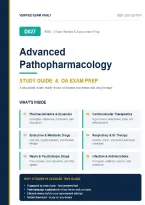
, WGU D027: ADVANCED PATHOPHARMACOLOGY
Objective Assessment Practice Exam & Comprehensive Rationales
Course Code: D027 Advanced Pathopharmacology
Total Questions: 70 Advanced Clinical Vignettes & Multiple-Choice
Items
EXAMINATION INSTRUCTIONS:
• This practice assessment is designed to mirror the rigorous clinical decision-making required for the
WGU D027 Advanced Pathopharmacology Objective Assessment.
• Questions integrate advanced pathophysiology, pharmacokinetics, pharmacodynamics,
pharmacogenomics, toxicities, and complex comorbidities across various organ systems.
• Select the single best answer for each question. Detailed rationales for both correct and incorrect
choices are provided at the end of the exam.
,Exam Questions
1. A 68-year-old male with heart failure with reduced ejection fraction (HFrEF) and chronic kidney
disease (CKD stage 3b, eGFR 38 mL/min/1.73m²) is initiated on sacubitril/valsartan. Two weeks later,
his serum potassium increases from 4.5 mEq/L to 5.4 mEq/L, and serum creatinine rises from 1.4
mg/dL to 1.9 mg/dL. Which pathophysiological and pharmacological mechanism best explains this
laboratory shift?
A) Inhibition of neprilysin leads to increased accumulation of natriuretic peptides, causing profound
renal efferent arteriole vasoconstriction.
B) Combined inhibition of the renin-angiotensin-aldosterone system (RAAS) via valsartan and
blockade of angiotensin receptor-neprilysin inhibitor pathways decreases aldosterone-mediated
potassium excretion and efferent arteriolar tone.
C) Sacubitril directly inhibits renal tubular sodium-glucose cotransporters, leading to hyperkalemic
tubular nephropathy.
D) Valsartan induces primary renal artery stenosis by precipitating severe atherosclerosis in
compromised renal beds.
Correct Answer: B
Rationale: Sacubitril/valsartan combines an angiotensin II receptor blocker (valsartan) and a
neprilysin inhibitor (sacubitril). Valsartan blocks angiotensin II, reducing efferent arteriolar
vasoconstriction (which can temporarily elevate serum creatinine as intraglomerular pressure drops)
and lowering aldosterone levels, which impairs potassium excretion (risk of hyperkalemia). Neprilysin
inhibition increases natriuretic peptides, bradykinin, and other vasoactive peptides, but the primary
driver of acute creatinine bump and hyperkalemia in CKD patients is the ARB component acting on
renal hemodynamics and aldosterone suppression.
2. A 54-year-old female with treatment-resistant depression is prescribed tranylcypromine, a
monoamine oxidase inhibitor (MAOI). She consumes a charcuterie board containing aged cheeses and
Chianti wine, subsequently presenting to the emergency department with a severe occipital
headache, diaphoresis, palpitations, and a blood pressure of 220/120 mmHg. What is the immediate
pharmacological mechanism underlying this hypertensive crisis?
A) Direct agonism of post-synaptic alpha-1 receptors by dietary tyramine due to MAO-A inhibition in
the gut wall and liver.
B) Massive systemic release of stored norepinephrine from sympathetic nerve terminals secondary
to dietary tyramine displacing norepinephrine, uninhibited by intestinal/hepatic MAO.
C) Inhibition of neuronal serotonin reuptake leading to profound peripheral vasoconstriction via 5-
HT2 receptor hyperstimulation.
D) Direct blockade of central baroreceptor reflexes through irreversible binding of tranylcypromine
to brainstem nuclei.
Correct Answer: B
Rationale: Dietary tyramine is normally degraded in the gut wall and liver by monoamine oxidase A
, (MAO-A). When an irreversible, non-selective MAOI like tranylcypromine is administered, dietary
tyramine escapes first-pass metabolism, enters the systemic circulation, and is taken up into
sympathetic nerve terminals where it displaces stored norepinephrine. The massive surge of
norepinephrine floods alpha-1 and beta-1 receptors, causing explosive vasoconstriction and severe
hypertension (the 'cheese effect').
3. A 45-year-old male with a history of generalized anxiety disorder and chronic back pain is brought
to the ED unresponsive, with pinpoint pupils, bradypnea (8 breaths/min), and oxygen saturation of
82% on room air. He is suspected of co-ingesting alprazolam and oxycodone. Which cellular receptor
mechanism and pharmacological antagonist interaction explain his clinical presentation and response
to naloxone?
A) Synergistic opening of GABA-A chloride channels and mu-opioid receptor hyperpolarization, fully
reversible by naloxone acting as a partial mu-agonist.
B) Mu-opioid receptor agonism causing potassium channel opening and calcium channel closure,
coupled with GABA-A allosteric modulation, where naloxone competitively antagonizes the mu-
opioid receptor.
C) NMDA receptor blockade by opioids combined with benzodiazepine-induced glycine receptor
activation, reversed by naloxone through inverse agonism.
D) Direct suppression of the medullary respiratory center via sigma receptor blockade, reversed by
naloxone via non-competitive antagonism.
Correct Answer: B
Rationale: Opiates bind to mu-opioid receptors, activating inhibitory G-proteins that close voltage-
gated calcium channels and open potassium channels, causing neuronal hyperpolarization and
suppression of the respiratory center. Benzodiazepines (alprazolam) bind allosterically to GABA-A
receptors, increasing chloride influx. Co-ingestion results in profound central nervous system and
respiratory depression. Naloxone is a competitive antagonist at mu-opioid receptors, rapidly
displacing opioids to restore respiration, though it has no reversing effect on benzodiazepines (which
require flumazenil if indicated).
Objective Assessment Practice Exam & Comprehensive Rationales
Course Code: D027 Advanced Pathopharmacology
Total Questions: 70 Advanced Clinical Vignettes & Multiple-Choice
Items
EXAMINATION INSTRUCTIONS:
• This practice assessment is designed to mirror the rigorous clinical decision-making required for the
WGU D027 Advanced Pathopharmacology Objective Assessment.
• Questions integrate advanced pathophysiology, pharmacokinetics, pharmacodynamics,
pharmacogenomics, toxicities, and complex comorbidities across various organ systems.
• Select the single best answer for each question. Detailed rationales for both correct and incorrect
choices are provided at the end of the exam.
,Exam Questions
1. A 68-year-old male with heart failure with reduced ejection fraction (HFrEF) and chronic kidney
disease (CKD stage 3b, eGFR 38 mL/min/1.73m²) is initiated on sacubitril/valsartan. Two weeks later,
his serum potassium increases from 4.5 mEq/L to 5.4 mEq/L, and serum creatinine rises from 1.4
mg/dL to 1.9 mg/dL. Which pathophysiological and pharmacological mechanism best explains this
laboratory shift?
A) Inhibition of neprilysin leads to increased accumulation of natriuretic peptides, causing profound
renal efferent arteriole vasoconstriction.
B) Combined inhibition of the renin-angiotensin-aldosterone system (RAAS) via valsartan and
blockade of angiotensin receptor-neprilysin inhibitor pathways decreases aldosterone-mediated
potassium excretion and efferent arteriolar tone.
C) Sacubitril directly inhibits renal tubular sodium-glucose cotransporters, leading to hyperkalemic
tubular nephropathy.
D) Valsartan induces primary renal artery stenosis by precipitating severe atherosclerosis in
compromised renal beds.
Correct Answer: B
Rationale: Sacubitril/valsartan combines an angiotensin II receptor blocker (valsartan) and a
neprilysin inhibitor (sacubitril). Valsartan blocks angiotensin II, reducing efferent arteriolar
vasoconstriction (which can temporarily elevate serum creatinine as intraglomerular pressure drops)
and lowering aldosterone levels, which impairs potassium excretion (risk of hyperkalemia). Neprilysin
inhibition increases natriuretic peptides, bradykinin, and other vasoactive peptides, but the primary
driver of acute creatinine bump and hyperkalemia in CKD patients is the ARB component acting on
renal hemodynamics and aldosterone suppression.
2. A 54-year-old female with treatment-resistant depression is prescribed tranylcypromine, a
monoamine oxidase inhibitor (MAOI). She consumes a charcuterie board containing aged cheeses and
Chianti wine, subsequently presenting to the emergency department with a severe occipital
headache, diaphoresis, palpitations, and a blood pressure of 220/120 mmHg. What is the immediate
pharmacological mechanism underlying this hypertensive crisis?
A) Direct agonism of post-synaptic alpha-1 receptors by dietary tyramine due to MAO-A inhibition in
the gut wall and liver.
B) Massive systemic release of stored norepinephrine from sympathetic nerve terminals secondary
to dietary tyramine displacing norepinephrine, uninhibited by intestinal/hepatic MAO.
C) Inhibition of neuronal serotonin reuptake leading to profound peripheral vasoconstriction via 5-
HT2 receptor hyperstimulation.
D) Direct blockade of central baroreceptor reflexes through irreversible binding of tranylcypromine
to brainstem nuclei.
Correct Answer: B
Rationale: Dietary tyramine is normally degraded in the gut wall and liver by monoamine oxidase A
, (MAO-A). When an irreversible, non-selective MAOI like tranylcypromine is administered, dietary
tyramine escapes first-pass metabolism, enters the systemic circulation, and is taken up into
sympathetic nerve terminals where it displaces stored norepinephrine. The massive surge of
norepinephrine floods alpha-1 and beta-1 receptors, causing explosive vasoconstriction and severe
hypertension (the 'cheese effect').
3. A 45-year-old male with a history of generalized anxiety disorder and chronic back pain is brought
to the ED unresponsive, with pinpoint pupils, bradypnea (8 breaths/min), and oxygen saturation of
82% on room air. He is suspected of co-ingesting alprazolam and oxycodone. Which cellular receptor
mechanism and pharmacological antagonist interaction explain his clinical presentation and response
to naloxone?
A) Synergistic opening of GABA-A chloride channels and mu-opioid receptor hyperpolarization, fully
reversible by naloxone acting as a partial mu-agonist.
B) Mu-opioid receptor agonism causing potassium channel opening and calcium channel closure,
coupled with GABA-A allosteric modulation, where naloxone competitively antagonizes the mu-
opioid receptor.
C) NMDA receptor blockade by opioids combined with benzodiazepine-induced glycine receptor
activation, reversed by naloxone through inverse agonism.
D) Direct suppression of the medullary respiratory center via sigma receptor blockade, reversed by
naloxone via non-competitive antagonism.
Correct Answer: B
Rationale: Opiates bind to mu-opioid receptors, activating inhibitory G-proteins that close voltage-
gated calcium channels and open potassium channels, causing neuronal hyperpolarization and
suppression of the respiratory center. Benzodiazepines (alprazolam) bind allosterically to GABA-A
receptors, increasing chloride influx. Co-ingestion results in profound central nervous system and
respiratory depression. Naloxone is a competitive antagonist at mu-opioid receptors, rapidly
displacing opioids to restore respiration, though it has no reversing effect on benzodiazepines (which
require flumazenil if indicated).