
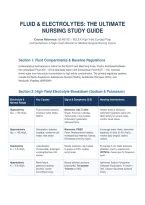
FLUID & ELECTROLYTES: THE ULTIMATE
NURSING STUDY GUIDE
Course Reference: NURS-301 / NCLEX High-Yield Concept Prep
Comprehensive 3-Page Crash Review for Medical-Surgical Nursing Exams
Section 1: Fluid Compartments & Baseline Regulations
Understanding fluid balance is critical for the NCLEX and Med-Surg finals. Fluid is distributed between
the Intracellular Fluid (ICF, ~2/3 of total body water) and Extracellular Fluid (ECF, ~1/3). Osmosis
drives water from low solute concentration to high solute concentration. The primary regulatory systems
include the Renin-Angiotensin-Aldosterone System (RAAS), Antidiuretic Hormone (ADH), and
Natriuretic Peptides (ANP/BNP).
Section 2: High-Yield Electrolyte Breakdown (Sodium & Potassium)
Electrolyte & Key Causes Signs & Symptoms (S/S) Nursing Interventions
Normal Range
Hyponatremia Fluid overload, diuretics, Mnemonic: SALT LOSS Restrict fluids (if dilutional),
Na+ < 135 mEq/L excessive water intake, Stupor, Anorexia, Lethargy, administer hypertonic saline (3%
SIADH. Tachycardia, Limp muscles, NaCl) slowly for severe cases,
Orthostatic hypotension, monitor neuro status.
Seizures/Coma.
Hypernatremia Dehydration, diabetes Mnemonic: FRIED Encourage water intake, administer
Na+ > 145 mEq/L insipidus, excessive salt Fever, Restlessness/Irritability, hypotonic IV fluids (0.45% NaCl),
intake, heat stroke. Increased fluid retention, Edema, monitor daily weights, restrict
Decreased urine/Dry mouth. sodium.
Hypokalemia Loop diuretics Muscle weakness, leg cramps, Encourage K-rich foods (bananas,
K+ < 3.5 mEq/L (Furosemide), prolonged U-waves on EKG, cardiac potatoes), oral K+ supplements.
vomiting/diarrhea, NG arrhythmias. CRITICAL: Never give IV Potassium
suction. push!
Hyperkalemia Renal failure, Muscle twitches, profound Administer Sodium Polystyrene
K+ > 5.0 mEq/L potassium-sparing bradycardia, Tall peaked Sulfonate (Kayexalate), IV Insulin +
diuretics, severe T-waves on EKG. D50, Calcium Gluconate (protects
burns/tissue injury. heart).
NURSING STUDY GUIDE
Course Reference: NURS-301 / NCLEX High-Yield Concept Prep
Comprehensive 3-Page Crash Review for Medical-Surgical Nursing Exams
Section 1: Fluid Compartments & Baseline Regulations
Understanding fluid balance is critical for the NCLEX and Med-Surg finals. Fluid is distributed between
the Intracellular Fluid (ICF, ~2/3 of total body water) and Extracellular Fluid (ECF, ~1/3). Osmosis
drives water from low solute concentration to high solute concentration. The primary regulatory systems
include the Renin-Angiotensin-Aldosterone System (RAAS), Antidiuretic Hormone (ADH), and
Natriuretic Peptides (ANP/BNP).
Section 2: High-Yield Electrolyte Breakdown (Sodium & Potassium)
Electrolyte & Key Causes Signs & Symptoms (S/S) Nursing Interventions
Normal Range
Hyponatremia Fluid overload, diuretics, Mnemonic: SALT LOSS Restrict fluids (if dilutional),
Na+ < 135 mEq/L excessive water intake, Stupor, Anorexia, Lethargy, administer hypertonic saline (3%
SIADH. Tachycardia, Limp muscles, NaCl) slowly for severe cases,
Orthostatic hypotension, monitor neuro status.
Seizures/Coma.
Hypernatremia Dehydration, diabetes Mnemonic: FRIED Encourage water intake, administer
Na+ > 145 mEq/L insipidus, excessive salt Fever, Restlessness/Irritability, hypotonic IV fluids (0.45% NaCl),
intake, heat stroke. Increased fluid retention, Edema, monitor daily weights, restrict
Decreased urine/Dry mouth. sodium.
Hypokalemia Loop diuretics Muscle weakness, leg cramps, Encourage K-rich foods (bananas,
K+ < 3.5 mEq/L (Furosemide), prolonged U-waves on EKG, cardiac potatoes), oral K+ supplements.
vomiting/diarrhea, NG arrhythmias. CRITICAL: Never give IV Potassium
suction. push!
Hyperkalemia Renal failure, Muscle twitches, profound Administer Sodium Polystyrene
K+ > 5.0 mEq/L potassium-sparing bradycardia, Tall peaked Sulfonate (Kayexalate), IV Insulin +
diuretics, severe T-waves on EKG. D50, Calcium Gluconate (protects
burns/tissue injury. heart).


