
1|P a g e
NUR 265 EXAM 3 REVIEW | 2026/2027 |
MEDICAL-SURGICAL NURSING |
GALEN-STYLE PRACTICE QUESTIONS
AND ANSWERS
INTRODUCTION
NUR 265 Exam 3 is designed to evaluate a nursing student's ability to apply medical-surgical
nursing knowledge to complex clinical situations. Success requires more than memorizing
disease definitions: students must recognize deterioration, prioritize competing patient needs,
interpret assessment findings, identify complications, administer medications safely, and
determine which intervention should occur first. Questions may require integration of
pathophysiology, pharmacology, assessment, clinical judgment, patient education, safety, and
evidence-based nursing interventions.
This practice bank is designed for students preparing for a medical-surgical nursing examination
and emphasizes application- level reasoning. The scenarios are intentionally challenging and
include patients with multiple findings in which several answers may initially appear
appropriate. The key skill is identifying the intervention that addresses the most immediate
physiological threat or greatest risk.
Students should attempt every question before reviewing the rationale. Pay particular attention to
questions involving ABCs, acute deterioration, prioritization, medication complications,
postoperative complications, fluid and electrolyte imbalance, infection, cardiovascular and
respiratory emergencies, and patient education. Repeated practice with these concepts can
strengthen clinical judgment and examination readiness.
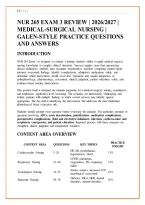
CONTENT AREA OVERVIEW
PRACTICE
CONTENT AREA QUESTIONS KEY TOPICS
WEIGHT
HF, MI, dysrhythmias,
Cardiovascular Nursing 1–20 13%
hypertension, shock
COPD, pneumonia,
Respiratory Nursing 21–40 oxygenation, PE, respiratory 13%
failure
Stroke, seizures, increased ICP,
Neurological Nursing 41–55 10%
neurological assessment
Diabetes, DKA, HHS, thyroid
Endocrine Nursing 56–70 10%
disorders, adrenal disorders
,2|P a g e
AKI, CKD, dialysis,
Renal & Urinary Nursing 71–82 8%
fluid/electrolytes
GI bleeding, liver disease,
GI & Hepatic Nursing 83–95 9%
pancreatitis, obstruction
Sepsis, antibiotics, infection
Infection & Sepsis 96–105 7%
control
Cancer, chemotherapy, anemia,
Oncology & Hematology 106–115 7%
neutropenia
Postoperative complications,
Perioperative & Critical Care 116–130 10%
shock, drains, wounds
Musculoskeletal & Other Fractures, arthritis,
131–140 5%
Medical-Surgical Conditions osteoporosis, complications
Pharmacology, Safety & Medication safety,
141–150 8%
Clinical Judgment prioritization, delegation
QUESTIONS SECTION
CONTENT AREA: CARDIOVASCULAR NURSING
Questions: 1–20 | Key Topics: HF, MI, dysrhythmias, hypertension, shock | Weight: 13%
Q1:
A client with acute heart failure suddenly develops severe dyspnea, bilateral crackles, pink frothy
sputum, and an oxygen saturation of 82%. Which action should the nurse take FIRST?
A) Encourage oral fluids
B) Position the client upright and initiate prescribed oxygen/respiratory support
C) Obtain a routine daily weight
D) Encourage the client to ambulate
Rationale: B is correct because the findings indicate acute pulmonary edema with severe
impaired oxygenation. Upright positioning improves ventilation, while oxygen or prescribed
respiratory support addresses hypoxemia. Oral fluids can worsen pulmonary congestion. A daily
weight is important for chronic heart failure but does not address the immediate emergency.
Ambulation would increase oxygen demand.
Q2:
A client with suspected myocardial infarction reports crushing substernal chest pain radiating to
the jaw. Which assessment finding requires the most immediate attention?
,3|P a g e
A) Mild anxiety
B) Heart rate of 92/min
C) New hypotension with altered mental status
D) Pain rated 6/10
Rationale: C is correct because hypotension combined with altered mental status may indicate
cardiogenic shock or inadequate tissue perfusion. Anxiety and pain are important but less
immediately life-threatening. A heart rate of 92/min is not independently alarming.
Q3:
A client receiving IV nitroglycerin for acute coronary syndrome develops a blood pressure of
78/46 mmHg. What is the nurse's priority action?
A) Increase the infusion rate
B) Stop or hold the infusion according to protocol and immediately assess the client
C) Encourage the client to ambulate
D) Administer another vasodilator
Rationale: B is correct because severe hypotension is a potentially dangerous nitrate effect and
may compromise coronary and systemic perfusion. Increasing the infusion would worsen
hypotension. Ambulation is unsafe, and another vasodilator is contraindicated.
Q4:
A client with heart failure has gained 2.5 kg over several days and reports increasing orthopnea.
Which finding best explains the weight gain?
A) Increased skeletal muscle mass
B) Reduced metabolic rate
C) Fluid retention associated with worsening heart failure
D) Improved nutritional status
Rationale: C is correct because rapid weight gain in heart failure usually reflects fluid
accumulation rather than tissue gain. Orthopnea further supports worsening congestion.
Q5:
A client taking digoxin reports nausea, anorexia, and seeing yellow-green halos around lights.
Which action is most appropriate?
A) Administer the scheduled dose
B) Hold the medication and notify the appropriate provider about possible toxicity
C) Encourage a high-calcium diet
D) Give an additional dose
, 4|P a g e
Rationale: B is correct because gastrointestinal symptoms and visual disturbances are classic
warning signs of digoxin toxicity. Continuing or increasing the dose could worsen toxicity.
Q6:
A client with atrial fibrillation is receiving anticoagulant therapy. Which finding requires
immediate follow-up?
A) Heart rate of 78/min
B) Mild fatigue
C) Black, tarry stool
D) Blood pressure of 128/74 mmHg
Rationale: C is correct because melena may indicate gastrointestinal bleeding, an important
complication of anticoagulation. The other findings are not immediately suggestive of serious
bleeding.
Q7:
A client with peripheral arterial disease reports severe leg pain at rest that improves when the leg
is placed in a dependent position. What should the nurse recognize?
A) Expected venous insufficiency
B) Significant arterial insufficiency requiring further evaluation
C) Normal aging
D) Lymphedema
Rationale: B is correct because rest pain relieved by dependency suggests advanced arterial
insufficiency. Venous disease more commonly causes dependent edema and discomfort that
improves with elevation.
Q8:
A client with suspected deep-vein thrombosis suddenly develops dyspnea and pleuritic chest
pain. What complication should the nurse suspect?
A) Pulmonary edema from heart failure
B) Pulmonary embolism
C) Pneumothorax from COPD
D) Acute kidney injury
Rationale: B is correct because a DVT can embolize to the pulmonary circulation, producing
sudden dyspnea and pleuritic chest pain.
Q9:


