
CAD1501 ASSIGNMENT 5 PORTFOLIO 2026
DUE 16 OCTOBER 2026
SECTION A: DEVELOPMENTAL DOMAIN ANALYSIS
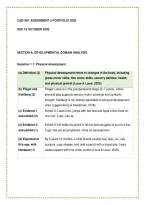
Question 1.1: Physical development
(a) Definition (2) Physical development refers to changes in the body, including
gross motor skills, fine motor skills, sensory abilities, health,
and physical growth (Louw & Louw, 2022).
(b) Piaget and Piaget: Lwazi is in the preoperational stage (2–7 years), where
Kohlberg (2) physical play supports sensory-motor schemas and symbolic
thought. Kohlberg is not directly applicable to physical development
(Van Loggerenberg & Haasbroek, 2018).
(c) Evidence 1 Exhibit 2: Lwazi runs, jumps with two feet and hops a few times on
and exhibit (2) one foot. Type: Can do
(c) Evidence 2 Exhibit 2: He holds his pencil in his fist and struggles to cut on a line.
and exhibit (1) Type: Not yet accomplished / Area for development
(d) Expected at By 5 years 10 months, a child should usually hop, skip, run, use
this age, with scissors, copy shapes, and hold a pencil with a tripod grip. Lwazi
literature (1) needs support with fine motor control (Louw & Louw, 2022).
,Question 1.2: Cognitive development
(a) Definition (2) Cognitive development is the development of thinking,
reasoning, memory, attention, problem-solving and
understanding (Louw & Louw, 2022).
(b) Piaget and Piaget: Lwazi is in the preoperational stage. He shows symbolic
Kohlberg (2) play, egocentrism and centration. He does not yet conserve
quantity or classify by more than one dimension. Kohlberg is not
applicable here (Van Loggerenberg & Haasbroek, 2018).
(c) Evidence 1 Exhibit 3: Lwazi builds a “taxi” from a milk crate and bottle tops,
and exhibit (2) counts ten tops correctly, and asks many “why” questions. Type:
Can do
(c) Evidence 2 Exhibit 3: He says Aphiwe has more juice although both glasses
and exhibit (1) were filled from the same jug; he is puzzled when asked to sort by
colour and size. Type: Not yet accomplished
(d) Expected at At this age, preoperational thinking is normal, but by Grade 1,
this age, with children begin to develop conservation, classification and seriation.
literature (1) Lwazi needs concrete, play-based cognitive stimulation (Louw &
Louw, 2022).
, Question 1.3: Language development
(a) Definition (2) Language development is the growing ability to understand and
use language, including receptive skills (listening,
understanding) and expressive skills (speaking, vocabulary,
grammar) (Louw & Louw, 2022).
(b) Piaget and Piaget: Lwazi is in the preoperational stage and uses language for
Kohlberg (2) symbolic representation. Vygotsky’s ideas also apply: he needs
scaffolding to move from one-step to two-step instructions and to
retell stories (Van Loggerenberg & Haasbroek, 2018).
(c) Evidence 1 Exhibit 3: Lwazi tells an iAntsomi about the tortoise and the hare in
and exhibit (2) isiZulu with a beginning, middle and end when Gogo prompts him.
Type: Can do with support
(c) Evidence 2 Exhibit 2: He follows one-step instructions in English but often looks
and exhibit (1) lost with two steps; he cannot yet retell a story in order. Type: Not
yet accomplished
(d) Expected at By age 6, children should use 250+ words, speak in full sentences,
this age, with follow two-step instructions and retell simple stories. Lwazi is
literature (1) multilingual but needs English academic language support (Louw &
Louw, 2022).


