
1 .
AMPLIFIERS :
in waveform is considered to be distortion and is
Any change
~
undesirable /
>
-
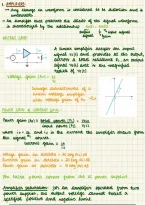
An amplifier that preserves the details of the signal waveform
is characterized by the relationship volt) Avilt) =
↳emput signate
&
disput
VOLTAGE GAIN :
qual
E A linear amplifier accepts an input
signal vI(t) and provides at the output
,
accross a load resistance R , an output
signal volt) that is the magnified
replica of VI(t)
voltage gain (AV) =
No
Transfer characteristic
of a
linear voltage amplifier
&
with vottage gain of Av
POWER GAIN E CURRENT GAIN :
Power gain (Ap) load power (P1)
=
=
input power (P1)
where io= and it is the current the amplifier draws from
the signal .
source
current gain = I
voltage gain in decibels = 20
log/AvldB
Current gain in decibels = 20
log/Ail dB
Power gain in decibels = 10
log1ApldB
The .
entra power comes from the ac
power supplies
Amplifier saturation For an amplifier operated from
:
two
power supplies the output voltage cannot exceed a
I
,
specified positive and
negative limit
.
, : the input signal must
swing between I distortion
↓ ↳ vi
I
(
range
Av
maincar
CIRCUIT MODELS FOR AMPLIFIERS :
In
figure (b),
vo = AroVi
RL + Ro
and voltage gain is
given by :
Av
== Avo Rock
An ideal voltage amplifier has
Ro = 0 and R1 = 0
,
and Avo = Av
Thus , Avo is the voltage gain of
the unloaded amplifier or the
, open-circuit voltage gain
if specified
I -
is it
* a load resistance not ,
s
-
normally
assumed that the voltage gain the
given is
circuit
open gain Avo
Vi
R(vs)
=
ve in order to not lose significant portion
of
the signal , Ri Rs
An ideal voltage amplifier was Rs =
0 & Ri =
: Overall ,
voltage gain
Avo XRs
!
=
Vout cannot
go beyond
the C inputs


