
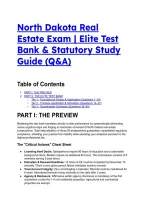
North Dakota Real
Estate Exam | Elite Test
Bank & Statutory Study
Guide (Q&A)
Table of Contents
1. PART I: THE PREVIEW
2. PART II: THE ELITE TEST BANK
○ Tier 1 - Foundational Syntax & Application (Questions 1–18)
○ Tier 2 - Complex Application & Simulation (Questions 19–37)
○ Tier 3 - Grandmaster Synthesis (Questions 38–55)
PART I: THE PREVIEW
Mastering this test bank translates directly to elite performance by systematically eliminating
novice cognitive traps and forging an instinctive command of North Dakota real estate
jurisprudence. Total internalization of these 55 assessments guarantees unparalleled regulatory
compliance, shielding your practice from liability while elevating your analytical precision to the
highest professional tier.
The "Critical Axioms" Cheat Sheet
● Licensing Hard Decks: Salespersons require 90 hours of education and a nationwide
background check; Brokers require an additional 60 hours. The Commission consists of 5
members serving 5-year terms.
● Education & Renewal Deadlines: 12 hours of CE must be completed by November 15
annually. There is zero grace period; failure mandates inactive renewal.
● Trust Account Integrity: Zero commingling is tolerated. Records must be maintained for
6 years. Abandoned earnest money escheats to the state after 3 years.
● Agency & Disclosure: Affirmative written agency disclosure is mandatory at the first
substantive contact for 1-4 unit residential properties. Agricultural and commercial
properties are exempt.
, ● Wholesaling Transparency: Wholesalers must disclose their equitable interest in writing.
Failure to do so allows the buyer or seller to cancel the contract penalty-free before
closing.
Regulatory Framework Primary Deadline / Limit Statutory Reference
CE Completion November 15 (Annual) NDAC 70-02-04
Trust Record Retention 6 Years NDAC 70-02-01-15
Unclaimed Property (Trust) 3 Years NDCC 47-30.1
Recovery Fund Payout $20,000 per judgment NDCC 43-23.2-03
Recovery Fund Aggregate $50,000 lifetime limit NDCC 43-23.2-04
PART II: THE ELITE TEST BANK
Tier 1 - Foundational Syntax & Application (Questions
1–18)
Q1: The governor is reviewing appointments for the North Dakota Real Estate Commission.
Based on the principles of NDCC 43-23-01, what is the MANDATORY composition of this
regulatory body? A) Seven members, serving four-year terms, with at least four active brokers.
B) Five members, serving five-year terms, with at least three being active real estate brokers. C)
Five members, serving three-year terms, appointed by the state legislature. D) Nine members,
serving five-year terms, representing each judicial district.
● Answer: B (Five members, serving five-year terms, with at least three being active real
estate brokers.)
● Distractor Analysis:
○ A is incorrect: Incorrect total membership and term limits, confusing ND standards
with larger state commissions.
○ C is incorrect: The governor appoints members, and terms are strictly five years.
○ D is incorrect: Fails to recognize the strict five-member statutory limit.
The Mentor's Analysis: Structural knowledge of your regulatory body is fundamental. When
facing administrative inquiries, the immediate priority is recognizing the commission's authority
and makeup. By utilizing the five-member, five-year term rule, you bypass the common trap of
confusing local association boards with state-level statutory commissions. Professional
Intuition: The ND Real Estate Commission is always a 5-member body, dominated by 3 active
brokers, serving 5-year terms.
Q2: An individual wishes to apply for a North Dakota real estate salesperson license. Based on
the principles of NDCC 43-23-08, which set of baseline criteria FIRST qualifies the candidate?
A) 21 years of age, high school diploma, and 150 hours of pre-licensing education. B) 18 years
of age, 90 hours of approved pre-licensing education, and a nationwide criminal history record
check. C) 18 years of age, a bachelor's degree in real estate, and a state-only background
check. D) 21 years of age, 60 hours of pre-licensing education, and sponsorship by a
designated broker.
● Answer: B (18 years of age, 90 hours of approved pre-licensing education, and a
nationwide criminal history record check.)
● Distractor Analysis:
○ A is incorrect: Inflates the minimum age requirement and lists broker-level hours.
○ C is incorrect: A college degree is not required; a nationwide fingerprint background
, check is mandatory.
○ D is incorrect: 60 hours is the additional requirement for a broker license, not the
foundational salesperson requirement.
The Mentor's Analysis: Baseline licensure sets the gateway for professional activity. When
facing applicant qualification, the priority is verifying statutory minimums. By utilizing the 90-hour
/ 18-year-old / FBI background check criteria, you bypass the common trap of misapplying
broker-level thresholds to entry-level candidates. Professional Intuition: Salesperson licensure
requires 18 years of life, 90 hours of study, and a clean national fingerprint check.
Q3: A licensed North Dakota broker is preparing for the upcoming license renewal cycle. Based
on the principles of NDAC 70-02-04, which action is the MOST APPROPRIATE regarding
continuing education (CE)? A) Completing 12 hours of mandatory state-specific legal updates
by December 31st with a 30-day grace period. B) Completing 9 hours of elective CE courses by
November 15th to avoid late fees. C) Completing 12 hours of elective CE courses by November
15th, acknowledging there is zero grace period. D) Completing 15 hours of post-licensure
courses every two years prior to December 31st.
● Answer: C (Completing 12 hours of elective CE courses by November 15th,
acknowledging there is zero grace period.)
● Distractor Analysis:
○ A is incorrect: Relies on the December 31st expiration date rather than the strict
November 15th renewal deadline, and falsely assumes a grace period exists.
○ B is incorrect: Relies on an outdated 9-hour requirement; the current NDREC
standard mandates 12 hours.
○ D is incorrect: Represents a completely different state's biennial renewal model; ND
requires annual renewal.
The Mentor's Analysis: Compliance deadlines are absolute. When facing license renewal, the
immediate priority is completing educational mandates before the statutory cutoff. By utilizing
the November 15th / 12-hour rule, you bypass the common trap of relying on end-of-year
expirations and non-existent grace periods. Professional Intuition: November 15 is the hard
deck for 12 hours of CE; there is zero grace period for late education in North Dakota.
Q4: A designated broker opens a property management division. Based on the principles of
NDCC 43-23-14.1, what is the STRICTEST requirement regarding the handling of client security
deposits? A) Funds must be deposited in the brokerage's general operating account within 24
hours. B) Funds must be deposited in an interest-bearing personal account until the transaction
closes. C) Funds must be placed in a federally insured financial institution in an account
explicitly titled as a "trust" or "escrow" account. D) Funds may be held in cash in a secured safe,
provided a detailed ledger is maintained.
● Answer: C (Funds must be placed in a federally insured financial institution in an account
explicitly titled as a "trust" or "escrow" account.)
● Distractor Analysis:
○ A is incorrect: Placing client funds into a general operating account constitutes
illegal commingling.
○ B is incorrect: Personal accounts are strictly forbidden for client funds.
○ D is incorrect: Physical cash hoarding violates the mandate to use authorized,
federally insured depositories.
The Mentor's Analysis: Fiduciary safeguarding of client funds is highly scrutinized. When facing
the receipt of money belonging to others, the priority is isolation in an approved depository. By
utilizing strictly titled trust accounts, you bypass the common trap of operational commingling,
which carries severe penalties. Professional Intuition: Client funds touch nothing but a
Estate Exam | Elite Test
Bank & Statutory Study
Guide (Q&A)
Table of Contents
1. PART I: THE PREVIEW
2. PART II: THE ELITE TEST BANK
○ Tier 1 - Foundational Syntax & Application (Questions 1–18)
○ Tier 2 - Complex Application & Simulation (Questions 19–37)
○ Tier 3 - Grandmaster Synthesis (Questions 38–55)
PART I: THE PREVIEW
Mastering this test bank translates directly to elite performance by systematically eliminating
novice cognitive traps and forging an instinctive command of North Dakota real estate
jurisprudence. Total internalization of these 55 assessments guarantees unparalleled regulatory
compliance, shielding your practice from liability while elevating your analytical precision to the
highest professional tier.
The "Critical Axioms" Cheat Sheet
● Licensing Hard Decks: Salespersons require 90 hours of education and a nationwide
background check; Brokers require an additional 60 hours. The Commission consists of 5
members serving 5-year terms.
● Education & Renewal Deadlines: 12 hours of CE must be completed by November 15
annually. There is zero grace period; failure mandates inactive renewal.
● Trust Account Integrity: Zero commingling is tolerated. Records must be maintained for
6 years. Abandoned earnest money escheats to the state after 3 years.
● Agency & Disclosure: Affirmative written agency disclosure is mandatory at the first
substantive contact for 1-4 unit residential properties. Agricultural and commercial
properties are exempt.
, ● Wholesaling Transparency: Wholesalers must disclose their equitable interest in writing.
Failure to do so allows the buyer or seller to cancel the contract penalty-free before
closing.
Regulatory Framework Primary Deadline / Limit Statutory Reference
CE Completion November 15 (Annual) NDAC 70-02-04
Trust Record Retention 6 Years NDAC 70-02-01-15
Unclaimed Property (Trust) 3 Years NDCC 47-30.1
Recovery Fund Payout $20,000 per judgment NDCC 43-23.2-03
Recovery Fund Aggregate $50,000 lifetime limit NDCC 43-23.2-04
PART II: THE ELITE TEST BANK
Tier 1 - Foundational Syntax & Application (Questions
1–18)
Q1: The governor is reviewing appointments for the North Dakota Real Estate Commission.
Based on the principles of NDCC 43-23-01, what is the MANDATORY composition of this
regulatory body? A) Seven members, serving four-year terms, with at least four active brokers.
B) Five members, serving five-year terms, with at least three being active real estate brokers. C)
Five members, serving three-year terms, appointed by the state legislature. D) Nine members,
serving five-year terms, representing each judicial district.
● Answer: B (Five members, serving five-year terms, with at least three being active real
estate brokers.)
● Distractor Analysis:
○ A is incorrect: Incorrect total membership and term limits, confusing ND standards
with larger state commissions.
○ C is incorrect: The governor appoints members, and terms are strictly five years.
○ D is incorrect: Fails to recognize the strict five-member statutory limit.
The Mentor's Analysis: Structural knowledge of your regulatory body is fundamental. When
facing administrative inquiries, the immediate priority is recognizing the commission's authority
and makeup. By utilizing the five-member, five-year term rule, you bypass the common trap of
confusing local association boards with state-level statutory commissions. Professional
Intuition: The ND Real Estate Commission is always a 5-member body, dominated by 3 active
brokers, serving 5-year terms.
Q2: An individual wishes to apply for a North Dakota real estate salesperson license. Based on
the principles of NDCC 43-23-08, which set of baseline criteria FIRST qualifies the candidate?
A) 21 years of age, high school diploma, and 150 hours of pre-licensing education. B) 18 years
of age, 90 hours of approved pre-licensing education, and a nationwide criminal history record
check. C) 18 years of age, a bachelor's degree in real estate, and a state-only background
check. D) 21 years of age, 60 hours of pre-licensing education, and sponsorship by a
designated broker.
● Answer: B (18 years of age, 90 hours of approved pre-licensing education, and a
nationwide criminal history record check.)
● Distractor Analysis:
○ A is incorrect: Inflates the minimum age requirement and lists broker-level hours.
○ C is incorrect: A college degree is not required; a nationwide fingerprint background
, check is mandatory.
○ D is incorrect: 60 hours is the additional requirement for a broker license, not the
foundational salesperson requirement.
The Mentor's Analysis: Baseline licensure sets the gateway for professional activity. When
facing applicant qualification, the priority is verifying statutory minimums. By utilizing the 90-hour
/ 18-year-old / FBI background check criteria, you bypass the common trap of misapplying
broker-level thresholds to entry-level candidates. Professional Intuition: Salesperson licensure
requires 18 years of life, 90 hours of study, and a clean national fingerprint check.
Q3: A licensed North Dakota broker is preparing for the upcoming license renewal cycle. Based
on the principles of NDAC 70-02-04, which action is the MOST APPROPRIATE regarding
continuing education (CE)? A) Completing 12 hours of mandatory state-specific legal updates
by December 31st with a 30-day grace period. B) Completing 9 hours of elective CE courses by
November 15th to avoid late fees. C) Completing 12 hours of elective CE courses by November
15th, acknowledging there is zero grace period. D) Completing 15 hours of post-licensure
courses every two years prior to December 31st.
● Answer: C (Completing 12 hours of elective CE courses by November 15th,
acknowledging there is zero grace period.)
● Distractor Analysis:
○ A is incorrect: Relies on the December 31st expiration date rather than the strict
November 15th renewal deadline, and falsely assumes a grace period exists.
○ B is incorrect: Relies on an outdated 9-hour requirement; the current NDREC
standard mandates 12 hours.
○ D is incorrect: Represents a completely different state's biennial renewal model; ND
requires annual renewal.
The Mentor's Analysis: Compliance deadlines are absolute. When facing license renewal, the
immediate priority is completing educational mandates before the statutory cutoff. By utilizing
the November 15th / 12-hour rule, you bypass the common trap of relying on end-of-year
expirations and non-existent grace periods. Professional Intuition: November 15 is the hard
deck for 12 hours of CE; there is zero grace period for late education in North Dakota.
Q4: A designated broker opens a property management division. Based on the principles of
NDCC 43-23-14.1, what is the STRICTEST requirement regarding the handling of client security
deposits? A) Funds must be deposited in the brokerage's general operating account within 24
hours. B) Funds must be deposited in an interest-bearing personal account until the transaction
closes. C) Funds must be placed in a federally insured financial institution in an account
explicitly titled as a "trust" or "escrow" account. D) Funds may be held in cash in a secured safe,
provided a detailed ledger is maintained.
● Answer: C (Funds must be placed in a federally insured financial institution in an account
explicitly titled as a "trust" or "escrow" account.)
● Distractor Analysis:
○ A is incorrect: Placing client funds into a general operating account constitutes
illegal commingling.
○ B is incorrect: Personal accounts are strictly forbidden for client funds.
○ D is incorrect: Physical cash hoarding violates the mandate to use authorized,
federally insured depositories.
The Mentor's Analysis: Fiduciary safeguarding of client funds is highly scrutinized. When facing
the receipt of money belonging to others, the priority is isolation in an approved depository. By
utilizing strictly titled trust accounts, you bypass the common trap of operational commingling,
which carries severe penalties. Professional Intuition: Client funds touch nothing but a


