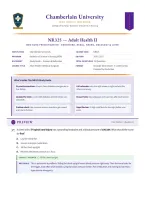
Chamberlain University
NR 325 • AH II
CHAMBERLAIN
A D U LT H E A LT H I I E X A M R E V I E W
College of Nursing · Bachelor of Science in Nursing
EST. 1889
NR325 — Adult Health II
M E D - S U R G P R I O R I T I Z AT I O N · E N D O C R I N E , R E N A L , N E U R O , O N C O L O G Y & L I V E R
INSTITUTION Chamberlain University COURSE CODE NR325
PROGRAM Bachelor of Science in Nursing (BSN) EDITION
DOCUMENT Study Guide — Answers & Rationales TOTAL QUESTIONS 50 Questions
COURSE TITLE Adult Health II (Medical-Surgical) FORMAT 50 single-best-answer · 6 content areas ·
Prepared by DoctorKen
What’s Inside This NR325 Study Guide.
50 practice questions: 6 topics, from diabetes emergencies to Full rationales: why the right answer is right and why the
liver failure. others are wrong.
Updated for 2026: current ADA diabetes and AHA stroke care Bonus Points: key takeaways and exam tips after each section.
standards.
Problem check: two common reasons questions get missed, Rapid Review: 12 high-yield facts for the night before your
and how to fix them. exam.
PREVIEW From Section 5 · Question 37
37. A client with a T4 spinal cord injury has a pounding headache and a blood pressure of 190/104. What should the nurse
do first?
A. Lay the client flat.
B. Give an oral pain medication.
C. Sit the client upright.
D. Recheck the blood pressure in 1 hour.
CORRECT ANSWER C. Sit the client upright.
RATIONALE This is autonomic dysreflexia. Sitting the client upright lowers blood pressure right away. Then the nurse looks for
the trigger, most often a full bladder. Lying flat raises pressure further. Pain medication and waiting do not treat a
hypertensive emergency.
,BEFORE YOU BEGIN
You Already Know This.
You already know more of this than you think. You learned these systems in Adult Health I and have cared for clients
with diabetes, kidney disease, and stroke in clinical. That experience is the base for this course.
NR325 feels hard because it asks what to do first when a condition turns into a complication. This guide gives you
practice with those calls across endocrine, renal, neuro, oncology, and liver care. Check your syllabus for anything else
your exam covers.
W H E R E I S YO U R P R E PA R AT I O N B R E A K I N G D O W N ?
Many missed questions come from one of two problems. See which one sounds like you.
PROBLEM 1 PROBLEM 2
“Every Answer Looks Like a Good Nursing “I Mix Up Opposite Disorders”
Action” W H AT ' S H A P P E N I N G
W H AT ' S H A P P E N I N G SIADH and diabetes insipidus, Addison’s and Cushing’s, DKA and HHS
All four options are things a nurse might do, but only one is first, and blur together under exam pressure.
you pick the one that feels most complete. WORK ON THIS
WORK ON THIS Learn each pair as opposites: what the body keeps, what it loses, and
Ask what kills the client soonest: airway, breathing, circulation, then the one lab that tells them apart.
neuro change. Act on an unstable finding before teaching, comfort, or
documenting.
EXAMINATION INSTRUCTIONS
Each question has one best answer. Read the bolded words in each question carefully.
For timed practice, allow about 1 minute per question, and cover the green answer and blue rationale boxes.
Check your answers, then read the rationale for every question you missed and every lucky guess.
DIABETES MELLITUS & GLUCOSE EMERGENCIES Questions 1 – 9
1. A client with type 1 diabetes is shaky, sweaty, and confused but can swallow. The fingerstick glucose is 58 mg/dL.
What should the nurse do first?
A. Give the scheduled dose of rapid-acting insulin.
B. Give 15 g of fast-acting carbohydrate.
C. Give a full meal tray with protein.
D. Give glucagon IM right away, before anything else.
CORRECT ANSWER B. Give 15 g of fast-acting carbohydrate.
RATIONALE A conscious client who can swallow gets 15 g of fast-acting carbohydrate, and the glucose is rechecked in 15
minutes. Insulin would lower the glucose further. A full meal acts too slowly to correct the low first. Glucagon is for
a client who cannot safely take carbohydrate by mouth.
, 2. A client in diabetic ketoacidosis is admitted. Which order should the nurse carry out first?
A. Start the IV regular insulin infusion.
B. Give sodium bicarbonate IV push.
C. Give 50% dextrose IV.
D. Start IV 0.9% sodium chloride.
CORRECT ANSWER D. Start IV 0.9% sodium chloride.
RATIONALE DKA causes severe fluid loss, so isotonic fluid replacement comes first. Insulin starts after fluids are running and
the potassium level is known, because insulin moves potassium into cells. Bicarbonate is not routine. Dextrose is
added only after glucose falls, usually below 250 mg/dL.
3. A client with DKA has a potassium of 3.1 mEq/L. The insulin infusion is ready to start. What should the nurse do?
A. Start the insulin, because insulin will raise the potassium level.
B. Hold the insulin and notify the provider.
C. Start the insulin and recheck potassium in 8 hours.
D. Give the insulin as an IV bolus instead.
CORRECT ANSWER B. Hold the insulin and notify the provider.
RATIONALE Insulin pushes potassium into cells, so starting it with a low level can cause a fatal dysrhythmia. Potassium is
replaced first, per the provider. Insulin lowers potassium; it does not raise it. Waiting 8 hours is unsafe. A bolus
would shift potassium even faster.
4. Which assessment finding is most consistent with DKA rather than hyperosmolar hyperglycemic state (HHS)?
A. Deep, rapid respirations with a fruity breath odor
B. Glucose of 900 mg/dL with no ketones in the blood or urine
C. Gradual onset over several days in an older adult
D. Severe dehydration with normal pH
CORRECT ANSWER A. Deep, rapid respirations with a fruity breath odor
RATIONALE Kussmaul breathing and fruity breath come from ketones and metabolic acidosis, which define DKA. Extreme
glucose with no ketones, slow onset in an older adult, and dehydration with a normal pH all point to HHS.
5. A client with type 1 diabetes has the flu and is not eating. Which statement shows a need for more teaching?
A. “I will check my glucose every 3 to 4 hours.”
B. “I will skip my insulin until I can eat again.”
C. “I will drink fluids such as water or broth often.”
D. “I will check for ketones if my glucose stays high.”
CORRECT ANSWER B. “I will skip my insulin until I can eat again.”
RATIONALE Illness raises glucose through stress hormones, so insulin is continued on sick days, even when the client is not
eating. Stopping it can lead to DKA. Frequent glucose checks, fluids, and ketone checks are all correct sick-day
rules.