
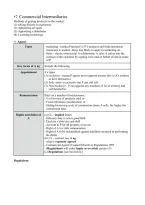
➪ Commercial Intermediaries
Methods of getting products on the market:
(1)selling directly to customers
(2)Appointing an agent
(3)Appointing a distributor
(4)Licensing technology
➪ Agency
Types -marketing - market Principal’s (‘P’) products and finds/introduces
customers to market - Regs less likely to apply to marketing As
-Sales - classic commercial A relationship. A sales A enters into the
contract w/the customer by signing it for and on behalf of and in name
of P
Key terms of A ag Include the following
Appointment 3 x types
(1)exclusive - means P agrees not to appoint anyone else in A’s territory
or do it themselves
(2)Sole- same as exclusive but P can still sell
(3)Non-exclusive - P can appoint any numbers of As in territory and
sell themselves
Remuneration Paid via a number of mechanisms:
-% of invoice of products sold; or
-Fixed minimum consideration; or
-Sliding/increasing scale of commission (more A sells, the higher the
commission rate)
Rights and duties of (a)CL - implied duties
A -fiduciary duty to act in good faith
-Exercise r’able care and skill
-Account to P for all property received
-Right of A to r’able remuneration
-Right of A to be indemnified against liabilities incurred in performing
his duties
(b)CL - contract law A ag
-what is expressly agreed
-Commercial Agents (Council Directive) Regulations 1993
(Regulations) will either imply or override certain cl’s
(c) Regulations [see box below]
Regulations
,Who is commercial A (1) w/in definition of A - defined Ref 2(1) as ‘self-employed
to which Regs apply? intermediary who has continuing authority to negotiate the sale or
purchase of goods on behalf of [P] or or negotiate and conclude the
sale or purchase of goods on behalf or and in P’s name’
-Therefore on the whole usually sale As although market As could still
fall w/in definition
(2)reg 1(3) if both parties agree contract is to be governed by another
MS’s law, a UK court must apply that MS’s equivalent reg - even if
A was acting in UK
(3)If both parties agree contract is to be governed by English/Scottish
law (even though A is operating in another MS) and equivalent MS
reg allow parties to choose English/Scottish law, court must apply
Regs
Reg 3 - -Look after P’s interests
A’s duties -Act dutifully and in good faith
-Communicate all necessary info to P
-Comply w/P r’able instructions
Reg 4 - -act dutifully and in good faith
P’s duties -Provide all necessary docs in goods for A
-Provide all necessary info for A
-Let A know if trans’s procured by A are accepted or refused
Reg 6 - -Usually dealt w/expressly but if no applicable custom, remuneration
Remuneration must be r’able
Nb. Regs 7, 8 and 9 are not mandatory and can be contracted out of
expressly
Reg 7 - A entitled to commission during contract when:
Commission during (1)trans has been concluded as a result of his action Reg 7(1)(a); or
contract (2)The contract is signed a customer who has previously been
introduced by the A Reg 7(1)(b); or
(3)The contract is signed w/a customer who is w/in the A’s exclusively
agreed territory or customer group Reg 7(2)
Reg 8 - A entitled to commission after contract when, Reg 8(a) and (b):
Commission after (a)trans entered into (contract w/customer) was ‘mainly attributable’ to
contract A’s effort and it was entered into w/in a r’able time after the agency
ended; or
(b)In acc w/conds in Reg 7, the trans results from an order being place
w/P before A ended
Nb common for P to exclude Reg 8
Reg 9 - apportioning Apportionment of commission earned under reg 8 if ‘equitable’.
commission between
outgoing and new As
Regs 10(2) and (3), 14-15 and 17-19 are mandatory
, Reg 10(2) and (3) - Reg 10(2) - comm is due when P becomes liable for sum
When is commission Reg 10(3) - comm is payable not later than the last day of the month
due and payable? following the quarter in which it became due
Regs 14-15 - Apply where A contract has indefinite term. Minimum notice periods
Minimum notice apply as follows:
periods (a)during first yr of A - 1 month
(b)During 2nd yr of A - 2 months
(c)During 3rd yr and subsequently - 3 months
Regs 17-19 - (1)Compensation = amount of payment is calculated by valuing
Indemnity OR business A has built up during term of ag. Reg 17(6) P must
compensation compensate A for ‘damage’ he suffers as a result of termination
payable on -Lonsdale v Howard and Hallam HL found:
termination -Compensation can be awarded for any damage suffered by A (not
limited to what is fair and r’able)
-Losses will include value of A business @ time of termination, in
particular value of goodwill built up by A which would otherwise pass
to P free of charge
-In valuing goodwill, correct approach is to consider the price a buyer
of A’s business would ahve paid for goodwill
(2)Indemnity - regs 17(2)-(5) = amount of payment takes account of:
-the extent to which A has brought new customers/significantly
increased business; AND
-The P continues to derive ‘substantial benefits’; AND
-Indemnity is ‘equitable in all circs’
If these conds are satisfied, I payment is limited to 1 yr’s salary based
on average annual commission earned over last 5 yrs of A
Which to pick? Not an easy decision! P doesn’t haven’t benefit of hindsight and will not
know (a) how long A will last and (b) how successful A will be
If A is likely to continue for a long, 1 yr indemnity may be preferable as
@ least it is certain and predictable
No comp or I (1)when immediate termination of A by P is justifiable Reg 18(a)
payable in following (2)When it was A who terminated A (unless justifiable) Reg 18(b);
circs and/or
(3)When A has failed to notify P w/in 1 yr following A that A intends
to clam Reg 17(9)
Reg 20 - -Doctrine of restraint of trade invalidates any contract term which has
Restraint of trade effect of preventing a party from engaging in any business activity,
unless term protects legitimate business interest of other party and
goes no further than is r’able on facts
-Reg applies in addition to CL
Nb. A and competition law:
-a genuine A does not establish a chain of trans’s as the P and A are treated effectively as 1 single
entity
Does EU law apply to A [even if not genuine A]?
-see VABE and vertical table above, A usually covered by VABE and therefore out of Art 101
, ➪ Distribution
Types -exclusive: supplier/manufacturer agrees to sell its stuff to one D in a
defined territory and agrees not to appoint any other Ds in that
territory and agrees not to sell themselves
-Sole: same as exclusive but S/M reserves right to sell themselves in
that territory
-Non-exclusive: S/M has complete freedom to appoint as many Ds in
territory as it likes and also to sell itself
-Selective: S/M can appoint as many Ds as it likes but must meet
specified criteria
Main provisions of D -products
ag -Territory
-Confidential info
-IP (particularly TMs)
-Minimum sales/minimum purchase targets
-Appointment
-Duration
-Duties of D
-Conds of sale
-Termination provisions
-Product liability as does S/M -> D -> Customer
Competition Law Unlike A, Art 101 is always prima facie relevant to D.
However, they may also use VABE


