
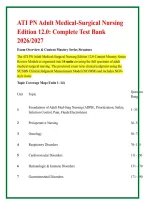
ATI PN Adult Medical-Surgical Nursing
Edition 12.0: Complete Test Bank
2026/2027
Exam Overview & Content Mastery Series Structure
The ATI PN Adult Medical-Surgical Nursing Edition 12.0 Content Mastery Series
Review Module is organized into 14 units covering the full spectrum of adult
medical-surgical nursing. The proctored exam tests clinical judgment using the
NCSBN Clinical Judgment Measurement Model (NCJMM) and includes NGN-
style items .
Topic Coverage Map (Units 1–14)
Question
Unit Topic
Range
Foundations of Adult Med-Surg Nursing (ADPIE, Prioritization, Safety,
1 1–35
Infection Control, Pain, Fluids/Electrolytes)
2 Perioperative Nursing 36–55
3 Oncology 56–75
4 Respiratory Disorders 76–110
5 Cardiovascular Disorders 111–150
6 Hematologic & Immune Disorders 151–170
7 Gastrointestinal Disorders 171–190
, Question
Unit Topic
Range
8 Endocrine Disorders 191–210
9 Renal & Urinary Disorders 211–225
10 Neurological & Sensory Disorders 226–235
11 Musculoskeletal Disorders 236–245
12 Integumentary Disorders & Burns 246–255
13 NGN-Style Case Scenarios (Unfolding Clinical Cases) 256–260
Critical Axioms for PN Scope of Practice
Axiom Core Principle Clinical Implication
PNs gather focused
Scope of PN safely cares for stable clients with
assessment data; escalate
Practice predictable outcomes
unstable findings to RN
Six steps: Recognize Cues → Analyze Cues
Clinical
→ Prioritize Hypotheses → Generate All clinical decisions foll
Judgment
Solutions → Take Action → Evaluate this framework
(NCJMM)
Outcomes
ABCDE Airway, Breathing, Circulation, Disability, Supersede all secondary
Imperative Exposure needs; dictate triage
,Axiom Core Principle Clinical Implication
High-Alert Require strict independen
Insulin, heparin, opioids, potassium
Medications double-checks
UAPs manage standard,
Delegation Clinical judgment, initial assessment, and
unchanging ADLs for sta
Integrity teaching cannot be delegated to UAP
clients
UNIT 1: FOUNDATIONS OF ADULT MED-SURGICAL NURSING
(Questions 1–35)
Q1. A nurse is caring for a client who is 2 days post-operative following a total hip
arthroplasty. Which of the following findings should the nurse report to the
provider immediately?
• A) Pain rating of 5 on a 0-to-10 scale
• B) Serosanguinous drainage on the surgical dressing
• C) Calf swelling and redness on the operative leg
• D) Temperature of 37.5°C (99.5°F)
Correct Answer: C
Rationale: Calf swelling, redness, and warmth are classic signs of a deep vein
thrombosis (DVT), a serious complication following hip surgery. This requires
immediate intervention to prevent pulmonary embolism .
Q2. A client with heart failure is prescribed furosemide (Lasix). Which laboratory
value should the nurse monitor most closely?
• A) Serum sodium
• B) Serum potassium
• C) Serum calcium
, • D) Serum magnesium
Correct Answer: B
Rationale: Furosemide is a loop diuretic that causes potassium wasting, leading
to hypokalemia. Hypokalemia increases the risk of cardiac dysrhythmias and
digoxin toxicity .
Q3. A client with type 2 diabetes mellitus is being discharged. Which statement
indicates understanding of disease management?
• A) "I will check my feet weekly for any sores or cuts."
• B) "I will need to have my eyes examined by an ophthalmologist every
year."
• C) "I can stop my medication once my blood glucose levels are normal."
• D) "I should avoid all carbohydrates in my diet."
Correct Answer: B
Rationale: Diabetic clients are at high risk for diabetic retinopathy, which can
lead to blindness. Annual eye examinations by an ophthalmologist are essential.
Foot inspections should be performed daily, not weekly .
Q4. A client is prescribed warfarin (Coumadin) for atrial fibrillation. Which
laboratory test should the nurse monitor to evaluate the therapeutic effect?
• A) aPTT
• B) INR
• C) Platelet count
• D) Bleeding time
Correct Answer: B
Edition 12.0: Complete Test Bank
2026/2027
Exam Overview & Content Mastery Series Structure
The ATI PN Adult Medical-Surgical Nursing Edition 12.0 Content Mastery Series
Review Module is organized into 14 units covering the full spectrum of adult
medical-surgical nursing. The proctored exam tests clinical judgment using the
NCSBN Clinical Judgment Measurement Model (NCJMM) and includes NGN-
style items .
Topic Coverage Map (Units 1–14)
Question
Unit Topic
Range
Foundations of Adult Med-Surg Nursing (ADPIE, Prioritization, Safety,
1 1–35
Infection Control, Pain, Fluids/Electrolytes)
2 Perioperative Nursing 36–55
3 Oncology 56–75
4 Respiratory Disorders 76–110
5 Cardiovascular Disorders 111–150
6 Hematologic & Immune Disorders 151–170
7 Gastrointestinal Disorders 171–190
, Question
Unit Topic
Range
8 Endocrine Disorders 191–210
9 Renal & Urinary Disorders 211–225
10 Neurological & Sensory Disorders 226–235
11 Musculoskeletal Disorders 236–245
12 Integumentary Disorders & Burns 246–255
13 NGN-Style Case Scenarios (Unfolding Clinical Cases) 256–260
Critical Axioms for PN Scope of Practice
Axiom Core Principle Clinical Implication
PNs gather focused
Scope of PN safely cares for stable clients with
assessment data; escalate
Practice predictable outcomes
unstable findings to RN
Six steps: Recognize Cues → Analyze Cues
Clinical
→ Prioritize Hypotheses → Generate All clinical decisions foll
Judgment
Solutions → Take Action → Evaluate this framework
(NCJMM)
Outcomes
ABCDE Airway, Breathing, Circulation, Disability, Supersede all secondary
Imperative Exposure needs; dictate triage
,Axiom Core Principle Clinical Implication
High-Alert Require strict independen
Insulin, heparin, opioids, potassium
Medications double-checks
UAPs manage standard,
Delegation Clinical judgment, initial assessment, and
unchanging ADLs for sta
Integrity teaching cannot be delegated to UAP
clients
UNIT 1: FOUNDATIONS OF ADULT MED-SURGICAL NURSING
(Questions 1–35)
Q1. A nurse is caring for a client who is 2 days post-operative following a total hip
arthroplasty. Which of the following findings should the nurse report to the
provider immediately?
• A) Pain rating of 5 on a 0-to-10 scale
• B) Serosanguinous drainage on the surgical dressing
• C) Calf swelling and redness on the operative leg
• D) Temperature of 37.5°C (99.5°F)
Correct Answer: C
Rationale: Calf swelling, redness, and warmth are classic signs of a deep vein
thrombosis (DVT), a serious complication following hip surgery. This requires
immediate intervention to prevent pulmonary embolism .
Q2. A client with heart failure is prescribed furosemide (Lasix). Which laboratory
value should the nurse monitor most closely?
• A) Serum sodium
• B) Serum potassium
• C) Serum calcium
, • D) Serum magnesium
Correct Answer: B
Rationale: Furosemide is a loop diuretic that causes potassium wasting, leading
to hypokalemia. Hypokalemia increases the risk of cardiac dysrhythmias and
digoxin toxicity .
Q3. A client with type 2 diabetes mellitus is being discharged. Which statement
indicates understanding of disease management?
• A) "I will check my feet weekly for any sores or cuts."
• B) "I will need to have my eyes examined by an ophthalmologist every
year."
• C) "I can stop my medication once my blood glucose levels are normal."
• D) "I should avoid all carbohydrates in my diet."
Correct Answer: B
Rationale: Diabetic clients are at high risk for diabetic retinopathy, which can
lead to blindness. Annual eye examinations by an ophthalmologist are essential.
Foot inspections should be performed daily, not weekly .
Q4. A client is prescribed warfarin (Coumadin) for atrial fibrillation. Which
laboratory test should the nurse monitor to evaluate the therapeutic effect?
• A) aPTT
• B) INR
• C) Platelet count
• D) Bleeding time
Correct Answer: B


