
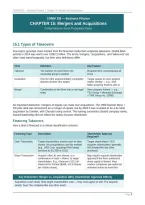
COMM 309 — Business Finance | Chapter 15: Mergers and Acquisitions
COMM 309 — Business Finance
CHAPTER 15: Mergers and Acquisitions
Comprehensive Exam Preparation Notes
15.1 Types of Takeovers
Few topics generate more interest from the financial media than corporate takeovers. Global M&A
activity in 2014 was worth over US$3.2 trillion. The terms 'mergers,' 'acquisitions,' and 'takeovers' are
often used interchangeably, but their strict definitions differ.
Term Definition Key Feature
Takeover The transfer of control from one Broadest term; encompasses all
ownership group to another forms
Acquisition One firm (the acquirer/bidder) completely Target ceases to exist; acquirer
absorbs another (the target) retains identity — e.g., SAB
Miller acquiring Foster's (2011)
Merger Combination of two firms into a new legal New company formed — e.g.,
entity TSX Group + Montreal Exchange
= TMX Group Inc. (2008)
An important distinction: mergers-of-equals can mask true acquisitions. The 1998 Daimler-Benz +
Chrysler deal was announced as a merger of equals, but by 2003 it was revealed to be a de facto
acquisition by Daimler, with Chrysler losing control. The naming convention (hybrid company name,
shared leadership) did not reflect the reality of power distribution.
Financing Takeovers
How a deal is financed is a critical classification criterion:
Financing Type Description Shareholder Approval
Required?
Cash Transaction Target shareholders receive cash for their Target shareholders: YES.
shares. Most acquisitions use this method Acquirer shareholders: generally
(e.g., URS Corp. acquiring Flint Energy NO (treated like any other
Services for $1.25B in 2012). purchase)
Share Transaction Acquirer offers its own shares, or a May require acquirer shareholder
combination of cash + shares, to target approval if the firm's authorized
shareholders. E.g., Glencore's 2012 all- share capital is limited. Most
share bid for Xstrata ($30B, at 2.8 shares modern companies pre-authorize
per Xstrata share). unlimited shares to avoid this.
📌 Key Distinction: Merger vs. Acquisition (Why Shareholder Approval Differs)
Acquisition (cash deal): Only target shareholders vote — they must agree to sell. The acquirer
simply 'buys' the company like any other asset.
Page 1
,COMM 309 — Business Finance | Chapter 15: Mergers and Acquisitions
Merger / Share deal: Both sets of shareholders vote — existing shareholders of both firms
exchange their shares for shares in the new entity.
This is the most fundamental legal distinction between a merger and an acquisition.
Amalgamations
In Canada, a genuine merger — where a new company is created and both sets of shareholders
exchange old shares for new ones — is called an amalgamation. Key rules under the Canada Business
Corporations Act (CBCA):
• 21 days' notice must be given for the special shareholder meeting.
• Two-thirds (66.7%) of shareholders of BOTH amalgamating firms must approve the special
resolution to amalgamate.
• All normal proxy and information rules apply, since shareholders must vote.
• An amalgamation can also be a formality if the acquirer already owns 100% of the target.
Going Private Transactions / Issuer Bids: When an acquirer holds a majority (e.g., 70%) but not all
shares, it may seek amalgamation to acquire remaining shares. Since the acquirer can get two-thirds
approval using its majority, this can be coercive to dissenting minority shareholders who refuse to sell.
⚠️
Majority of the Minority Rule & Fairness Opinions
When a controlling shareholder seeks approval for an amalgamation, two critical safeguards
apply:
1. Majority of the minority shareholders must ALSO approve the resolution (protecting minorities
from the controlling shareholder's information advantage).
2. A fairness opinion is required — an independent expert values the shares based on an
external valuation to prevent the controlling shareholder from buying out minorities cheaply.
Real Example — Sears Canada (2005): Sears, Roebuck bid $16.86/share for the 46% of Sears
Canada it didn't own. The independent fairness opinion valued shares at $19–$22.25.
Independent directors unanimously rejected the bid. After receiving only 9.5% of target shares,
Sears raised the price to $18, but the OSC ultimately ruled that 'locked-up' shares by financial
advisors could not be counted as majority-of-minority votes.
This protects minority shareholders from being squeezed out at below-FMV prices.
Additional context: Going-private transactions were historically common in Canada because U.S.
parent companies (e.g., Exxon/Imperial Oil, Ford Canada, Sears Canada) kept a public 'float' of shares
in Canadian hands. After the Free Trade Agreement (FTA), these parents wanted to integrate fully,
buying out the Canadian minority holders.
15.2 Securities Legislation and Takeovers
Concerns Regarding Takeovers
Securities legislation plays a central role in governing what can be done and when in a takeover.
Regulators can and do nullify takeovers — e.g., European regulators blocked the proposed NYSE
Euronext / Deutsche Bourse merger. Grounds for rejection include:
• National security concerns — foreign ownership of strategic assets may pose national security
risks.
Page 2
, COMM 309 — Business Finance | Chapter 15: Mergers and Acquisitions
• Sensitive industries — Canada limits foreign ownership of banks, broadcast media, etc.
• Anti-trust concerns — an amalgamation that too narrowly restricts competition can be blocked.
In Canada (as of 2014), foreign takeovers worth over $340M are subject to the net benefit rule
(rising to $1B by 2017).
• Example: BHP Billiton's 2010 attempted takeover of Potash Corporation of Saskatchewan was
rejected by Canadian regulators under the net benefit rule.
The Ontario Securities Act, administered by the Ontario Securities Commission (OSC), is the primary
reference point — it contains provisions common to all Canadian jurisdictions, though securities
regulation is a provincial responsibility (slight differences exist between provinces).
Critical Thresholds
There are five critical ownership thresholds that govern takeover behaviour. Each triggers different legal
rights and obligations:
Ownershi Threshold Legal Consequence Practical Implication
p% Name
10% Early Warning Owner must file a report with the Target company learns a
OSC (5% in the U.S.). significant block has been
acquired — potential acquirer
identified.
20% Takeover Bid Cannot buy more shares in the Acquirer must make a public
open market without making a offer to ALL shareholders;
formal takeover bid. strict rules apply.
50.1% Control Can call a special shareholder Acquirer can change
meeting; can change the board of management and fully control
directors (BOD). In Canada (unlike firm operations.
the U.S.), directors can be
removed WITHOUT cause.
66.7% Amalgamation Can force an amalgamation if Acquirer can formally merge
approved by two-thirds of the two entities into one new
shareholders (subject to majority- company.
of-minority rule).
90% Minority Can FORCE remaining minority Prevents a tiny minority from
Squeeze-Out shareholders to sell at the takeover holding the acquirer hostage;
price. ensures deal completion.
📌 Strategic Use of Thresholds — The 'Toehold' Strategy
Most acquirers build their position strategically BEFORE triggering the formal takeover process:
Step 1: Acquire <10% in the open market — no reporting required, shares bought at market price
with no premium.
Step 2: Acquire up to 20% in the open market — still no formal bid required; builds toehold at
market price.
Step 3: Once above 20%, a formal TAKEOVER BID is required for any further purchases — must
comply with all takeover rules.
Rationale: Acquiring shares below 20% avoids paying the takeover premium, saving the acquirer
significant money before the bid is launched.
Page 3
COMM 309 — Business Finance
CHAPTER 15: Mergers and Acquisitions
Comprehensive Exam Preparation Notes
15.1 Types of Takeovers
Few topics generate more interest from the financial media than corporate takeovers. Global M&A
activity in 2014 was worth over US$3.2 trillion. The terms 'mergers,' 'acquisitions,' and 'takeovers' are
often used interchangeably, but their strict definitions differ.
Term Definition Key Feature
Takeover The transfer of control from one Broadest term; encompasses all
ownership group to another forms
Acquisition One firm (the acquirer/bidder) completely Target ceases to exist; acquirer
absorbs another (the target) retains identity — e.g., SAB
Miller acquiring Foster's (2011)
Merger Combination of two firms into a new legal New company formed — e.g.,
entity TSX Group + Montreal Exchange
= TMX Group Inc. (2008)
An important distinction: mergers-of-equals can mask true acquisitions. The 1998 Daimler-Benz +
Chrysler deal was announced as a merger of equals, but by 2003 it was revealed to be a de facto
acquisition by Daimler, with Chrysler losing control. The naming convention (hybrid company name,
shared leadership) did not reflect the reality of power distribution.
Financing Takeovers
How a deal is financed is a critical classification criterion:
Financing Type Description Shareholder Approval
Required?
Cash Transaction Target shareholders receive cash for their Target shareholders: YES.
shares. Most acquisitions use this method Acquirer shareholders: generally
(e.g., URS Corp. acquiring Flint Energy NO (treated like any other
Services for $1.25B in 2012). purchase)
Share Transaction Acquirer offers its own shares, or a May require acquirer shareholder
combination of cash + shares, to target approval if the firm's authorized
shareholders. E.g., Glencore's 2012 all- share capital is limited. Most
share bid for Xstrata ($30B, at 2.8 shares modern companies pre-authorize
per Xstrata share). unlimited shares to avoid this.
📌 Key Distinction: Merger vs. Acquisition (Why Shareholder Approval Differs)
Acquisition (cash deal): Only target shareholders vote — they must agree to sell. The acquirer
simply 'buys' the company like any other asset.
Page 1
,COMM 309 — Business Finance | Chapter 15: Mergers and Acquisitions
Merger / Share deal: Both sets of shareholders vote — existing shareholders of both firms
exchange their shares for shares in the new entity.
This is the most fundamental legal distinction between a merger and an acquisition.
Amalgamations
In Canada, a genuine merger — where a new company is created and both sets of shareholders
exchange old shares for new ones — is called an amalgamation. Key rules under the Canada Business
Corporations Act (CBCA):
• 21 days' notice must be given for the special shareholder meeting.
• Two-thirds (66.7%) of shareholders of BOTH amalgamating firms must approve the special
resolution to amalgamate.
• All normal proxy and information rules apply, since shareholders must vote.
• An amalgamation can also be a formality if the acquirer already owns 100% of the target.
Going Private Transactions / Issuer Bids: When an acquirer holds a majority (e.g., 70%) but not all
shares, it may seek amalgamation to acquire remaining shares. Since the acquirer can get two-thirds
approval using its majority, this can be coercive to dissenting minority shareholders who refuse to sell.
⚠️
Majority of the Minority Rule & Fairness Opinions
When a controlling shareholder seeks approval for an amalgamation, two critical safeguards
apply:
1. Majority of the minority shareholders must ALSO approve the resolution (protecting minorities
from the controlling shareholder's information advantage).
2. A fairness opinion is required — an independent expert values the shares based on an
external valuation to prevent the controlling shareholder from buying out minorities cheaply.
Real Example — Sears Canada (2005): Sears, Roebuck bid $16.86/share for the 46% of Sears
Canada it didn't own. The independent fairness opinion valued shares at $19–$22.25.
Independent directors unanimously rejected the bid. After receiving only 9.5% of target shares,
Sears raised the price to $18, but the OSC ultimately ruled that 'locked-up' shares by financial
advisors could not be counted as majority-of-minority votes.
This protects minority shareholders from being squeezed out at below-FMV prices.
Additional context: Going-private transactions were historically common in Canada because U.S.
parent companies (e.g., Exxon/Imperial Oil, Ford Canada, Sears Canada) kept a public 'float' of shares
in Canadian hands. After the Free Trade Agreement (FTA), these parents wanted to integrate fully,
buying out the Canadian minority holders.
15.2 Securities Legislation and Takeovers
Concerns Regarding Takeovers
Securities legislation plays a central role in governing what can be done and when in a takeover.
Regulators can and do nullify takeovers — e.g., European regulators blocked the proposed NYSE
Euronext / Deutsche Bourse merger. Grounds for rejection include:
• National security concerns — foreign ownership of strategic assets may pose national security
risks.
Page 2
, COMM 309 — Business Finance | Chapter 15: Mergers and Acquisitions
• Sensitive industries — Canada limits foreign ownership of banks, broadcast media, etc.
• Anti-trust concerns — an amalgamation that too narrowly restricts competition can be blocked.
In Canada (as of 2014), foreign takeovers worth over $340M are subject to the net benefit rule
(rising to $1B by 2017).
• Example: BHP Billiton's 2010 attempted takeover of Potash Corporation of Saskatchewan was
rejected by Canadian regulators under the net benefit rule.
The Ontario Securities Act, administered by the Ontario Securities Commission (OSC), is the primary
reference point — it contains provisions common to all Canadian jurisdictions, though securities
regulation is a provincial responsibility (slight differences exist between provinces).
Critical Thresholds
There are five critical ownership thresholds that govern takeover behaviour. Each triggers different legal
rights and obligations:
Ownershi Threshold Legal Consequence Practical Implication
p% Name
10% Early Warning Owner must file a report with the Target company learns a
OSC (5% in the U.S.). significant block has been
acquired — potential acquirer
identified.
20% Takeover Bid Cannot buy more shares in the Acquirer must make a public
open market without making a offer to ALL shareholders;
formal takeover bid. strict rules apply.
50.1% Control Can call a special shareholder Acquirer can change
meeting; can change the board of management and fully control
directors (BOD). In Canada (unlike firm operations.
the U.S.), directors can be
removed WITHOUT cause.
66.7% Amalgamation Can force an amalgamation if Acquirer can formally merge
approved by two-thirds of the two entities into one new
shareholders (subject to majority- company.
of-minority rule).
90% Minority Can FORCE remaining minority Prevents a tiny minority from
Squeeze-Out shareholders to sell at the takeover holding the acquirer hostage;
price. ensures deal completion.
📌 Strategic Use of Thresholds — The 'Toehold' Strategy
Most acquirers build their position strategically BEFORE triggering the formal takeover process:
Step 1: Acquire <10% in the open market — no reporting required, shares bought at market price
with no premium.
Step 2: Acquire up to 20% in the open market — still no formal bid required; builds toehold at
market price.
Step 3: Once above 20%, a formal TAKEOVER BID is required for any further purchases — must
comply with all takeover rules.
Rationale: Acquiring shares below 20% avoids paying the takeover premium, saving the acquirer
significant money before the bid is launched.
Page 3


