
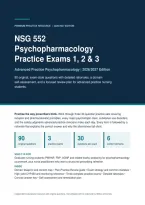
PREMIUM PRACTICE RESOURCE | 2026/2027 EDITION
NSG 552
Psychopharmacology
Practice Exams 1, 2 & 3
Advanced Practice Psychopharmacology | 2026/2027 Edition
90 original, exam-style questions with detailed rationales, a domain
self-assessment, and a focused review plan for advanced practice nursing
students.
Practise the way prescribers think. Work through three 30-question practice sets covering
receptor and pharmacokinetic principles, every major psychotropic class, substance use disorders,
and the safety judgments advanced practice clinicians make each day. Every item is followed by a
rationale that explains the correct answer and why the alternatives fall short.
90 3 30 6
original questions practice exams questions per exam content domains
WHO IT IS FOR
Graduate nursing students (PMHNP, FNP, AGNP and related tracks) preparing for psychopharmacology
coursework, plus nurse practitioners who want a structured prescribing refresher.
INSIDE
Domain blueprint and content map • Plan-Practice-Review guide • Exam strategy and common mistakes •
High-yield CYP450 and monitoring reference • Three complete practice exams • Detailed rationales •
Concise answer key • Self-assessment and remediation plan
Independent educational resource with original questions. Not affiliated with or endorsed by Wilkes University.
,NSG 552 Psychopharmacology Practice Exams | 2026/2027 Edition Original practice resource
Prepare for Advanced Practice
Psychopharmacology with Confidence
Mastering psychopharmacology takes more than memorizing drug names. NSG 552
Psychopharmacology Practice Exams 1, 2 & 3 (2026/2027 Edition) gives advanced practice
nursing students 90 original, exam-style questions that build the prescribing judgment courses
and certification-style assessments reward. Each question is followed by a detailed rationale so
every attempt becomes a lesson.
This guide covers advanced practice psychopharmacology across six domains: receptor pharmacology
and pharmacokinetics, antidepressants and anxiolytics, mood stabilizers, antipsychotics, ADHD and
substance use disorder treatment, and safety in special populations. Questions emphasize application
and analysis of realistic clinical scenarios, including drug interactions, monitoring, adverse-effect
recognition, and prescriptive decision-making.
What You'll Get
• 90 original multiple-choice questions in three 30-question practice exams
• A domain blueprint and content map so you can see exactly what each exam covers
• Detailed rationales explaining why the answer is correct and why other options are less suitable
• A key takeaway on every item to anchor the concept in memory
• A high-yield quick reference for CYP450 interactions, monitoring, and washout periods
• Exam strategy and common-mistake alerts specific to psychopharmacology
• A concise answer key, domain self-assessment, and remediation plan
Who This Guide Is For
Graduate nursing students in psychiatric-mental health, family, and adult-gerontology nurse practitioner
tracks who are enrolled in advanced psychopharmacology or pharmacotherapeutics courses, and
practicing nurse practitioners who want a structured refresher on prescribing and monitoring psychotropic
medication.
How to Use This Guide
Attempt one exam at a time under realistic conditions, record your answers on paper, then check the
rationales and log each missed item by domain. Use the self-assessment and remediation plan to decide
what to review before you attempt the next exam. Retry missed items after a few days, because spaced
review improves retention.
Consistent, reflective practice turns uncertainty into clinical reasoning. Use these exams to find your gaps
early and to build the habits of careful, safe prescribing.
Please note. All questions are original and were written for study purposes. They are not drawn from any course
examination or commercial test bank, and performance on them does not predict or guarantee results on any real
assessment. Clinical content is educational; always confirm doses, contraindications, and requirements against
current prescribing information, institutional policy, and your state's scope-of-practice rules.
Independent study resource. Verify clinical details against current prescribing information. Page 2
,NSG 552 Psychopharmacology Practice Exams | 2026/2027 Edition Original practice resource
Overview, Blueprint & Content Map
The three exams share one structure so you can compare performance across attempts. The blueprint
below is a recommended practice blueprint designed for this guide. It is not an official course or
credentialing blueprint, and the weights are not taken from any published exam.
Domain Blueprint
Domain Items % of Exam 1 Exam 2 Exam 3
total
1. Neuroscience, Receptor Pharmacology & 14 15.6% 5 5 4
Pharmacokinetics
2. Antidepressants, Anxiolytics & 20 22.2% 7 7 6
Sedative-Hypnotics
3. Mood Stabilizers & Bipolar Disorder 10 11.1% 3 3 4
4. Antipsychotics & Psychotic Disorders 16 17.8% 5 5 6
5. ADHD, Stimulants & Substance Use Disorders 14 15.6% 5 5 4
6. Special Populations, Safety & Prescribing 16 17.8% 5 5 6
Judgment
Total 90 100% 30 30 30
Percentages are rounded to one decimal place.
Content Map
Domain Topics emphasized
1. Neuroscience, Receptor Receptor mechanisms, PK/PD principles, CYP450 interactions,
Pharmacology & Pharmacokinetics first-pass metabolism, pharmacogenomic dosing
2. Antidepressants, Anxiolytics & Depression and anxiety pharmacotherapy, serotonin syndrome,
Sedative-Hypnotics discontinuation, insomnia agents, esketamine
3. Mood Stabilizers & Bipolar Disorder Lithium, valproate, lamotrigine, carbamazepine, bipolar depression,
pregnancy and lab monitoring
4. Antipsychotics & Psychotic Disorders EPS, NMS, metabolic and QTc monitoring, clozapine, LAIs, tardive
dyskinesia, newer mechanisms
5. ADHD, Stimulants & Substance Use Stimulant and nonstimulant ADHD care, opioid, alcohol, nicotine and
Disorders benzodiazepine use disorders
6. Special Populations, Safety & Older adults, pregnancy, youth, organ impairment, interactions,
Prescribing Judgment controlled substances, capacity, adherence
Every item is a four-option, single-best-answer question, tagged by cognitive skill in the rationale section and mixed across
domains within each exam.
Independent study resource. Verify clinical details against current prescribing information. Page 3
, NSG 552 Psychopharmacology Practice Exams | 2026/2027 Edition Original practice resource
PLAN • PRACTICE • REVIEW
A simple three-stage routine turns practice questions into durable knowledge.
1. PLAN
• Set aside 45 minutes of uninterrupted time per exam. This is a suggested pace of 1.5 minutes per
question, not an official time limit.
• Gather paper for answers and a notes sheet for flagged questions. Keep the rationale section closed.
• Decide in advance how you will handle uncertainty: eliminate, choose, flag, and move on.
2. PRACTICE
• Read the stem twice, then identify what is actually being asked: diagnosis, next step, best drug,
monitoring, or safety action.
• Predict the answer before reading the options, then eliminate options that are unsafe, outdated, or
off-target.
• Record your answer and a confidence level (sure, unsure, guess) for each question.
3. REVIEW
• Check your answers against the concise key, then read the rationale for every missed question and
every guess, even if correct.
• Log each miss in the self-assessment by domain, and write one sentence on why you missed it:
knowledge gap, misread stem, or rushed judgment.
• Revisit the related concept in your course materials and the quick reference, then retry missed items
after two to three days.
Tip: Treat guessed-but-correct answers as misses for review. A lucky guess does not indicate
mastery.
Independent study resource. Verify clinical details against current prescribing information. Page 4
NSG 552
Psychopharmacology
Practice Exams 1, 2 & 3
Advanced Practice Psychopharmacology | 2026/2027 Edition
90 original, exam-style questions with detailed rationales, a domain
self-assessment, and a focused review plan for advanced practice nursing
students.
Practise the way prescribers think. Work through three 30-question practice sets covering
receptor and pharmacokinetic principles, every major psychotropic class, substance use disorders,
and the safety judgments advanced practice clinicians make each day. Every item is followed by a
rationale that explains the correct answer and why the alternatives fall short.
90 3 30 6
original questions practice exams questions per exam content domains
WHO IT IS FOR
Graduate nursing students (PMHNP, FNP, AGNP and related tracks) preparing for psychopharmacology
coursework, plus nurse practitioners who want a structured prescribing refresher.
INSIDE
Domain blueprint and content map • Plan-Practice-Review guide • Exam strategy and common mistakes •
High-yield CYP450 and monitoring reference • Three complete practice exams • Detailed rationales •
Concise answer key • Self-assessment and remediation plan
Independent educational resource with original questions. Not affiliated with or endorsed by Wilkes University.
,NSG 552 Psychopharmacology Practice Exams | 2026/2027 Edition Original practice resource
Prepare for Advanced Practice
Psychopharmacology with Confidence
Mastering psychopharmacology takes more than memorizing drug names. NSG 552
Psychopharmacology Practice Exams 1, 2 & 3 (2026/2027 Edition) gives advanced practice
nursing students 90 original, exam-style questions that build the prescribing judgment courses
and certification-style assessments reward. Each question is followed by a detailed rationale so
every attempt becomes a lesson.
This guide covers advanced practice psychopharmacology across six domains: receptor pharmacology
and pharmacokinetics, antidepressants and anxiolytics, mood stabilizers, antipsychotics, ADHD and
substance use disorder treatment, and safety in special populations. Questions emphasize application
and analysis of realistic clinical scenarios, including drug interactions, monitoring, adverse-effect
recognition, and prescriptive decision-making.
What You'll Get
• 90 original multiple-choice questions in three 30-question practice exams
• A domain blueprint and content map so you can see exactly what each exam covers
• Detailed rationales explaining why the answer is correct and why other options are less suitable
• A key takeaway on every item to anchor the concept in memory
• A high-yield quick reference for CYP450 interactions, monitoring, and washout periods
• Exam strategy and common-mistake alerts specific to psychopharmacology
• A concise answer key, domain self-assessment, and remediation plan
Who This Guide Is For
Graduate nursing students in psychiatric-mental health, family, and adult-gerontology nurse practitioner
tracks who are enrolled in advanced psychopharmacology or pharmacotherapeutics courses, and
practicing nurse practitioners who want a structured refresher on prescribing and monitoring psychotropic
medication.
How to Use This Guide
Attempt one exam at a time under realistic conditions, record your answers on paper, then check the
rationales and log each missed item by domain. Use the self-assessment and remediation plan to decide
what to review before you attempt the next exam. Retry missed items after a few days, because spaced
review improves retention.
Consistent, reflective practice turns uncertainty into clinical reasoning. Use these exams to find your gaps
early and to build the habits of careful, safe prescribing.
Please note. All questions are original and were written for study purposes. They are not drawn from any course
examination or commercial test bank, and performance on them does not predict or guarantee results on any real
assessment. Clinical content is educational; always confirm doses, contraindications, and requirements against
current prescribing information, institutional policy, and your state's scope-of-practice rules.
Independent study resource. Verify clinical details against current prescribing information. Page 2
,NSG 552 Psychopharmacology Practice Exams | 2026/2027 Edition Original practice resource
Overview, Blueprint & Content Map
The three exams share one structure so you can compare performance across attempts. The blueprint
below is a recommended practice blueprint designed for this guide. It is not an official course or
credentialing blueprint, and the weights are not taken from any published exam.
Domain Blueprint
Domain Items % of Exam 1 Exam 2 Exam 3
total
1. Neuroscience, Receptor Pharmacology & 14 15.6% 5 5 4
Pharmacokinetics
2. Antidepressants, Anxiolytics & 20 22.2% 7 7 6
Sedative-Hypnotics
3. Mood Stabilizers & Bipolar Disorder 10 11.1% 3 3 4
4. Antipsychotics & Psychotic Disorders 16 17.8% 5 5 6
5. ADHD, Stimulants & Substance Use Disorders 14 15.6% 5 5 4
6. Special Populations, Safety & Prescribing 16 17.8% 5 5 6
Judgment
Total 90 100% 30 30 30
Percentages are rounded to one decimal place.
Content Map
Domain Topics emphasized
1. Neuroscience, Receptor Receptor mechanisms, PK/PD principles, CYP450 interactions,
Pharmacology & Pharmacokinetics first-pass metabolism, pharmacogenomic dosing
2. Antidepressants, Anxiolytics & Depression and anxiety pharmacotherapy, serotonin syndrome,
Sedative-Hypnotics discontinuation, insomnia agents, esketamine
3. Mood Stabilizers & Bipolar Disorder Lithium, valproate, lamotrigine, carbamazepine, bipolar depression,
pregnancy and lab monitoring
4. Antipsychotics & Psychotic Disorders EPS, NMS, metabolic and QTc monitoring, clozapine, LAIs, tardive
dyskinesia, newer mechanisms
5. ADHD, Stimulants & Substance Use Stimulant and nonstimulant ADHD care, opioid, alcohol, nicotine and
Disorders benzodiazepine use disorders
6. Special Populations, Safety & Older adults, pregnancy, youth, organ impairment, interactions,
Prescribing Judgment controlled substances, capacity, adherence
Every item is a four-option, single-best-answer question, tagged by cognitive skill in the rationale section and mixed across
domains within each exam.
Independent study resource. Verify clinical details against current prescribing information. Page 3
, NSG 552 Psychopharmacology Practice Exams | 2026/2027 Edition Original practice resource
PLAN • PRACTICE • REVIEW
A simple three-stage routine turns practice questions into durable knowledge.
1. PLAN
• Set aside 45 minutes of uninterrupted time per exam. This is a suggested pace of 1.5 minutes per
question, not an official time limit.
• Gather paper for answers and a notes sheet for flagged questions. Keep the rationale section closed.
• Decide in advance how you will handle uncertainty: eliminate, choose, flag, and move on.
2. PRACTICE
• Read the stem twice, then identify what is actually being asked: diagnosis, next step, best drug,
monitoring, or safety action.
• Predict the answer before reading the options, then eliminate options that are unsafe, outdated, or
off-target.
• Record your answer and a confidence level (sure, unsure, guess) for each question.
3. REVIEW
• Check your answers against the concise key, then read the rationale for every missed question and
every guess, even if correct.
• Log each miss in the self-assessment by domain, and write one sentence on why you missed it:
knowledge gap, misread stem, or rushed judgment.
• Revisit the related concept in your course materials and the quick reference, then retry missed items
after two to three days.
Tip: Treat guessed-but-correct answers as misses for review. A lucky guess does not indicate
mastery.
Independent study resource. Verify clinical details against current prescribing information. Page 4


