
COMM 223 — Marketing Management | Chapter 10: Marketing Channels — Delivering Customer Value
COMM 223 — Marketing Management
Chapter 10: Marketing Channels — Delivering Customer Value
Based on: Armstrong, Kotler et al., Marketing: An Introduction, 7th Canadian Edition
Chapter Overview:
This chapter covers the third major marketing mix tool: Place (Distribution). It examines how
companies build and manage marketing channels — the networks that move products from producer
to consumer. Topics include: why channels exist and what functions they perform; how channel
members behave and organize (including VMSs, horizontal systems, and multichannel systems); how
companies design channels (analyzing needs, setting objectives, choosing intermediaries); how to
select, motivate, and evaluate channel members; and how marketing logistics and supply chain
management create competitive advantage and efficiency.
1. Supply Chains and the Value Delivery Network
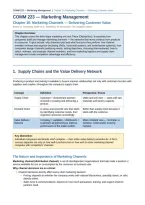
Producing a product and making it available to buyers requires relationships not only with customers but also with
suppliers and resellers throughout the company's supply chain.
Concept Definition Perspective / Focus
Supply Chain Upstream + downstream partners Make-and-sell view — starts with raw
involved in creating and delivering a materials and factory capacity.
product.
Demand Chain A sense-and-respond view that starts Better than supply chain because it
by identifying customer needs, then starts with the customer.
organises resources accordingly.
Value Delivery Company + suppliers + distributors + Most complete view — not linear; a
Network customers all partnering to improve complex, continuously evolving
performance of the entire system. network.
Key Distinction:
Individual companies and brands don't compete — their entire value delivery networks do. A firm's
success depends not only on how well it performs but on how well its entire marketing channel
competes with competitors' channels.
The Nature and Importance of Marketing Channels
Marketing channel (distribution channel): A set of interdependent organizations that help make a product or
service available for use or consumption by the consumer or business user.
Why channel decisions are so critical:
• Channel decisions directly affect every other marketing decision:
◦ Pricing: depends on whether the company works with national discounters, specialty stores, or sells
directly online.
◦ Sales force & communications: depend on how much persuasion, training, and support channel
partners need.
,COMM 223 — Marketing Management | Chapter 10: Marketing Channels — Delivering Customer Value
◦ New product decisions: may depend on whether those products fit the capabilities of existing channel
members.
• Distribution channels often involve long-term commitments — harder to change than pricing or promotions.
• Companies that neglect channels can suffer serious consequences. Those that innovate distribution can
gain major competitive advantage.
Distribution Innovation Examples (Competitive Advantage):
• Enterprise Rent-A-Car: revolutionised car rental by setting up off-airport rental offices.
• Apple iTunes: turned the retail music business upside down by selling music digitally.
• FedEx: creative distribution made it the leader in express package delivery.
• Uber / Airbnb: sharing models disrupted the taxi and hospitality industries.
• Amazon.com: changed retailing by selling everything without physical stores.
How Channel Members Add Value
Why use intermediaries? Because they create greater efficiency in making goods available to target markets
through their contacts, experience, specialization, and scale of operation.
Without Distributor (Direct) With Distributor
3 manufacturers × 3 customers = 9 contact lines 3 manufacturers + 3 customers = 6 contact lines
(33% reduction)
Each producer must reach each customer One distributor serves as a hub — intermediaries
individually → high cost & complexity. transform narrow large-quantity assortments from
producers into the broad small-quantity
assortments consumers want.
The 8 Key Functions Channel Members Perform:
Category Function Description
Complete Information Gather & distribute info about consumers, producers, actors
Transactions in the environment needed for planning and exchange.
Promotion Develop & spread persuasive communications about an
offer.
Contact Find and engage customers and prospective buyers.
Matching Shape offers to meet buyers' needs — manufacturing,
grading, assembling, packaging.
Negotiation Reach agreement on price and terms so that ownership or
possession can be transferred.
Fulfil Physical Distribution Transporting and storing goods.
Transactions
Financing Acquire and use funds to cover the costs of channel work.
Risk Taking Assume the risks of carrying out the channel work.
Exam Insight — The Cost Trade-Off:
The question is NOT whether these functions need to be performed — they must be. The question is
WHO performs them. If the manufacturer performs them → costs rise → prices go up. If
intermediaries perform them → producer's costs may fall, but intermediaries charge more. Functions
, COMM 223 — Marketing Management | Chapter 10: Marketing Channels — Delivering Customer Value
should be assigned to channel members that can add the most value for the cost.
Number of Channel Levels
Channel level: A layer of intermediaries that performs some work in bringing the product and its ownership closer
to the final buyer. Both the producer and the final consumer are part of every channel.
The number of intermediary levels = the length of the channel.
Channel Type Consumer Channels Business Channels Key Implication
Channel 1 Producer → Consumer Producer → Business Direct Marketing Channel
(Direct) (no intermediaries) Ex: Customer (direct sales — maximum producer
GEICO, Quicken Loans, force) control.
Omaha Steaks
Channel 2 (One Producer → Retailer → Producer → Business One intermediary; some
level) Consumer Ex: Most Distributor → Business loss of control.
consumer goods in Customer
stores
Channel 3 (Two Producer → Wholesaler Producer → Indirect marketing channel
levels) → Retailer → Manufacturer's Rep → — more complexity, less
Consumer Ex: Business Distributor → control.
Packaged goods (Dove Customer
soap)
Flows within channels (even simple ones can be complex):
• Physical flow of products
• Flow of ownership
• Payment flow
• Information flow
• Promotion flow
2. Channel Behaviour and Organization
Distribution channels are NOT simple collections of firms — they are complex behavioural systems in which
people and companies interact to accomplish individual, company, and channel goals. New types of
intermediaries constantly emerge and whole new channel systems evolve.
Channel Behaviour
Each channel member plays a specialized role. The channel is most effective when each member assumes the
tasks it can do best. However, individual members often act in their own short-run best interests, generating
conflict.
Type of Conflict Definition Example
Horizontal Conflict Conflict among firms at the Ford dealers in Calgary complaining other
SAME level of the channel. dealers price too low or advertise outside
their territory. Holiday Inn franchisees
COMM 223 — Marketing Management
Chapter 10: Marketing Channels — Delivering Customer Value
Based on: Armstrong, Kotler et al., Marketing: An Introduction, 7th Canadian Edition
Chapter Overview:
This chapter covers the third major marketing mix tool: Place (Distribution). It examines how
companies build and manage marketing channels — the networks that move products from producer
to consumer. Topics include: why channels exist and what functions they perform; how channel
members behave and organize (including VMSs, horizontal systems, and multichannel systems); how
companies design channels (analyzing needs, setting objectives, choosing intermediaries); how to
select, motivate, and evaluate channel members; and how marketing logistics and supply chain
management create competitive advantage and efficiency.
1. Supply Chains and the Value Delivery Network
Producing a product and making it available to buyers requires relationships not only with customers but also with
suppliers and resellers throughout the company's supply chain.
Concept Definition Perspective / Focus
Supply Chain Upstream + downstream partners Make-and-sell view — starts with raw
involved in creating and delivering a materials and factory capacity.
product.
Demand Chain A sense-and-respond view that starts Better than supply chain because it
by identifying customer needs, then starts with the customer.
organises resources accordingly.
Value Delivery Company + suppliers + distributors + Most complete view — not linear; a
Network customers all partnering to improve complex, continuously evolving
performance of the entire system. network.
Key Distinction:
Individual companies and brands don't compete — their entire value delivery networks do. A firm's
success depends not only on how well it performs but on how well its entire marketing channel
competes with competitors' channels.
The Nature and Importance of Marketing Channels
Marketing channel (distribution channel): A set of interdependent organizations that help make a product or
service available for use or consumption by the consumer or business user.
Why channel decisions are so critical:
• Channel decisions directly affect every other marketing decision:
◦ Pricing: depends on whether the company works with national discounters, specialty stores, or sells
directly online.
◦ Sales force & communications: depend on how much persuasion, training, and support channel
partners need.
,COMM 223 — Marketing Management | Chapter 10: Marketing Channels — Delivering Customer Value
◦ New product decisions: may depend on whether those products fit the capabilities of existing channel
members.
• Distribution channels often involve long-term commitments — harder to change than pricing or promotions.
• Companies that neglect channels can suffer serious consequences. Those that innovate distribution can
gain major competitive advantage.
Distribution Innovation Examples (Competitive Advantage):
• Enterprise Rent-A-Car: revolutionised car rental by setting up off-airport rental offices.
• Apple iTunes: turned the retail music business upside down by selling music digitally.
• FedEx: creative distribution made it the leader in express package delivery.
• Uber / Airbnb: sharing models disrupted the taxi and hospitality industries.
• Amazon.com: changed retailing by selling everything without physical stores.
How Channel Members Add Value
Why use intermediaries? Because they create greater efficiency in making goods available to target markets
through their contacts, experience, specialization, and scale of operation.
Without Distributor (Direct) With Distributor
3 manufacturers × 3 customers = 9 contact lines 3 manufacturers + 3 customers = 6 contact lines
(33% reduction)
Each producer must reach each customer One distributor serves as a hub — intermediaries
individually → high cost & complexity. transform narrow large-quantity assortments from
producers into the broad small-quantity
assortments consumers want.
The 8 Key Functions Channel Members Perform:
Category Function Description
Complete Information Gather & distribute info about consumers, producers, actors
Transactions in the environment needed for planning and exchange.
Promotion Develop & spread persuasive communications about an
offer.
Contact Find and engage customers and prospective buyers.
Matching Shape offers to meet buyers' needs — manufacturing,
grading, assembling, packaging.
Negotiation Reach agreement on price and terms so that ownership or
possession can be transferred.
Fulfil Physical Distribution Transporting and storing goods.
Transactions
Financing Acquire and use funds to cover the costs of channel work.
Risk Taking Assume the risks of carrying out the channel work.
Exam Insight — The Cost Trade-Off:
The question is NOT whether these functions need to be performed — they must be. The question is
WHO performs them. If the manufacturer performs them → costs rise → prices go up. If
intermediaries perform them → producer's costs may fall, but intermediaries charge more. Functions
, COMM 223 — Marketing Management | Chapter 10: Marketing Channels — Delivering Customer Value
should be assigned to channel members that can add the most value for the cost.
Number of Channel Levels
Channel level: A layer of intermediaries that performs some work in bringing the product and its ownership closer
to the final buyer. Both the producer and the final consumer are part of every channel.
The number of intermediary levels = the length of the channel.
Channel Type Consumer Channels Business Channels Key Implication
Channel 1 Producer → Consumer Producer → Business Direct Marketing Channel
(Direct) (no intermediaries) Ex: Customer (direct sales — maximum producer
GEICO, Quicken Loans, force) control.
Omaha Steaks
Channel 2 (One Producer → Retailer → Producer → Business One intermediary; some
level) Consumer Ex: Most Distributor → Business loss of control.
consumer goods in Customer
stores
Channel 3 (Two Producer → Wholesaler Producer → Indirect marketing channel
levels) → Retailer → Manufacturer's Rep → — more complexity, less
Consumer Ex: Business Distributor → control.
Packaged goods (Dove Customer
soap)
Flows within channels (even simple ones can be complex):
• Physical flow of products
• Flow of ownership
• Payment flow
• Information flow
• Promotion flow
2. Channel Behaviour and Organization
Distribution channels are NOT simple collections of firms — they are complex behavioural systems in which
people and companies interact to accomplish individual, company, and channel goals. New types of
intermediaries constantly emerge and whole new channel systems evolve.
Channel Behaviour
Each channel member plays a specialized role. The channel is most effective when each member assumes the
tasks it can do best. However, individual members often act in their own short-run best interests, generating
conflict.
Type of Conflict Definition Example
Horizontal Conflict Conflict among firms at the Ford dealers in Calgary complaining other
SAME level of the channel. dealers price too low or advertise outside
their territory. Holiday Inn franchisees


