
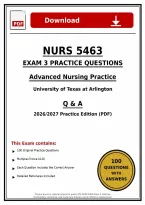
, NURS 5463 EXAM 3 PRACTICE QUESTIONS
Advanced Nursing Practice
Adult Gerontology Acute Care - UTA-aligned infection scope
University of Texas at Arlington
100-Question Practice Examination | 2026/2027 Edition
Normal Flora & Microbiology Foundations
1. Which organism is a common component of normal skin flora and an important cause ofcatheter-
associated bloodstream infection?
A) Legionella pneumophila
B) Vibrio cholerae
C) Streptococcus pyogenes
D) Staphylococcus epidermidis
Correct Answer: D) Staphylococcus epidermidis
Rationale: Coagulase-negative staphylococci, especially S. epidermidis, commonly colonize skin and can form
biofilm on prosthetic material and intravascular devices.
2. Which genus is normally dominant in the healthy vaginal microbiome and helps maintain an
acidicpH?
A) Pseudomonas
B) Neisseria meningitidis
C) Clostridioides
D) Lactobacillus
Correct Answer: D) Lactobacillus
Rationale: Lactobacilli produce lactic acid and help maintain a low vaginal pH that suppresses overgrowth of many
pathogens.
3. Viridans streptococci are common normal flora of which site?
A) Urinary bladder
B) Pleural space
C) Oropharynx
D) Bloodstream
Correct Answer: C) Oropharynx
Rationale: Viridans streptococci commonly colonize the mouth and oropharynx and can cause endocarditis after
entering the bloodstream.
4. Bacteroides fragilis is normally found primarily where?
A) Blood
B) Lower respiratory tract
C) Cerebrospinal fluid
D) Colon
NURS 5463 Exam 3 | Advanced Nursing Practice | Original Practice Questions Page 1
, Correct Answer: D) Colon
Rationale: B. fragilis is part of normal colonic flora but becomes pathogenic when bowel integrity is disrupted,
especially in intra-abdominal abscesses.
5. Which organism can colonize the anterior nares and later cause invasive disease?
A) Clostridium tetani
B) Staphylococcus aureus
C) Bordetella pertussis
D) Treponema pallidum
Correct Answer: B) Staphylococcus aureus
Rationale: S. aureus frequently colonizes the nose and skin; colonization is a major reservoir for subsequent
infection and transmission.
6. What term describes microorganisms present at a body site without causing tissue invasion
orsymptoms?
A) Contamination only
B) Colonization
C) Sepsis
D) Bacteremia
Correct Answer: B) Colonization
Rationale: Colonization means organisms are present without clinical infection. Treatment is usually unnecessary
unless a specific decolonization indication exists.
7. Which finding most strongly distinguishes infection from colonization?
A) Presence of any organism on skin
B) Positive culture alone
C) A single swab result
D) Host inflammatory response with compatible clinical signs
Correct Answer: D) Host inflammatory response with compatible clinical signs
Rationale: Infection requires tissue invasion and a host response; culture positivity without symptoms may simply
reflect colonization.
8. What is the main purpose of obtaining cultures before antibiotics when clinically safe?
A) Eliminate the need for antibiotics
B) Prevent resistance completely
C) Guarantee a positive result
D) Identify the pathogen and permit targeted therapy
Correct Answer: D) Identify the pathogen and permit targeted therapy
Rationale: Pre-antibiotic cultures improve diagnostic yield and allow de-escalation from broad empiric therapy to
narrower treatment.
9. What does antimicrobial de-escalation mean?
NURS 5463 Exam 3 | Advanced Nursing Practice | Original Practice Questions Page 2


