
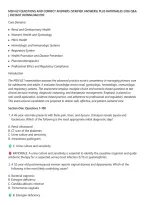
MSN 621 QUESTIONS AND CORRECT ANSWERS (VERIFIED ANSWERS) PLUS RATIONALES 2026 Q&A
| INSTANT DOWNLOAD PDF.
Core Domains
Renal and Genitourinary Health
Women's Health and Gynecology
Men's Health
Hematologic and Immunologic Systems
Respiratory System
Health Promotion and Disease Prevention
Pharmacotherapeutics
Professional Ethics and Regulatory Compliance
Introduction
The MSN 621 examination assesses the advanced practice nurse's competency in managing primary care
for adolescents and adults. It evaluates knowledge across renal, gynecologic, hematologic, immunologic,
and respiratory systems. The assessment employs multiple-choice and scenario-based questions to test
clinical decision-making, diagnostic reasoning, and therapeutic management. Emphasis is placed on
real-world application, evidence-based practice, and adherence to professional and regulatory standards.
This exam ensures candidates are prepared to deliver safe, effective, and patient-centered care.
Section One: Questions 1–100
1. A 45-year-old male presents with flank pain, fever, and dysuria. Urinalysis reveals pyuria and
bacteriuria. Which of the following is the most appropriate initial diagnostic step?
A. Renal ultrasound
B. CT scan of the abdomen
C. Urine culture and sensitivity
D. Intravenous pyelogram
🟢 C. Urine culture and sensitivity
🔴 RATIONALE: A urine culture and sensitivity is essential to identify the causative organism and guide
antibiotic therapy for a suspected urinary tract infection (UTI) or pyelonephritis.
2. A 52-year-old postmenopausal woman reports vaginal dryness and dyspareunia. Which of the
following is the most likely underlying cause?
A. Bacterial vaginosis
B. Estrogen deficiency
C. Candida albicans infection
D. Trichomonas vaginalis
🟢 B. Estrogen deficiency
,🔴 RATIONALE: Postmenopausal women experience decreased estrogen levels, leading to
vulvovaginal atrophy, which manifests as dryness, itching, and painful intercourse.
3. A 60-year-old male with a history of smoking presents with hematuria and weight loss. Which of the
following is the most concerning diagnosis?
A. Benign prostatic hyperplasia
B. Bladder cancer
C. Prostatitis
D. Urinary tract infection
🟢 B. Bladder cancer
🔴 RATIONALE: Painless hematuria in an older male smoker is a classic presentation for bladder
cancer, which requires urgent urologic evaluation.
4. A 28-year-old woman with a history of recurrent UTIs asks about prevention. Which of the following
is the most appropriate recommendation?
A. Increase caffeine intake
B. Postcoital voiding
C. Daily antibiotic prophylaxis for life
D. Limit fluid intake
🟢 B. Postcoital voiding
🔴 RATIONALE: Voiding after intercourse helps flush bacteria from the urethra and is a recommended
behavioral strategy for preventing recurrent UTIs.
5. A 35-year-old man presents with a painless ulcer on the penis. Which of the following is the most
likely diagnosis?
A. Herpes simplex virus
B. Syphilis
C. Chancroid
D. Gonorrhea
🟢 B. Syphilis
🔴 RATIONALE: The primary stage of syphilis presents as a single, painless, indurated ulcer (chancre) at
the site of infection.
6. A 50-year-old woman undergoes a routine Pap smear. Results show atypical squamous cells of
undetermined significance (ASC-US). What is the next best step?
A. Immediate colposcopy
B. Repeat Pap smear in 12 months
C. HPV testing
D. Endometrial biopsy
, 🟢 C. HPV testing
🔴 RATIONALE: For ASC-US results, reflex HPV testing is recommended to determine whether further
evaluation with colposcopy is necessary.
7. A 72-year-old male is prescribed finasteride for benign prostatic hyperplasia. Which of the following
is a common side effect?
A. Hypertension
B. Decreased libido
C. Hyperkalemia
D. Tachycardia
🟢 B. Decreased libido
🔴 RATIONALE: Finasteride, a 5-alpha-reductase inhibitor, can cause sexual side effects including
decreased libido, erectile dysfunction, and reduced ejaculate volume.
8. A 40-year-old woman presents with a breast lump. Which of the following findings is most
suggestive of malignancy?
A. Mobile, smooth, round mass
B. Firm, irregular, fixed mass
C. Painful, diffuse breast tenderness
D. Cyclical lumpiness
🟢 B. Firm, irregular, fixed mass
🔴 RATIONALE: Malignant breast masses are typically firm, irregular, and fixed to underlying tissue,
whereas benign masses are often mobile and smooth.
9. A 55-year-old male with a history of alcohol abuse presents with macrocytic anemia. Which of the
following is the most likely cause?
A. Iron deficiency
B. Folate deficiency
C. Thalassemia
D. Anemia of chronic disease
🟢 B. Folate deficiency
🔴 RATIONALE: Alcohol abuse can lead to folate deficiency, which causes macrocytic anemia due to
impaired DNA synthesis.
10. A 62-year-old woman presents with fatigue, pallor, and a hemoglobin of 9 g/dL. Which of the
following is the most appropriate initial test to evaluate the anemia?
A. Serum ferritin
B. Bone marrow biopsy
| INSTANT DOWNLOAD PDF.
Core Domains
Renal and Genitourinary Health
Women's Health and Gynecology
Men's Health
Hematologic and Immunologic Systems
Respiratory System
Health Promotion and Disease Prevention
Pharmacotherapeutics
Professional Ethics and Regulatory Compliance
Introduction
The MSN 621 examination assesses the advanced practice nurse's competency in managing primary care
for adolescents and adults. It evaluates knowledge across renal, gynecologic, hematologic, immunologic,
and respiratory systems. The assessment employs multiple-choice and scenario-based questions to test
clinical decision-making, diagnostic reasoning, and therapeutic management. Emphasis is placed on
real-world application, evidence-based practice, and adherence to professional and regulatory standards.
This exam ensures candidates are prepared to deliver safe, effective, and patient-centered care.
Section One: Questions 1–100
1. A 45-year-old male presents with flank pain, fever, and dysuria. Urinalysis reveals pyuria and
bacteriuria. Which of the following is the most appropriate initial diagnostic step?
A. Renal ultrasound
B. CT scan of the abdomen
C. Urine culture and sensitivity
D. Intravenous pyelogram
🟢 C. Urine culture and sensitivity
🔴 RATIONALE: A urine culture and sensitivity is essential to identify the causative organism and guide
antibiotic therapy for a suspected urinary tract infection (UTI) or pyelonephritis.
2. A 52-year-old postmenopausal woman reports vaginal dryness and dyspareunia. Which of the
following is the most likely underlying cause?
A. Bacterial vaginosis
B. Estrogen deficiency
C. Candida albicans infection
D. Trichomonas vaginalis
🟢 B. Estrogen deficiency
,🔴 RATIONALE: Postmenopausal women experience decreased estrogen levels, leading to
vulvovaginal atrophy, which manifests as dryness, itching, and painful intercourse.
3. A 60-year-old male with a history of smoking presents with hematuria and weight loss. Which of the
following is the most concerning diagnosis?
A. Benign prostatic hyperplasia
B. Bladder cancer
C. Prostatitis
D. Urinary tract infection
🟢 B. Bladder cancer
🔴 RATIONALE: Painless hematuria in an older male smoker is a classic presentation for bladder
cancer, which requires urgent urologic evaluation.
4. A 28-year-old woman with a history of recurrent UTIs asks about prevention. Which of the following
is the most appropriate recommendation?
A. Increase caffeine intake
B. Postcoital voiding
C. Daily antibiotic prophylaxis for life
D. Limit fluid intake
🟢 B. Postcoital voiding
🔴 RATIONALE: Voiding after intercourse helps flush bacteria from the urethra and is a recommended
behavioral strategy for preventing recurrent UTIs.
5. A 35-year-old man presents with a painless ulcer on the penis. Which of the following is the most
likely diagnosis?
A. Herpes simplex virus
B. Syphilis
C. Chancroid
D. Gonorrhea
🟢 B. Syphilis
🔴 RATIONALE: The primary stage of syphilis presents as a single, painless, indurated ulcer (chancre) at
the site of infection.
6. A 50-year-old woman undergoes a routine Pap smear. Results show atypical squamous cells of
undetermined significance (ASC-US). What is the next best step?
A. Immediate colposcopy
B. Repeat Pap smear in 12 months
C. HPV testing
D. Endometrial biopsy
, 🟢 C. HPV testing
🔴 RATIONALE: For ASC-US results, reflex HPV testing is recommended to determine whether further
evaluation with colposcopy is necessary.
7. A 72-year-old male is prescribed finasteride for benign prostatic hyperplasia. Which of the following
is a common side effect?
A. Hypertension
B. Decreased libido
C. Hyperkalemia
D. Tachycardia
🟢 B. Decreased libido
🔴 RATIONALE: Finasteride, a 5-alpha-reductase inhibitor, can cause sexual side effects including
decreased libido, erectile dysfunction, and reduced ejaculate volume.
8. A 40-year-old woman presents with a breast lump. Which of the following findings is most
suggestive of malignancy?
A. Mobile, smooth, round mass
B. Firm, irregular, fixed mass
C. Painful, diffuse breast tenderness
D. Cyclical lumpiness
🟢 B. Firm, irregular, fixed mass
🔴 RATIONALE: Malignant breast masses are typically firm, irregular, and fixed to underlying tissue,
whereas benign masses are often mobile and smooth.
9. A 55-year-old male with a history of alcohol abuse presents with macrocytic anemia. Which of the
following is the most likely cause?
A. Iron deficiency
B. Folate deficiency
C. Thalassemia
D. Anemia of chronic disease
🟢 B. Folate deficiency
🔴 RATIONALE: Alcohol abuse can lead to folate deficiency, which causes macrocytic anemia due to
impaired DNA synthesis.
10. A 62-year-old woman presents with fatigue, pallor, and a hemoglobin of 9 g/dL. Which of the
following is the most appropriate initial test to evaluate the anemia?
A. Serum ferritin
B. Bone marrow biopsy


