
INTRO. TO CORPORATE ENTREPRENEURSHIP
HC 1 - INTRODUCTION TO CE
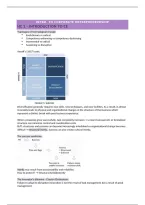
Typologies of technological change:
Evolutionary vs radical.
Competence-enhancing vs competence-destroying
Incremental vs radical
Sustaining vs disruptive
Ansoff's (1657) natri:
Diversification generally requires new skills, new techniques, and new facilities. As a result, it almost
invariably leads to physical and organizational changes in the structure of the business which
represent a distinct break with past business experience.
When companies grow successfully, task complexity increases → a more bureaucratic or formalized
structure can minimize control and coordination costs
BUT: structures and systems can become increasingly interlinked so organizational change becomes
difficult → structural inertia. Success can also create cultural inertia.
The success syndrome:
Inertia may result from accountability and reliability.
How to protect? → Structural Ambidexterity
The innovator's dilemma - Clayton Christensen:
Failure to adapt to disruptive innovation is not the result of bad management but a result of good
management.
,Disruptive technologies typically have
Lower profit margins.
Small markets.
No reliable markets statistics.
Forms of corporate entrepreneurship;
HC 2 - DISRUPTIVE INNOVATION
Stylized model industry evolution;
, Porter's five forces model;
Market power: the ability of a company to set the price of its product profitably above the prevailing
market rates without losing market share.
Market power → barriers to entry, prevent imitation.
RCD - knowledge investments, intellectual property rights.
Minimum efficiency scale; economies of scale, economies of scope.
Capital - sunk capital investments.
Network effect.
Government policies.
Resource partitioning (Carroll, 1685)
Industries with economies of scale.
High and increasing market concentration.
Focus by large established firms on serving the mainstream customers provides
opportunities for specialist startups to fill up niches.
Concentration offers start-up opportunities;
Sustaining innovations: innovations that improve product performance (can be incremental or
radical).
HC 1 - INTRODUCTION TO CE
Typologies of technological change:
Evolutionary vs radical.
Competence-enhancing vs competence-destroying
Incremental vs radical
Sustaining vs disruptive
Ansoff's (1657) natri:
Diversification generally requires new skills, new techniques, and new facilities. As a result, it almost
invariably leads to physical and organizational changes in the structure of the business which
represent a distinct break with past business experience.
When companies grow successfully, task complexity increases → a more bureaucratic or formalized
structure can minimize control and coordination costs
BUT: structures and systems can become increasingly interlinked so organizational change becomes
difficult → structural inertia. Success can also create cultural inertia.
The success syndrome:
Inertia may result from accountability and reliability.
How to protect? → Structural Ambidexterity
The innovator's dilemma - Clayton Christensen:
Failure to adapt to disruptive innovation is not the result of bad management but a result of good
management.
,Disruptive technologies typically have
Lower profit margins.
Small markets.
No reliable markets statistics.
Forms of corporate entrepreneurship;
HC 2 - DISRUPTIVE INNOVATION
Stylized model industry evolution;
, Porter's five forces model;
Market power: the ability of a company to set the price of its product profitably above the prevailing
market rates without losing market share.
Market power → barriers to entry, prevent imitation.
RCD - knowledge investments, intellectual property rights.
Minimum efficiency scale; economies of scale, economies of scope.
Capital - sunk capital investments.
Network effect.
Government policies.
Resource partitioning (Carroll, 1685)
Industries with economies of scale.
High and increasing market concentration.
Focus by large established firms on serving the mainstream customers provides
opportunities for specialist startups to fill up niches.
Concentration offers start-up opportunities;
Sustaining innovations: innovations that improve product performance (can be incremental or
radical).


