
BIOL 1108 Test 1 | UPDATED Questions with 100% Verified
Answers
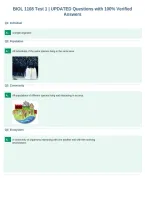
Q1: Individual
A: a single organism
Q2: Population
A: All individuals of the same species living in the same area.
Q3: Community
A: All populations of different species living and interacting in an area.
Q4: Ecosystem
A: A community of organisms interacting with one another and with the nonliving
environment.
, Q5: Factors that make up an ecosystem
A: Biotic factors: Living or onceliving components, such as plants, animals, bacteria, and
dead organic matter.
Abiotic factors: Nonliving components, such as water, light, temperature, soil, air, and
nutrients.
Q6: biotic vs. abiotic
A: If the factor is living or came from something living, it is biotic. If it is nonliving and
physical or chemical, it is abiotic.
Q7: Why Mt. St. Helens (MSH) is an ecosystem
A: MSH contains organisms interacting with each other and with abiotic factors such as ash,
soil, sunlight, water, and temperature.
Q8: MSH before vs. after the eruption
A: Before 1980, MSH was mainly an oldgrowth temperate forest with rich soil. The eruption
destroyed or buried much of the forest, covered the area in ash and tephra, altered the
landscape, and created open habitats that are now undergoing succession.
Q9: Macromolecule
A: A large organic molecule built from smaller molecular subunits.
Q10: Four major macromolcules
A: Carbohydrates, Lipids, Proteins, Nucleic acids
Answers
Q1: Individual
A: a single organism
Q2: Population
A: All individuals of the same species living in the same area.
Q3: Community
A: All populations of different species living and interacting in an area.
Q4: Ecosystem
A: A community of organisms interacting with one another and with the nonliving
environment.
, Q5: Factors that make up an ecosystem
A: Biotic factors: Living or onceliving components, such as plants, animals, bacteria, and
dead organic matter.
Abiotic factors: Nonliving components, such as water, light, temperature, soil, air, and
nutrients.
Q6: biotic vs. abiotic
A: If the factor is living or came from something living, it is biotic. If it is nonliving and
physical or chemical, it is abiotic.
Q7: Why Mt. St. Helens (MSH) is an ecosystem
A: MSH contains organisms interacting with each other and with abiotic factors such as ash,
soil, sunlight, water, and temperature.
Q8: MSH before vs. after the eruption
A: Before 1980, MSH was mainly an oldgrowth temperate forest with rich soil. The eruption
destroyed or buried much of the forest, covered the area in ash and tephra, altered the
landscape, and created open habitats that are now undergoing succession.
Q9: Macromolecule
A: A large organic molecule built from smaller molecular subunits.
Q10: Four major macromolcules
A: Carbohydrates, Lipids, Proteins, Nucleic acids


