
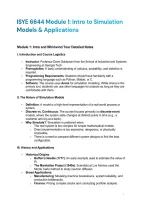
ISYE 6644 Module 1: Intro to Simulation
Models & Applications
Module 1: Intro and Whirlwind Tour Detailed Notes
I. Introduction and Course Logistics
• Instructor: Professor Dave Goldsman from the School of Industrial and Systems
Engineering at Georgia Tech.
• Prerequisites: A basic understanding of calculus, probability, and statistics is
required.
• Programming Requirements: Students should have familiarity with a
programming language such as Python, Matlab, or C.
• Software: The course uses Arena for simulation modeling. While Arena is the
primary tool, students can use other languages for projects as long as they are
comfortable with them.
II. The Nature of Simulation Models
• Definition: A model is a high-level representation of a real-world process or
system.
• Discrete vs. Continuous: The course focuses primarily on discrete-event
models, where the system state changes at distinct points in time (e.g., a
customer arriving at a bank).
• Why Simulate?: Simulation is preferred when:
o The real system is too complex for simple mathematical models.
o Direct experimentation is too expensive, dangerous, or physically
impossible.
o There is a need to compare different system designs to find the best
configuration.
III. History and Applications
• Historical Origins:
o Buffon’s Needle (1777): An early example used to estimate the value of
Pi.
o The Manhattan Project (1940s): Scientists at Los Alamos used the
Monte Carlo method to study neutron diffusion.
• Broad Applications:
o Manufacturing: Modeling machine breakdowns, system reliability, and
production bottlenecks.
o Finance: Pricing complex stocks and conducting portfolio analysis.
)
Models & Applications
Module 1: Intro and Whirlwind Tour Detailed Notes
I. Introduction and Course Logistics
• Instructor: Professor Dave Goldsman from the School of Industrial and Systems
Engineering at Georgia Tech.
• Prerequisites: A basic understanding of calculus, probability, and statistics is
required.
• Programming Requirements: Students should have familiarity with a
programming language such as Python, Matlab, or C.
• Software: The course uses Arena for simulation modeling. While Arena is the
primary tool, students can use other languages for projects as long as they are
comfortable with them.
II. The Nature of Simulation Models
• Definition: A model is a high-level representation of a real-world process or
system.
• Discrete vs. Continuous: The course focuses primarily on discrete-event
models, where the system state changes at distinct points in time (e.g., a
customer arriving at a bank).
• Why Simulate?: Simulation is preferred when:
o The real system is too complex for simple mathematical models.
o Direct experimentation is too expensive, dangerous, or physically
impossible.
o There is a need to compare different system designs to find the best
configuration.
III. History and Applications
• Historical Origins:
o Buffon’s Needle (1777): An early example used to estimate the value of
Pi.
o The Manhattan Project (1940s): Scientists at Los Alamos used the
Monte Carlo method to study neutron diffusion.
• Broad Applications:
o Manufacturing: Modeling machine breakdowns, system reliability, and
production bottlenecks.
o Finance: Pricing complex stocks and conducting portfolio analysis.
)


