D OSAGE CALC • GUIDE
Nursing Dosage Calculation Exam Prep
C O N V E R T F I R S T. R O U N D L A S T.
DOSAGE
Medication Math Review for Nursing Students
DOCTORKEN
Dosage Calculation Exam — Study Guide
C O N V E R S I O N S , O R A L & I N J E C T A B L E D O S E S , W E I G H T- B A S E D D O S I N G & I V R AT E S
EXAM Nursing Dosage Calculation Exam METHOD Formula Method (D ÷ H × Q)
PROGRAM Pre-Licensure Nursing (ADN / BSN) EDITION
DOCUMENT Study Guide — Answers & Rationales TOTAL QUESTIONS 50 Questions
FOCUS Conversions, Oral, Injectable, Weight-Based, FORMAT 50 single-best-answer · 6 content areas ·
IV Flow Rates, Infusions Prepared by DoctorKen
What’s Inside This Dosage Calculation Study Guide.
50 practice questions: 6 topics, from conversions to heparin Full rationales: the formula, each step, and the error behind
and insulin drips. every wrong answer.
Updated for 2026: current medication safety rules for zeros, Bonus Points: key takeaways and exam tips after each section.
units, and rounding.
Problem check: two common reasons questions get missed, Rapid Review: 12 high-yield rules for the night before your
and how to fix them. exam.
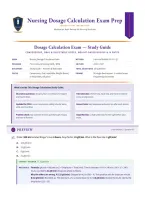
PREVIEW From Section 5 · Question 37
37. Order: 500 mL lactated Ringer’s over 4 hours. Drop factor: 15 gtt/mL. What is the flow rate in gtt/min?
A. 125 gtt/min
B. 32 gtt/min
C. 8 gtt/min
D. 31 gtt/min
CORRECT ANSWER D. 31 gtt/min
RATIONALE Formula: gtt/min = Volume (mL) × Drop factor ÷ Time (min). Time in minutes: 4 × 60 = 240 min. 500 × 15 ÷ 240 =
31.25, rounded to 31 gtt/min (drops are whole numbers).
Why the others are wrong. A (125 gtt/min): Stopped at mL/hr (500 ÷ 4). The question asks for drops per minute.
B (32 gtt/min): Rounded up. The decimal is .25, so round down to 31. C (8 gtt/min): Divided the mL/hr rate by the
drop factor (125 ÷ 15).
,BEFORE YOU BEGIN
You Already Know This.
You already know more of this than you think. You have worked dosage problems in class and in skills lab, and you can
set up D ÷ H × Q.
Dosage exams feel hard because one small slip costs the whole answer: a missed conversion, a flipped fraction, or
rounding at the wrong step. This guide gives you formula-based practice on each problem type. Your program’s rounding
rules come first, so check them before you start.
W H E R E I S YO U R P R E PA R AT I O N B R E A K I N G D O W N ?
Many missed questions come from one of two problems. See which one sounds like you.
PROBLEM 1 PROBLEM 2
“My Numbers End Up in the Wrong Place” “My Setup Was Right, but the Answer Was
W H AT ' S H A P P E N I N G Wrong”
You know the formula, but you flip D and H or start before the units W H AT ' S H A P P E N I N G
match, such as g and mg or lb and kg. You round too early, round to the wrong place, or stop at mL/hr when
WORK ON THIS the question asks for gtt/min.
Convert first. Then write D, H, and Q with their units before you touch WORK ON THIS
the calculator. Circle what the question asks for. Round once, at the end, and label
your answer.
EXAMINATION INSTRUCTIONS
Each question has one best answer. Read the bolded words in each question carefully.
Unless a question says otherwise, round answers greater than 1 to tenths, less than 1 to hundredths, and gtt/min and mL/hr to
whole numbers. For timed practice, cover the green answer and blue rationale boxes.
Check your answers, then read the rationale for every question you missed and every lucky guess.
, CONVERSIONS & ROUNDING SAFETY Questions 1 – 8
1. Order: cefuroxime 0.25 g PO. How many milligrams is this dose?
A. 2,500 mg
B. 2.5 mg
C. 250 mg
D. 25 mg
CORRECT ANSWER C. 250 mg
RATIONALE Formula: Larger unit to smaller unit: multiply. 1 g = 1,000 mg. Moving from a larger unit to a smaller unit, multiply.
0.25 × 1,000 = 250 mg.
Why the others are wrong. A (2,500 mg): Multiplied by 10,000. The decimal moved one place too many. B (2.5
mg): Multiplied by 10. Grams to milligrams always moves the decimal three places. D (25 mg): Multiplied by 100
instead of 1,000.
2. A vial label reads 750 mcg. How many milligrams is this?
A. 750,000 mg
B. 0.75 mg
C. 7.5 mg
D. 0.075 mg
CORRECT ANSWER B. 0.75 mg
RATIONALE Formula: Smaller unit to larger unit: divide. 1 mg = 1,000 mcg. Moving from a smaller unit to a larger unit, divide.
750 ÷ 1,000 = 0.75 mg (leading zero required).
Why the others are wrong. A (750,000 mg): Multiplied instead of divided. A smaller unit to a larger unit gives a
smaller number. C (7.5 mg): Divided by 100 instead of 1,000. D (0.075 mg): Divided by 10,000. The decimal moved
one place too many.
3. A client weighs 172 lb. What is the weight in kilograms? Round to the nearest tenth.
A. 378.4 kg
B. 78.2 kg
C. 86 kg
D. 78.1 kg
CORRECT ANSWER B. 78.2 kg
RATIONALE Formula: lb ÷ 2.2 = kg. 1 kg = 2.2 lb. Pounds to kilograms: divide by 2.2. 172 ÷ 2.2 = 78.18, rounded to 78.2 kg.
Why the others are wrong. A (378.4 kg): Multiplied by 2.2. Weight in kilograms is always a smaller number than
weight in pounds. C (86 kg): Divided by 2. The conversion factor is 2.2, not 2. D (78.1 kg): Dropped the extra digits
instead of rounding. The hundredths digit is 8, so the tenths digit rounds up.