
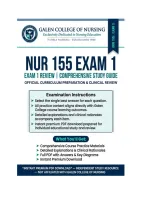
,NUR 155 Exam 1 | Foundations of Nursing (2026/2027)
PDF | Nursing | Galen College
1. Which of the following best describes the primary purpose of the nursing
process?
A) To diagnose and treat medical diseases
B) To provide a systematic framework for delivering individualized patient care
C) To prescribe medications and treatments independently
D) To replace the need for clinical judgment in nursing practice
Correct Answer: To provide a systematic framework for delivering individualized
patient care
Rationale: The nursing process is a systematic, five-step framework
(assessment, diagnosis, planning, implementation, evaluation) that guides
nurses in delivering holistic, patient-centered care. It promotes clinical
reasoning and individualized interventions rather than rigid standardization. It
does not diagnose medical diseases, prescribe treatments independently, or
replace clinical judgment.
2. What is the primary function of the assessment phase in the nursing process?
A) To establish patient goals and expected outcomes
B) To systematically collect and analyze patient data
C) To implement nursing interventions based on evidence
D) To evaluate the effectiveness of nursing care
,Correct Answer: To systematically collect and analyze patient data
Rationale: The assessment phase is the first step of the nursing process,
involving the systematic collection of subjective and objective data through
history taking, physical examination, and diagnostic testing. This data forms the
foundation for identifying patient problems and planning care. Goal setting
occurs during planning, implementation involves carrying out interventions, and
evaluation determines whether outcomes were met.
3. According to the NCSBN Clinical Judgment Measurement Model, which layer
immediately follows "Analyze Cues"?
A) Take Actions
B) Recognize Cues
C) Prioritize Hypotheses
D) Evaluate Outcomes
Correct Answer: Prioritize Hypotheses
Rationale: The NCSBN CJMM consists of six layers: Recognize Cues, Analyze
Cues, Prioritize Hypotheses, Generate Solutions, Take Actions, and Evaluate
Outcomes. After analyzing cues, the nurse prioritizes hypotheses to determine
which patient problems are most urgent. Taking actions and evaluating
outcomes occur later in the model.
, 4. A nurse is caring for a patient who refuses a scheduled blood transfusion for
religious reasons. The nurse respects the patient's decision even though they
disagree. Which ethical principle is being demonstrated?
A) Autonomy
B) Non-maleficence
C) Beneficence
D) Justice
Correct Answer: Autonomy
Rationale: Autonomy refers to the patient's right to make their own decisions
about their healthcare, even if those decisions conflict with the healthcare
provider's beliefs. Non-maleficence is the duty to do no harm, beneficence is
acting in the patient's best interest, and justice is fair and equal treatment for all
patients.
5. During the assessment phase of the nursing process, which of the following is
considered subjective data?
A) Blood pressure reading of 140/90 mmHg
B) Oxygen saturation of 92% on room air
C) The patient's report of a throbbing headache
D) Presence of edema in the lower extremities
Correct Answer: The patient's report of a throbbing headache
PDF | Nursing | Galen College
1. Which of the following best describes the primary purpose of the nursing
process?
A) To diagnose and treat medical diseases
B) To provide a systematic framework for delivering individualized patient care
C) To prescribe medications and treatments independently
D) To replace the need for clinical judgment in nursing practice
Correct Answer: To provide a systematic framework for delivering individualized
patient care
Rationale: The nursing process is a systematic, five-step framework
(assessment, diagnosis, planning, implementation, evaluation) that guides
nurses in delivering holistic, patient-centered care. It promotes clinical
reasoning and individualized interventions rather than rigid standardization. It
does not diagnose medical diseases, prescribe treatments independently, or
replace clinical judgment.
2. What is the primary function of the assessment phase in the nursing process?
A) To establish patient goals and expected outcomes
B) To systematically collect and analyze patient data
C) To implement nursing interventions based on evidence
D) To evaluate the effectiveness of nursing care
,Correct Answer: To systematically collect and analyze patient data
Rationale: The assessment phase is the first step of the nursing process,
involving the systematic collection of subjective and objective data through
history taking, physical examination, and diagnostic testing. This data forms the
foundation for identifying patient problems and planning care. Goal setting
occurs during planning, implementation involves carrying out interventions, and
evaluation determines whether outcomes were met.
3. According to the NCSBN Clinical Judgment Measurement Model, which layer
immediately follows "Analyze Cues"?
A) Take Actions
B) Recognize Cues
C) Prioritize Hypotheses
D) Evaluate Outcomes
Correct Answer: Prioritize Hypotheses
Rationale: The NCSBN CJMM consists of six layers: Recognize Cues, Analyze
Cues, Prioritize Hypotheses, Generate Solutions, Take Actions, and Evaluate
Outcomes. After analyzing cues, the nurse prioritizes hypotheses to determine
which patient problems are most urgent. Taking actions and evaluating
outcomes occur later in the model.
, 4. A nurse is caring for a patient who refuses a scheduled blood transfusion for
religious reasons. The nurse respects the patient's decision even though they
disagree. Which ethical principle is being demonstrated?
A) Autonomy
B) Non-maleficence
C) Beneficence
D) Justice
Correct Answer: Autonomy
Rationale: Autonomy refers to the patient's right to make their own decisions
about their healthcare, even if those decisions conflict with the healthcare
provider's beliefs. Non-maleficence is the duty to do no harm, beneficence is
acting in the patient's best interest, and justice is fair and equal treatment for all
patients.
5. During the assessment phase of the nursing process, which of the following is
considered subjective data?
A) Blood pressure reading of 140/90 mmHg
B) Oxygen saturation of 92% on room air
C) The patient's report of a throbbing headache
D) Presence of edema in the lower extremities
Correct Answer: The patient's report of a throbbing headache


