
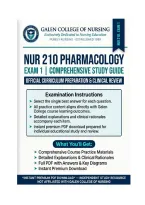
,NUR 210 Exam 1 | Pharmacology (2026/2027) PDF |
Nursing | Galen College
1. Which of the following best describes the primary focus of pharmacokinetics?
A) The study of how drugs produce their therapeutic effects
B) The study of what the body does to a drug, including absorption, distribution,
metabolism, and excretion
C) The study of how drugs interact with receptors to cause responses
D) The study of the harmful effects of drugs on living organisms
Correct Answer: The study of what the body does to a drug, including
absorption, distribution, metabolism, and excretion
Rationale: Pharmacokinetics is the branch of pharmacology that examines the
movement of drugs through the body over time. It encompasses four main
processes: absorption, distribution, metabolism, and excretion.
Pharmacodynamics, by contrast, focuses on what the drug does to the body.
Understanding pharmacokinetics is essential for determining appropriate dosing
regimens and predicting drug behavior.
2. What is the primary function of an agonist drug at a receptor site?
A) To block the endogenous ligand from binding
B) To bind to the receptor and stimulate a biological response
C) To permanently deactivate the receptor
D) To decrease the sensitivity of the receptor to other drugs
,Correct Answer: To bind to the receptor and stimulate a biological response
Rationale: An agonist is a drug that binds to a receptor and activates it,
producing a physiological response similar to that of the body's natural ligand.
Agonists have both affinity for the receptor and intrinsic activity. Antagonists, in
contrast, bind to receptors but do not activate them, instead blocking the
effects of agonists. This distinction is fundamental to understanding drug action.
3. Which process of pharmacokinetics is primarily affected by the first-pass
effect?
A) Metabolism
B) Distribution
C) Absorption
D) Excretion
Correct Answer: Metabolism
Rationale: The first-pass effect occurs when a drug is metabolized in the liver
before it reaches the systemic circulation, significantly reducing its
bioavailability. This primarily affects the metabolism phase of
pharmacokinetics. Drugs administered orally are absorbed into the portal vein
and transported to the liver, where a significant portion may be metabolized.
This reduces bioavailability and may necessitate higher oral doses compared to
parenteral routes.
, 4. When a drug has a narrow therapeutic index, the nurse should expect which
of the following?
A) The drug is very safe and requires little monitoring
B) The drug will have a very long half-life
C) There is a small margin between the effective dose and the toxic dose
D) The drug must be administered intravenously only
Correct Answer: There is a small margin between the effective dose and the
toxic dose
Rationale: A narrow therapeutic index means the difference between a
therapeutic dose and a toxic dose is small, requiring close monitoring of blood
levels. Drugs with a narrow therapeutic index require careful dosing and
therapeutic drug monitoring to prevent toxicity. Examples include digoxin,
lithium, and phenytoin. The other options do not accurately describe a narrow
therapeutic index.
5. Which route of administration provides the highest bioavailability?
A) Oral
B) Intravenous
C) Sublingual
D) Rectal
Correct Answer: Intravenous
Nursing | Galen College
1. Which of the following best describes the primary focus of pharmacokinetics?
A) The study of how drugs produce their therapeutic effects
B) The study of what the body does to a drug, including absorption, distribution,
metabolism, and excretion
C) The study of how drugs interact with receptors to cause responses
D) The study of the harmful effects of drugs on living organisms
Correct Answer: The study of what the body does to a drug, including
absorption, distribution, metabolism, and excretion
Rationale: Pharmacokinetics is the branch of pharmacology that examines the
movement of drugs through the body over time. It encompasses four main
processes: absorption, distribution, metabolism, and excretion.
Pharmacodynamics, by contrast, focuses on what the drug does to the body.
Understanding pharmacokinetics is essential for determining appropriate dosing
regimens and predicting drug behavior.
2. What is the primary function of an agonist drug at a receptor site?
A) To block the endogenous ligand from binding
B) To bind to the receptor and stimulate a biological response
C) To permanently deactivate the receptor
D) To decrease the sensitivity of the receptor to other drugs
,Correct Answer: To bind to the receptor and stimulate a biological response
Rationale: An agonist is a drug that binds to a receptor and activates it,
producing a physiological response similar to that of the body's natural ligand.
Agonists have both affinity for the receptor and intrinsic activity. Antagonists, in
contrast, bind to receptors but do not activate them, instead blocking the
effects of agonists. This distinction is fundamental to understanding drug action.
3. Which process of pharmacokinetics is primarily affected by the first-pass
effect?
A) Metabolism
B) Distribution
C) Absorption
D) Excretion
Correct Answer: Metabolism
Rationale: The first-pass effect occurs when a drug is metabolized in the liver
before it reaches the systemic circulation, significantly reducing its
bioavailability. This primarily affects the metabolism phase of
pharmacokinetics. Drugs administered orally are absorbed into the portal vein
and transported to the liver, where a significant portion may be metabolized.
This reduces bioavailability and may necessitate higher oral doses compared to
parenteral routes.
, 4. When a drug has a narrow therapeutic index, the nurse should expect which
of the following?
A) The drug is very safe and requires little monitoring
B) The drug will have a very long half-life
C) There is a small margin between the effective dose and the toxic dose
D) The drug must be administered intravenously only
Correct Answer: There is a small margin between the effective dose and the
toxic dose
Rationale: A narrow therapeutic index means the difference between a
therapeutic dose and a toxic dose is small, requiring close monitoring of blood
levels. Drugs with a narrow therapeutic index require careful dosing and
therapeutic drug monitoring to prevent toxicity. Examples include digoxin,
lithium, and phenytoin. The other options do not accurately describe a narrow
therapeutic index.
5. Which route of administration provides the highest bioavailability?
A) Oral
B) Intravenous
C) Sublingual
D) Rectal
Correct Answer: Intravenous


