
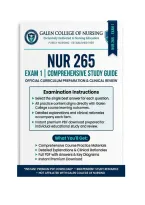
,NUR 265 Exam 1 | Advanced Med-Surg Concepts
(2026/2027) PDF | Nursing | Galen College
1. Which of the following best describes the primary purpose of the nursing
process in medical-surgical nursing?
A) To diagnose and treat medical diseases independently
B) To provide a systematic framework for delivering individualized patient care
C) To prescribe medications and treatments without provider orders
D) To replace the need for clinical judgment in nursing practice
Correct Answer: To provide a systematic framework for delivering individualized
patient care
Rationale: The nursing process is a systematic, five-step framework
(assessment, diagnosis, planning, implementation, evaluation) that guides
nurses in delivering holistic, patient-centered care. It promotes clinical
reasoning and individualized interventions rather than rigid standardization. It
does not diagnose medical diseases, prescribe treatments independently, or
replace clinical judgment.
2. What is the primary function of the assessment phase in the nursing process?
A) To establish patient goals and expected outcomes
B) To systematically collect and analyze patient data
C) To implement nursing interventions based on evidence
D) To evaluate the effectiveness of nursing care
,Correct Answer: To systematically collect and analyze patient data
Rationale: The assessment phase is the first step of the nursing process,
involving the systematic collection of subjective and objective data through
history taking, physical examination, and diagnostic testing. This data forms the
foundation for identifying patient problems and planning care. Goal setting
occurs during planning, implementation involves carrying out interventions, and
evaluation determines whether outcomes were met.
3. According to the NCSBN Clinical Judgment Measurement Model, which layer
immediately follows "Analyze Cues"?
A) Take Actions
B) Recognize Cues
C) Prioritize Hypotheses
D) Evaluate Outcomes
Correct Answer: Prioritize Hypotheses
Rationale: The NCSBN CJMM consists of six layers: Recognize Cues, Analyze
Cues, Prioritize Hypotheses, Generate Solutions, Take Actions, and Evaluate
Outcomes. After analyzing cues, the nurse prioritizes hypotheses to determine
which patient problems are most urgent. Taking actions and evaluating
outcomes occur later in the model.
4. Which statement best describes the evaluation step of the nursing process?
, A) Collecting the initial database only
B) Choosing nursing diagnoses before assessment
C) Determining whether patient outcomes were achieved and revising the plan
as needed
D) Administering medications without reassessment
Correct Answer: Determining whether patient outcomes were achieved and
revising the plan as needed
Rationale: Evaluation compares actual patient responses with expected
outcomes. The care plan is continued, modified, or discontinued based on
results. Collecting the initial database occurs during assessment, choosing
nursing diagnoses occurs during diagnosis, and administering medications
without reassessment is unsafe practice.
5. A nurse enters a room and finds a patient short of breath and diaphoretic.
Which action best reflects priority clinical judgment?
A) Assess airway and breathing immediately before completing routine tasks
B) Finish documenting the previous assessment first
C) Ask dietary services to bring fluids
D) Delay assessment until the next scheduled vital signs
Correct Answer: Assess airway and breathing immediately before completing
routine tasks
(2026/2027) PDF | Nursing | Galen College
1. Which of the following best describes the primary purpose of the nursing
process in medical-surgical nursing?
A) To diagnose and treat medical diseases independently
B) To provide a systematic framework for delivering individualized patient care
C) To prescribe medications and treatments without provider orders
D) To replace the need for clinical judgment in nursing practice
Correct Answer: To provide a systematic framework for delivering individualized
patient care
Rationale: The nursing process is a systematic, five-step framework
(assessment, diagnosis, planning, implementation, evaluation) that guides
nurses in delivering holistic, patient-centered care. It promotes clinical
reasoning and individualized interventions rather than rigid standardization. It
does not diagnose medical diseases, prescribe treatments independently, or
replace clinical judgment.
2. What is the primary function of the assessment phase in the nursing process?
A) To establish patient goals and expected outcomes
B) To systematically collect and analyze patient data
C) To implement nursing interventions based on evidence
D) To evaluate the effectiveness of nursing care
,Correct Answer: To systematically collect and analyze patient data
Rationale: The assessment phase is the first step of the nursing process,
involving the systematic collection of subjective and objective data through
history taking, physical examination, and diagnostic testing. This data forms the
foundation for identifying patient problems and planning care. Goal setting
occurs during planning, implementation involves carrying out interventions, and
evaluation determines whether outcomes were met.
3. According to the NCSBN Clinical Judgment Measurement Model, which layer
immediately follows "Analyze Cues"?
A) Take Actions
B) Recognize Cues
C) Prioritize Hypotheses
D) Evaluate Outcomes
Correct Answer: Prioritize Hypotheses
Rationale: The NCSBN CJMM consists of six layers: Recognize Cues, Analyze
Cues, Prioritize Hypotheses, Generate Solutions, Take Actions, and Evaluate
Outcomes. After analyzing cues, the nurse prioritizes hypotheses to determine
which patient problems are most urgent. Taking actions and evaluating
outcomes occur later in the model.
4. Which statement best describes the evaluation step of the nursing process?
, A) Collecting the initial database only
B) Choosing nursing diagnoses before assessment
C) Determining whether patient outcomes were achieved and revising the plan
as needed
D) Administering medications without reassessment
Correct Answer: Determining whether patient outcomes were achieved and
revising the plan as needed
Rationale: Evaluation compares actual patient responses with expected
outcomes. The care plan is continued, modified, or discontinued based on
results. Collecting the initial database occurs during assessment, choosing
nursing diagnoses occurs during diagnosis, and administering medications
without reassessment is unsafe practice.
5. A nurse enters a room and finds a patient short of breath and diaphoretic.
Which action best reflects priority clinical judgment?
A) Assess airway and breathing immediately before completing routine tasks
B) Finish documenting the previous assessment first
C) Ask dietary services to bring fluids
D) Delay assessment until the next scheduled vital signs
Correct Answer: Assess airway and breathing immediately before completing
routine tasks


