
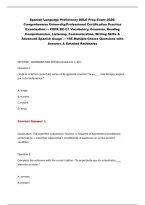
Spanish Language Proficiency DELE Prep Exam 2026:
Comprehensive University/Professional Certification Practice
Examination — CEFR B2–C1 Vocabulary, Grammar, Reading
Comprehension, Listening, Communication, Writing Skills &
Advanced Spanish Usage — 195 Multiple-Choice Questions with
Answers & Detailed Rationales
SECTION I: GRAMMAR AND SYNTAX (Questions 1–40)
Question 1
¿Cuál es la forma correct del verbo en la siguiente oración? "Si yo ___ más tiempo, viajaría
por toda Sudamérica."
A. tengo
B. tuviera
C. tendré
D. tenía
Correct Answer: B
Explanation: The imperfect subjunctive "tuviera" is required in hypothetical conditional
sentences (si + imperfect subjunctive + conditional). It expresses an unreal present
condition.
Question 2
Complete the sentence with the correct option: "Es importante que los estudiantes ___
atención en clase."
A. prestan
B. presten
,C. prestarán
D. prestaban
Correct Answer: B
Explanation: "Es importante que" triggers the subjunctive mood. The present subjunctive
"presten" expresses subjective necessity or value judgment.
Question 3
Which sentence correctly uses the passive voice in Spanish?
A. La carta fue escrita por Juan.
B. La carta escribió por Juan.
C. La carta es escribida por Juan.
D. La carta se escribió Juan.
Correct Answer: A
Explanation: Spanish passive voice uses "ser" + past participle + "por." "Fue escrita" is the
correct passive construction in preterite tense.
Question 4
Select the correct relative pronoun: "El libro ___ me recomendaste es fascinante."
A. quien
B. que
C. cuyo
D. cual
,Correct Answer: B
Explanation: "Que" is the most common relative pronoun for things. It introduces a
restrictive clause referring to "el libro."
Question 5
Choose the correct form: "Cuando llegamos, ellos ya ___."
A. se fueron
B. se habían ido
C. se van
D. se irán
Correct Answer: B
Explanation: The pluperfect "se habían ido" indicates an action completed before another
past action. It expresses anteriority in the past.
Question 6
Which option correctly completes the sentence? "No creo que él ___ la verdad."
A. dice
B. diga
C. dirá
D. decía
Correct Answer: B
, Explanation: "No creo que" negates belief and requires the subjunctive. "Diga" is the present
subjunctive of "decir."
Question 7
Identify the correct use of "por" vs. "para": "Este regalo es ___ ti."
A. por
B. para
C. de
D. en
Correct Answer: B
Explanation: "Para" indicates destination or recipient. "Este regalo es para ti" means the gift
is intended for you.
Question 8
What is the correct superlative form? "Es la película ___ interesante que he visto."
A. más
B. muy
C. tan
D. mucho
Correct Answer: A
Explanation: Superlative in Spanish uses "el/la más + adjective + de/que." "La más
interesante" is the correct superlative construction.
Comprehensive University/Professional Certification Practice
Examination — CEFR B2–C1 Vocabulary, Grammar, Reading
Comprehension, Listening, Communication, Writing Skills &
Advanced Spanish Usage — 195 Multiple-Choice Questions with
Answers & Detailed Rationales
SECTION I: GRAMMAR AND SYNTAX (Questions 1–40)
Question 1
¿Cuál es la forma correct del verbo en la siguiente oración? "Si yo ___ más tiempo, viajaría
por toda Sudamérica."
A. tengo
B. tuviera
C. tendré
D. tenía
Correct Answer: B
Explanation: The imperfect subjunctive "tuviera" is required in hypothetical conditional
sentences (si + imperfect subjunctive + conditional). It expresses an unreal present
condition.
Question 2
Complete the sentence with the correct option: "Es importante que los estudiantes ___
atención en clase."
A. prestan
B. presten
,C. prestarán
D. prestaban
Correct Answer: B
Explanation: "Es importante que" triggers the subjunctive mood. The present subjunctive
"presten" expresses subjective necessity or value judgment.
Question 3
Which sentence correctly uses the passive voice in Spanish?
A. La carta fue escrita por Juan.
B. La carta escribió por Juan.
C. La carta es escribida por Juan.
D. La carta se escribió Juan.
Correct Answer: A
Explanation: Spanish passive voice uses "ser" + past participle + "por." "Fue escrita" is the
correct passive construction in preterite tense.
Question 4
Select the correct relative pronoun: "El libro ___ me recomendaste es fascinante."
A. quien
B. que
C. cuyo
D. cual
,Correct Answer: B
Explanation: "Que" is the most common relative pronoun for things. It introduces a
restrictive clause referring to "el libro."
Question 5
Choose the correct form: "Cuando llegamos, ellos ya ___."
A. se fueron
B. se habían ido
C. se van
D. se irán
Correct Answer: B
Explanation: The pluperfect "se habían ido" indicates an action completed before another
past action. It expresses anteriority in the past.
Question 6
Which option correctly completes the sentence? "No creo que él ___ la verdad."
A. dice
B. diga
C. dirá
D. decía
Correct Answer: B
, Explanation: "No creo que" negates belief and requires the subjunctive. "Diga" is the present
subjunctive of "decir."
Question 7
Identify the correct use of "por" vs. "para": "Este regalo es ___ ti."
A. por
B. para
C. de
D. en
Correct Answer: B
Explanation: "Para" indicates destination or recipient. "Este regalo es para ti" means the gift
is intended for you.
Question 8
What is the correct superlative form? "Es la película ___ interesante que he visto."
A. más
B. muy
C. tan
D. mucho
Correct Answer: A
Explanation: Superlative in Spanish uses "el/la más + adjective + de/que." "La más
interesante" is the correct superlative construction.


