
Why litter is surging as lockdowns ease
Recent visitors have left mounds of rubbish at public spaces and beauty
spots across the UK and beyond. What’s driving this behaviour?
“We fear a littering epidemic as lockdown eases”, warns the environmental charity Keep
Britain Tidy. And indeed, Brits have embraced the opportunity to throng beaches and beauty
spots in recent days. Images of the mounds of rubbish left in their wake have made headlines,
sparked outrage and resulted in pleas by local government officials for visitors to stay away.
Research suggests that littering can be challenging to eradicate in the best of times – and these
clearly aren’t the best of times. So what is it about current circumstances that’s driving this
surge, and is there anything we can do to contain the problem?
The Covid-19 effect
In general, people justify littering by saying that bins are overflowing or too far away – although
others believe the root cause is laziness or ignorance. In places where governments can’t afford
to pay for rubbish collection, like informal settlements in Maputo, Mozambique, literal walls of
rubbish can result.
Like every other aspect of our everyday lives, rubbish and recycling collection has been
disrupted in some places by the Covid-19 pandemic. This context is crucial because waste
disposal depends on “social proof”, or the copying of others’ behaviour. “If you see a place
that’s full of litter and a mess, you’re more likely to think that it doesn’t matter,” says coaching
psychologist Stephen Palmer of the International Academy for Professional Development and
University of Wales Trinity Saint David. “If you actually see someone dropping litter, you’re
probably more likely to drop litter yourself.”
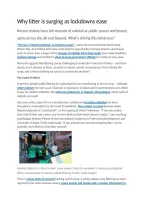
Rubbish collectors in Paris in April. Some experts think the pandemic's intense psychological
effects cause people to care less about littering (Credit: Getty Images)
There’s a large body of research backing up this point. It partly explains why littering has been
reported to be more common among young people and people with a weaker attachment to
, their communities. For these people, feeling part of a small group is especially important, and
one way to express that is through defiance of broader norms. And it’s especially awkward to
hold onto an empty can for the recycling bin if mates have already thrown theirs to the ground.
The pandemic may also be having a psychological effect. It’s natural that caring for the
environment isn’t top of mind right now, says Palmer. “Certainly, when people are stressed or
distressed, they go into more all-or-nothing thinking.” This can be useful for dealing with high-
risk situations, but the upshot is that “the last thing on your mind is things like litter”. And the
people who are the quickest to head for the beach may not be the most cautious of people
overall.
More picnics, more disposable goods
Lockdown rules have also transformed the way people socialise, which affects the rubbish they
produce. Chris Coode is the deputy chief executive of Thames21, a charity that works with
volunteers to maintain healthy waterways in London, for instance through litter clean-ups and
monitoring. Instead of meeting friends in pubs, restaurants and homes, Coode points out that
now “you’re getting people using the parks and open spaces in ways that they hadn’t before…
and in a sense haven’t got the rhythm of the way that new socialising is like”. He believes that
people aren’t necessarily being wilful or malicious when they discard pizza boxes and plastic
cups in public, but are “using these spaces in ways they haven’t before, and not thinking
through the repercussions of their behaviour”.
It’s not only when or where people are littering that has shifted, but also what they’re littering.
Gloves and masks are being chucked on the streets in Canada and in Wales, raising concerns
that this could be an infection hazard in addition to being an environmental hazard.
Shadi Moqbel has also seen more PPE waste in Jordan. Moqbel, a civil engineer at the
University of Jordan who researches waste, explains that some of the patterns we’re seeing
with the Covid-19 pandemic aren’t new. “As a result of the pandemic, people tend to move
towards using disposable items rather than regular reusable items. They don’t want to get sick
from using or touching something that might be used by others… We have seen it in previous
outbreaks”, such as H1N1 (swine flu). Then as well as now, people used more disposable plates
and packaging material. And the closure of restaurants during the Covid-19 pandemic has led to
a rise in food delivery and takeaway meals – which has meant more plastic packaging refuse.
SOURCE: https://www.bbc.com/worklife/article/20200610-why-are-parks-full-of-litter-as-
lockdown-eases
Recent visitors have left mounds of rubbish at public spaces and beauty
spots across the UK and beyond. What’s driving this behaviour?
“We fear a littering epidemic as lockdown eases”, warns the environmental charity Keep
Britain Tidy. And indeed, Brits have embraced the opportunity to throng beaches and beauty
spots in recent days. Images of the mounds of rubbish left in their wake have made headlines,
sparked outrage and resulted in pleas by local government officials for visitors to stay away.
Research suggests that littering can be challenging to eradicate in the best of times – and these
clearly aren’t the best of times. So what is it about current circumstances that’s driving this
surge, and is there anything we can do to contain the problem?
The Covid-19 effect
In general, people justify littering by saying that bins are overflowing or too far away – although
others believe the root cause is laziness or ignorance. In places where governments can’t afford
to pay for rubbish collection, like informal settlements in Maputo, Mozambique, literal walls of
rubbish can result.
Like every other aspect of our everyday lives, rubbish and recycling collection has been
disrupted in some places by the Covid-19 pandemic. This context is crucial because waste
disposal depends on “social proof”, or the copying of others’ behaviour. “If you see a place
that’s full of litter and a mess, you’re more likely to think that it doesn’t matter,” says coaching
psychologist Stephen Palmer of the International Academy for Professional Development and
University of Wales Trinity Saint David. “If you actually see someone dropping litter, you’re
probably more likely to drop litter yourself.”
Rubbish collectors in Paris in April. Some experts think the pandemic's intense psychological
effects cause people to care less about littering (Credit: Getty Images)
There’s a large body of research backing up this point. It partly explains why littering has been
reported to be more common among young people and people with a weaker attachment to
, their communities. For these people, feeling part of a small group is especially important, and
one way to express that is through defiance of broader norms. And it’s especially awkward to
hold onto an empty can for the recycling bin if mates have already thrown theirs to the ground.
The pandemic may also be having a psychological effect. It’s natural that caring for the
environment isn’t top of mind right now, says Palmer. “Certainly, when people are stressed or
distressed, they go into more all-or-nothing thinking.” This can be useful for dealing with high-
risk situations, but the upshot is that “the last thing on your mind is things like litter”. And the
people who are the quickest to head for the beach may not be the most cautious of people
overall.
More picnics, more disposable goods
Lockdown rules have also transformed the way people socialise, which affects the rubbish they
produce. Chris Coode is the deputy chief executive of Thames21, a charity that works with
volunteers to maintain healthy waterways in London, for instance through litter clean-ups and
monitoring. Instead of meeting friends in pubs, restaurants and homes, Coode points out that
now “you’re getting people using the parks and open spaces in ways that they hadn’t before…
and in a sense haven’t got the rhythm of the way that new socialising is like”. He believes that
people aren’t necessarily being wilful or malicious when they discard pizza boxes and plastic
cups in public, but are “using these spaces in ways they haven’t before, and not thinking
through the repercussions of their behaviour”.
It’s not only when or where people are littering that has shifted, but also what they’re littering.
Gloves and masks are being chucked on the streets in Canada and in Wales, raising concerns
that this could be an infection hazard in addition to being an environmental hazard.
Shadi Moqbel has also seen more PPE waste in Jordan. Moqbel, a civil engineer at the
University of Jordan who researches waste, explains that some of the patterns we’re seeing
with the Covid-19 pandemic aren’t new. “As a result of the pandemic, people tend to move
towards using disposable items rather than regular reusable items. They don’t want to get sick
from using or touching something that might be used by others… We have seen it in previous
outbreaks”, such as H1N1 (swine flu). Then as well as now, people used more disposable plates
and packaging material. And the closure of restaurants during the Covid-19 pandemic has led to
a rise in food delivery and takeaway meals – which has meant more plastic packaging refuse.
SOURCE: https://www.bbc.com/worklife/article/20200610-why-are-parks-full-of-litter-as-
lockdown-eases


