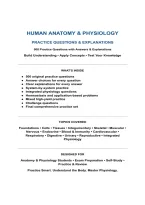
HUMAN ANATOMY & PHYSIOLOGY
PRACTICE QUESTIONS & EXPLANATIONS
500 Practice Questions with Answers & Explanations
Build Understanding • Apply Concepts • Test Your Knowledge
WHAT'S INSIDE
● 500 original practice questions
● Answer choices for every question
● Clear explanations for every answer
● System-by-system practice
● Integrated physiology questions
● Homeostasis and application-based problems
● Mixed high-yield practice
● Challenge questions
● Final comprehensive practice set
TOPICS COVERED
Foundations • Cells • Tissues • Integumentary • Skeletal • Muscular •
Nervous • Endocrine • Blood & Immunity • Cardiovascular •
Respiratory • Digestive • Urinary • Reproductive • Integrated
Physiology
DESIGNED FOR
Anatomy & Physiology Students • Exam Preparation • Self-Study •
Practice & Review
Practice Smart. Understand the Body. Master Physiology.
, HUMAN ANATOMY & PHYSIOLOGY
PRACTICE QUESTIONS & EXPLANATIONS
Section 1 — Foundations & Anatomical
Concepts
Practice Question 1 — Anatomical Position
A clinician documents that a patient's thumb is lateral to the little finger when the patient is
standing in anatomical position. Which statement best explains this observation?
A. The thumb is closer to the body's midline.
B. The thumb is farther from the body's midline.
C. The thumb is closer to the head.
D. The thumb is closer to the body's posterior surface.
Correct Answer: B. The thumb is farther from the body's midline.
Explanation:
Lateral means farther away from the body's midline. In anatomical position, the palms face
forward, placing the thumb on the lateral side of the hand.
Practice Question 2 — Directional Relationships
The heart is located medial to the lungs. Which interpretation is correct?
A. The heart is closer to the body's midline than the lungs.
B. The heart is farther from the body's midline than the lungs.
C. The heart is closer to the skin than the lungs.
D. The heart is below the lungs.
Correct Answer: A. The heart is closer to the body's midline than the lungs.
Explanation:
Medial means toward the body's midline. The two lungs lie on either side of the heart, making
the heart medial to them.
Practice Question 3 — Proximal vs Distal
A fracture occurs in the forearm near the elbow. Compared with the wrist, the fracture is located:
A. Distal to the wrist
B. Proximal to the wrist
C. Lateral to the wrist
D. Inferior to the wrist
Correct Answer: B. Proximal to the wrist
Explanation:
Proximal means closer to the point of attachment of a limb to the trunk. The elbow is closer to
the shoulder than the wrist is, so a location near the elbow is proximal to the wrist.
, Practice Question 4 — Body Planes
A medical image divides the body into anterior and posterior portions. Which plane was most
likely used?
A. Transverse plane
B. Sagittal plane
C. Frontal plane
D. Oblique plane
Correct Answer: C. Frontal plane
Explanation:
A frontal, or coronal, plane divides the body into anterior and posterior portions.
Practice Question 5 — Transverse Section
A CT image shows a cross-section dividing the body into superior and inferior portions.
Which anatomical plane produced this view?
A. Frontal
B. Sagittal
C. Transverse
D. Midsagittal
Correct Answer: C. Transverse
Explanation:
The transverse plane divides the body horizontally into superior and inferior portions.
Practice Question 6 — Body Cavities
A physician identifies an organ located within the thoracic cavity but outside the pleural
cavities. Which location is most appropriate?
A. Mediastinum
B. Cranial cavity
C. Abdominal cavity
D. Vertebral cavity
Correct Answer: A. Mediastinum
Explanation:
The mediastinum is the central region of the thoracic cavity between the lungs. It contains the
heart, major blood vessels, trachea, esophagus, and other structures.
Practice Question 7 — Serous Cavities
Which cavity directly surrounds each lung?
A. Pericardial cavity
B. Pleural cavity
, C. Peritoneal cavity
D. Cranial cavity
Correct Answer: B. Pleural cavity
Explanation:
Each lung is enclosed by a pleural cavity. The pericardial cavity surrounds the heart, while the
peritoneal cavity is associated with many abdominal organs.
Practice Question 8 — Anatomical Organization
A group of similar cells works together to perform a specialized function. What level of
organization does this describe?
A. Organ
B. Tissue
C. Organ system
D. Organism
Correct Answer: B. Tissue
Explanation:
A tissue is a group of similar cells that work together to perform a particular function. Multiple
tissues combine to form an organ.
Practice Question 9 — Organ vs Organ System
The stomach contains several tissue types working together to perform digestion. The stomach
is therefore classified as a:
A. Cell
B. Tissue
C. Organ
D. Organ system
Correct Answer: C. Organ
Explanation:
An organ consists of two or more tissue types working together to perform specific functions.
The stomach is an organ of the digestive system.
Practice Question 10 — Homeostatic Control
A person's body temperature rises after exercising. Sensors detect the increase, and the
nervous system activates mechanisms that promote heat loss. What component of a
homeostatic system first detects the change?
A. Effector
B. Receptor
C. Control center
D. Response
Correct Answer: B. Receptor
PRACTICE QUESTIONS & EXPLANATIONS
500 Practice Questions with Answers & Explanations
Build Understanding • Apply Concepts • Test Your Knowledge
WHAT'S INSIDE
● 500 original practice questions
● Answer choices for every question
● Clear explanations for every answer
● System-by-system practice
● Integrated physiology questions
● Homeostasis and application-based problems
● Mixed high-yield practice
● Challenge questions
● Final comprehensive practice set
TOPICS COVERED
Foundations • Cells • Tissues • Integumentary • Skeletal • Muscular •
Nervous • Endocrine • Blood & Immunity • Cardiovascular •
Respiratory • Digestive • Urinary • Reproductive • Integrated
Physiology
DESIGNED FOR
Anatomy & Physiology Students • Exam Preparation • Self-Study •
Practice & Review
Practice Smart. Understand the Body. Master Physiology.
, HUMAN ANATOMY & PHYSIOLOGY
PRACTICE QUESTIONS & EXPLANATIONS
Section 1 — Foundations & Anatomical
Concepts
Practice Question 1 — Anatomical Position
A clinician documents that a patient's thumb is lateral to the little finger when the patient is
standing in anatomical position. Which statement best explains this observation?
A. The thumb is closer to the body's midline.
B. The thumb is farther from the body's midline.
C. The thumb is closer to the head.
D. The thumb is closer to the body's posterior surface.
Correct Answer: B. The thumb is farther from the body's midline.
Explanation:
Lateral means farther away from the body's midline. In anatomical position, the palms face
forward, placing the thumb on the lateral side of the hand.
Practice Question 2 — Directional Relationships
The heart is located medial to the lungs. Which interpretation is correct?
A. The heart is closer to the body's midline than the lungs.
B. The heart is farther from the body's midline than the lungs.
C. The heart is closer to the skin than the lungs.
D. The heart is below the lungs.
Correct Answer: A. The heart is closer to the body's midline than the lungs.
Explanation:
Medial means toward the body's midline. The two lungs lie on either side of the heart, making
the heart medial to them.
Practice Question 3 — Proximal vs Distal
A fracture occurs in the forearm near the elbow. Compared with the wrist, the fracture is located:
A. Distal to the wrist
B. Proximal to the wrist
C. Lateral to the wrist
D. Inferior to the wrist
Correct Answer: B. Proximal to the wrist
Explanation:
Proximal means closer to the point of attachment of a limb to the trunk. The elbow is closer to
the shoulder than the wrist is, so a location near the elbow is proximal to the wrist.
, Practice Question 4 — Body Planes
A medical image divides the body into anterior and posterior portions. Which plane was most
likely used?
A. Transverse plane
B. Sagittal plane
C. Frontal plane
D. Oblique plane
Correct Answer: C. Frontal plane
Explanation:
A frontal, or coronal, plane divides the body into anterior and posterior portions.
Practice Question 5 — Transverse Section
A CT image shows a cross-section dividing the body into superior and inferior portions.
Which anatomical plane produced this view?
A. Frontal
B. Sagittal
C. Transverse
D. Midsagittal
Correct Answer: C. Transverse
Explanation:
The transverse plane divides the body horizontally into superior and inferior portions.
Practice Question 6 — Body Cavities
A physician identifies an organ located within the thoracic cavity but outside the pleural
cavities. Which location is most appropriate?
A. Mediastinum
B. Cranial cavity
C. Abdominal cavity
D. Vertebral cavity
Correct Answer: A. Mediastinum
Explanation:
The mediastinum is the central region of the thoracic cavity between the lungs. It contains the
heart, major blood vessels, trachea, esophagus, and other structures.
Practice Question 7 — Serous Cavities
Which cavity directly surrounds each lung?
A. Pericardial cavity
B. Pleural cavity
, C. Peritoneal cavity
D. Cranial cavity
Correct Answer: B. Pleural cavity
Explanation:
Each lung is enclosed by a pleural cavity. The pericardial cavity surrounds the heart, while the
peritoneal cavity is associated with many abdominal organs.
Practice Question 8 — Anatomical Organization
A group of similar cells works together to perform a specialized function. What level of
organization does this describe?
A. Organ
B. Tissue
C. Organ system
D. Organism
Correct Answer: B. Tissue
Explanation:
A tissue is a group of similar cells that work together to perform a particular function. Multiple
tissues combine to form an organ.
Practice Question 9 — Organ vs Organ System
The stomach contains several tissue types working together to perform digestion. The stomach
is therefore classified as a:
A. Cell
B. Tissue
C. Organ
D. Organ system
Correct Answer: C. Organ
Explanation:
An organ consists of two or more tissue types working together to perform specific functions.
The stomach is an organ of the digestive system.
Practice Question 10 — Homeostatic Control
A person's body temperature rises after exercising. Sensors detect the increase, and the
nervous system activates mechanisms that promote heat loss. What component of a
homeostatic system first detects the change?
A. Effector
B. Receptor
C. Control center
D. Response
Correct Answer: B. Receptor