
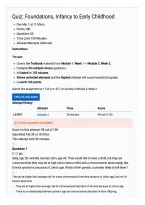
Quiz: Foundations, Infancy to Early Childhood
Due Mar 1 at 11:59pm
Points 100
Questions 50
Time Limit 150 Minutes
Allowed Attempts Unlimited
Instructions
The quiz:
Covers the Textbook material from Module 1: Week 1 — Module 2: Week 2.
Contains 50 multiple-choice questions.
Is limited to 150 minutes.
Allows unlimited attempts and the highest attempt will count towards the grade.
Is worth 100 points.
Submit this assignment by 11:59 p.m. (ET) on Sunday of Module 2: Week 2.
TAKE THE QUIZ AGAIN
Attempt History
Attempt Time Score
LATEST Attempt 1 36 minutes 98 out of 100
Correct answers are hidden.
Score for this attempt: 98 out of 100
Submitted Feb 28 at 10:57am
This attempt took 36 minutes.
Question 1
pts
Sally, age 28, recently married John, age 45. They would like to have a child, but they are
concerned that they may be at high risk to have a child with a chromosomal abnormality, like
Down’s syndrome, because of John’s age. What is their genetic counselor likely to tell them?
They are at higher than average risk for some chromosomal disorders because of John’s age, but not for
Down’s syndrome.
They are at higher than average risk for chromosomal disorders of all sorts because of John’s age.
There is no relationship between parents’ age and chromosomal disorders in their offspring.
, The risk of any chromosomal disorder in a child is only related to the mother’s age, not to the father’s age.
Question 2
pts
Which of the following statements is FALSE regarding chronic stress during pregnancy and its
impact on the fetus?
Stress during pregnancy, has no lasting effects on the fetus.
There is a dose-response relationship between prenatal stress and maladaptive outcomes.
Maternal stress at 16 weeks were more strongly related to later problems than those experiences at 34
weeks.
Maternal stress causes long term psychopathology.
Question 3
pts
Which statement regarding the understanding of objects, in infancy is FALSE?
Object permanence underlies a baby’s ability to form an attachment to a specific adult, like a parent or other
caregiver
Infants younger than 8 months old, typically fail to search for objects that go out of sight.
The development of one sensory system does not influence the development of other systems.
A child must have a mental representation of the object in order to keep it in mind, when it is not present.
Question 4
pts
According to Vygotsky, language is one product of shared understanding among members of a
social group and may be considered a ____________ that facilitates learning and thinking.
Scaffold
Tool or sign
Culture
Developmental line
Question 5
pts
Counselors must recognize the principle of ___________: Individual pathways of development
may result in a wide range of possible outcomes.
equifinality
hierarchical integration dysfunctionality
Due Mar 1 at 11:59pm
Points 100
Questions 50
Time Limit 150 Minutes
Allowed Attempts Unlimited
Instructions
The quiz:
Covers the Textbook material from Module 1: Week 1 — Module 2: Week 2.
Contains 50 multiple-choice questions.
Is limited to 150 minutes.
Allows unlimited attempts and the highest attempt will count towards the grade.
Is worth 100 points.
Submit this assignment by 11:59 p.m. (ET) on Sunday of Module 2: Week 2.
TAKE THE QUIZ AGAIN
Attempt History
Attempt Time Score
LATEST Attempt 1 36 minutes 98 out of 100
Correct answers are hidden.
Score for this attempt: 98 out of 100
Submitted Feb 28 at 10:57am
This attempt took 36 minutes.
Question 1
pts
Sally, age 28, recently married John, age 45. They would like to have a child, but they are
concerned that they may be at high risk to have a child with a chromosomal abnormality, like
Down’s syndrome, because of John’s age. What is their genetic counselor likely to tell them?
They are at higher than average risk for some chromosomal disorders because of John’s age, but not for
Down’s syndrome.
They are at higher than average risk for chromosomal disorders of all sorts because of John’s age.
There is no relationship between parents’ age and chromosomal disorders in their offspring.
, The risk of any chromosomal disorder in a child is only related to the mother’s age, not to the father’s age.
Question 2
pts
Which of the following statements is FALSE regarding chronic stress during pregnancy and its
impact on the fetus?
Stress during pregnancy, has no lasting effects on the fetus.
There is a dose-response relationship between prenatal stress and maladaptive outcomes.
Maternal stress at 16 weeks were more strongly related to later problems than those experiences at 34
weeks.
Maternal stress causes long term psychopathology.
Question 3
pts
Which statement regarding the understanding of objects, in infancy is FALSE?
Object permanence underlies a baby’s ability to form an attachment to a specific adult, like a parent or other
caregiver
Infants younger than 8 months old, typically fail to search for objects that go out of sight.
The development of one sensory system does not influence the development of other systems.
A child must have a mental representation of the object in order to keep it in mind, when it is not present.
Question 4
pts
According to Vygotsky, language is one product of shared understanding among members of a
social group and may be considered a ____________ that facilitates learning and thinking.
Scaffold
Tool or sign
Culture
Developmental line
Question 5
pts
Counselors must recognize the principle of ___________: Individual pathways of development
may result in a wide range of possible outcomes.
equifinality
hierarchical integration dysfunctionality


