
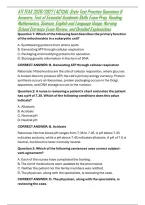
ATI TEAS 2026/2027 | ACTUAL-Style Test Practice Questions &
Answers, Test of Essential Academic Skills Exam Prep, Reading,
Mathematics, Science, English and Language Usage, Nursing
School Entrance Exam Review, and Detailed Explanations
Question 1: Which of the following best describes the primary function
of the mitochondria in a eukaryotic cell?
A. Synthesizing proteins from amino acids
B. Generating ATP through cellular respiration
C. Packaging and modifying proteins for secretion
D. Storing genetic information in the form of DNA
CORRECT ANSWER: B. Generating ATP through cellular respiration
Rationale: Mitochondria are the site of cellular respiration, where glucose
is broken down to produce ATP, the cell's primary energy currency. Protein
synthesis occurs at ribosomes, protein packaging occurs in the Golgi
apparatus, and DNA storage occurs in the nucleus.
Question 2: A nurse is reviewing a patient's chart and notes the patient
has a pH of 7.30. Which of the following conditions does this value
indicate?
A. Alkalosis
B. Acidosis
C. Normal pH
D. Neutral pH
CORRECT ANSWER: B. Acidosis
Rationale: Normal blood pH ranges from 7.35 to 7.45. A pH below 7.35
indicates acidosis, while a pH above 7.45 indicates alkalosis. A pH of 7.0 is
neutral, but blood is never normally neutral.
Question 3: Which of the following sentences uses correct subject-
verb agreement?
A. Each of the nurses have completed the training.
B. The list of medications were updated by the pharmacist.
C. Neither the patient nor the family members was notified.
D. The physician, along with the specialists, is reviewing the case.
CORRECT ANSWER: D. The physician, along with the specialists, is
reviewing the case.
,Rationale: The subject is "physician" (singular). Phrases beginning with
"along with," "as well as," and "in addition to" do not change the number of
the subject. Options A and B use plural verbs with singular subjects. Option
C uses "nor," which follows the nearest subject rule: "family members" is
plural, requiring "were."
Question 4: A patient is prescribed 0.5 grams of a medication. The
pharmacy dispenses tablets labeled 250 mg each. How many tablets
should the patient take per dose?
A. 1 tablet
B. 2 tablets
C. 3 tablets
D. 4 tablets
CORRECT ANSWER: B. 2 tablets
Rationale: Convert grams to milligrams: 0.5 g = 500 mg. Each tablet
contains 250 mg. 500 mg ÷ 250 mg per tablet = 2 tablets. This ensures the
patient receives the correct prescribed dose.
Question 5: Which of the following best describes the term "inference"
in the context of reading comprehension?
A. A statement directly stated by the author
B. A conclusion drawn from evidence and reasoning
C. A summary of the main idea of a passage
D. A personal opinion unrelated to the text
CORRECT ANSWER: B. A conclusion drawn from evidence and
reasoning
Rationale: An inference is a logical conclusion derived from evidence in the
text combined with the reader's background knowledge. It is not explicitly
stated, unlike a fact. A summary describes the main idea, and opinions are
subjective and not necessarily grounded in the text.
Question 6: A solution has a hydrogen ion concentration of 1 × 10⁻⁴ M.
What is the pH of this solution?
A. 2
B. 4
,C. 6
D. 10
CORRECT ANSWER: B. 4
Rationale: The pH is calculated as the negative logarithm of the hydrogen
ion concentration: pH = -log[H⁺] = -log(1 × 10⁻⁴) = 4. This indicates the
solution is acidic.
Question 7: Which of the following is the correct order of the stages of
mitosis?
A. Prophase, Metaphase, Anaphase, Telophase
B. Metaphase, Prophase, Anaphase, Telophase
C. Anaphase, Telophase, Prophase, Metaphase
D. Telophase, Anaphase, Metaphase, Prophase
CORRECT ANSWER: A. Prophase, Metaphase, Anaphase, Telophase
Rationale: Mitosis proceeds in a fixed sequence: prophase (chromosomes
condense), metaphase (chromosomes align), anaphase (sister chromatids
separate), and telophase (nuclear envelopes reform). This order ensures
accurate distribution of genetic material to daughter cells.
Question 8: A nurse needs to administer 1,000 mL of IV fluid over 8
hours. What is the flow rate in mL per hour?
A. 100 mL/hr
B. 125 mL/hr
C. 150 mL/hr
D. 200 mL/hr
CORRECT ANSWER: B. 125 mL/hr
Rationale: Flow rate = total volume ÷ total time. 1,000 mL ÷ 8 hours = 125
mL/hr. This calculation ensures the patient receives the prescribed volume
at a consistent rate.
Question 9: Which of the following sentences contains a misplaced
modifier?
A. The nurse gave the medication to the patient in the blue gown.
B. Running down the hallway, the stretcher was pushed by the orderly.
, C. The doctor examined the patient with a stethoscope.
D. After reviewing the chart, the physician ordered more tests.
CORRECT ANSWER: B. Running down the hallway, the stretcher was
pushed by the orderly.
Rationale: The introductory phrase "Running down the hallway" should
modify the person doing the running (the orderly), not the stretcher. In this
sentence, the modifier is misplaced, creating a dangling construction.
Option A correctly places the modifier near the patient.
Question 10: Which of the following is the primary function of the
respiratory system?
A. Transporting oxygen to body tissues
B. Exchanging gases between the body and the environment
C. Regulating blood pressure
D. Producing red blood cells
CORRECT ANSWER: B. Exchanging gases between the body and the
environment
Rationale: The respiratory system's primary role is gas exchange: oxygen
enters the blood and carbon dioxide is expelled. Transport of oxygen is a
function of the cardiovascular system. Blood pressure regulation involves
the cardiovascular and renal systems, and red blood cell production
occurs in bone marrow.
Question 11: A patient's temperature reads 38.9°C. What is this
temperature in Fahrenheit?
A. 100.0°F
B. 101.0°F
C. 102.0°F
D. 103.0°F
CORRECT ANSWER: C. 102.0°F
Rationale: The conversion formula is °F = (°C × 9/5) + 32. (38.9 × 1.8) + 32 =
70.02 + 32 = 102.02°F, rounded to 102.0°F. This indicates the patient has a
fever.
Question 12: Which of the following best describes the term "tone" in a
written passage?


