
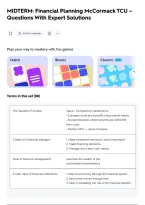
MIDTERM: Financial Planning McCormack TCU –
Questions With Expert Solutions
Add to calendar
Play your way to mastery with fun games
Match Blocks Charms NEW
Terms in this set (88)
The Valuation Principle Value = Competitive market price.
• Compare costs and benefits using market values
• Accept decisions where benefits are GREATER
than costs
• Positive NPV → value increases
3 tasks of a financial manager: 1. Make investment decisions. (most important)
2. Make financing decisions.
3. Manage short-term cash needs.
Goal of financial management: maximize the wealth of the
stockholders/shareholders
3 main roles of financial institutions: 1. help move money through the financial system
2. help move money through time
3. help in spreading out risk in the financial markets.
,Financial cycle 1. people invest and save their money
2. that money, through loans and stock, flows to
companies that use it to fund growth through new
products, generating profits and wages
3. the money then flows back to the savers and
investors
Balance Sheet Assets = Liabilities + Stockholders' Equity
Net Working Capital Net Working Capital = Current Assets - Current
Liabilities
Enterprise Value Enterprise Value = Equity + Debt - Cash
Income Statement A list of a firm's revenues and expenses over a
period of time
Net Income The last or "bottom" line of a firm's income
statement
Earnings per share (EPS) EPS = Net Income / Shares Outstanding
EBIT A firm's earnings before interest and taxes are
deducted
EBITDA EBIT + Depreciation + Amortization
, Statement of cash flows shows how a firm has used the cash it earned during
a set period
includes:
Operating activities
Investment activities
Financing activities
How do investors use accounting Either:
statements to evaluate a firm? 1. Compare the firm with itself by analyzing how the
firm has changed over time.
2. Compare the firm to other similar firms using a
common set of financial ratios.
Profitability Ratios: Gross margin the ratio of gross profit to revenues (sales)
gross margin = gross profit / sales
Profitability Ratios: Operating Margin the ratio of operating income to revenues
Operating Margin = Operating Income / Sales
Profitability Ratios: Net Profit Margin The ratio of net income to revenues
Net Profit Margin = Net Income / Sales
Liquidity Ratios: Current Ratio the ratio of current assets to current liabilities
Current Ratio = Current Assets / Current Liabilities
Liquidity Ratios: Quick Ratio compares only cash and "near cash" assets to
current liabilities
Quick Ratio = (Current Assets - Inventory) / Current
Liabilities
Liquidity Ratios: Cash Ratio The ratio of cash to current liabilities
Cash Ratio = Cash / Current Liabilities
Asset Efficiency: Asset turnover the ratio of sales to total assets
Asset Turnover = Sales / Total Assets
Asset Efficiency: Fixed asset turnover Fixed Asset Turnover = Sales / Fixed Assets
Questions With Expert Solutions
Add to calendar
Play your way to mastery with fun games
Match Blocks Charms NEW
Terms in this set (88)
The Valuation Principle Value = Competitive market price.
• Compare costs and benefits using market values
• Accept decisions where benefits are GREATER
than costs
• Positive NPV → value increases
3 tasks of a financial manager: 1. Make investment decisions. (most important)
2. Make financing decisions.
3. Manage short-term cash needs.
Goal of financial management: maximize the wealth of the
stockholders/shareholders
3 main roles of financial institutions: 1. help move money through the financial system
2. help move money through time
3. help in spreading out risk in the financial markets.
,Financial cycle 1. people invest and save their money
2. that money, through loans and stock, flows to
companies that use it to fund growth through new
products, generating profits and wages
3. the money then flows back to the savers and
investors
Balance Sheet Assets = Liabilities + Stockholders' Equity
Net Working Capital Net Working Capital = Current Assets - Current
Liabilities
Enterprise Value Enterprise Value = Equity + Debt - Cash
Income Statement A list of a firm's revenues and expenses over a
period of time
Net Income The last or "bottom" line of a firm's income
statement
Earnings per share (EPS) EPS = Net Income / Shares Outstanding
EBIT A firm's earnings before interest and taxes are
deducted
EBITDA EBIT + Depreciation + Amortization
, Statement of cash flows shows how a firm has used the cash it earned during
a set period
includes:
Operating activities
Investment activities
Financing activities
How do investors use accounting Either:
statements to evaluate a firm? 1. Compare the firm with itself by analyzing how the
firm has changed over time.
2. Compare the firm to other similar firms using a
common set of financial ratios.
Profitability Ratios: Gross margin the ratio of gross profit to revenues (sales)
gross margin = gross profit / sales
Profitability Ratios: Operating Margin the ratio of operating income to revenues
Operating Margin = Operating Income / Sales
Profitability Ratios: Net Profit Margin The ratio of net income to revenues
Net Profit Margin = Net Income / Sales
Liquidity Ratios: Current Ratio the ratio of current assets to current liabilities
Current Ratio = Current Assets / Current Liabilities
Liquidity Ratios: Quick Ratio compares only cash and "near cash" assets to
current liabilities
Quick Ratio = (Current Assets - Inventory) / Current
Liabilities
Liquidity Ratios: Cash Ratio The ratio of cash to current liabilities
Cash Ratio = Cash / Current Liabilities
Asset Efficiency: Asset turnover the ratio of sales to total assets
Asset Turnover = Sales / Total Assets
Asset Efficiency: Fixed asset turnover Fixed Asset Turnover = Sales / Fixed Assets


