
BMC Fixed Income Certification Exam — Complete Questions & Answers
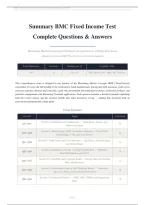
Summary BMC Fixed Income Test
Complete Questions & Answers
Bloomberg Market Concepts Certification | Comprehensive 100-Question Exam
Aligned with current BMC Fixed Income certification standards
Total Questions Sections Options per Q Cognitive Mix
100 8 4 (A–D) 30% Recall / 50% App / 20% Analysis
This comprehensive exam is designed to test mastery of the Bloomberg Market Concepts (BMC) Fixed Income
curriculum. It covers the full breadth of the certification: bond fundamentals, pricing and yield measures, yield curves
and term structure, duration and convexity, credit risk, government and municipal securities, securitized products, and
portfolio management with Bloomberg Terminal applications. Each question includes a detailed rationale explaining
both the correct answer and the common pitfalls that make distractors wrong — making this document both an
assessment instrument and a study guide.
Exam Structure
Section Topic Questions
Section 1: Fixed Income Fundamentals — Bond Basics, Issuers, and
Q1–Q14 14
Market Structure
Section 2: Bond Pricing, Yield, and Return Measures — Price/Yield
Q15–Q30 16
Relationship, YTM, and Total Return
Section 3: Yield Curves and Term Structure — Spot Rates, Forward Rates,
Q31–Q44 14
and Curve Shapes
Section 4: Duration, Convexity, and Interest Rate Risk — Macaulay,
Q45–Q60 16
Modified Duration, and DV01
Section 5: Credit Risk and Corporate Bonds — Ratings, Spreads, Default
Q61–Q72 12
Risk, and Recovery
Section 6: Government, Agency, and Municipal Bonds — Treasuries,
Q73–Q82 10
Agencies, Munis, and Tax-Equivalent Yield
Section 7: Securitized Products — MBS, ABS, CMBS, and Prepayment
Q83–Q92 10
Risk
Page 1
,BMC Fixed Income Certification Exam — Complete Questions & Answers
Section 8: Fixed Income Portfolio Management and Bloomberg Terminal
Q93–Q100 8
Applications — Strategies, Immunization, and BMC Functions
Section 1: Fixed Income Fundamentals
Bond Basics, Issuers, and Market Structure
Q1: A bond indenture is best described as:
A. A guarantee from a third-party bank that the issuer will not default
B. A legal contract between the bond issuer and bondholders detailing covenants, payment terms, and security
[CORRECT]
C. The date on which the bond's principal is repaid to investors
D. The unsecured promise of the issuer to pay coupon interest on schedule
Correct Answer: B. A legal contract between the bond issuer and bondholders detailing covenants, payment
terms, and security
Rationale: An indenture (also called a deed of trust) is the legally binding contract that specifies all terms of a bond issue:
coupon rate, maturity, redemption provisions, covenants ( affirmative and negative ), collateral, and default remedies.
Option A confuses indentures with bank guarantees; option C confuses indenture with maturity date; option D confuses
indenture with the debenture itself.
Q2: Which of the following best describes the par value (face value) of a bond?
A. The market price at which the bond currently trades
B. The present value of all future coupon payments discounted at YTM
C. The principal amount the issuer promises to repay at maturity and on which coupon is computed
[CORRECT]
D. The dirty price less the accrued interest
Correct Answer: C. The principal amount the issuer promises to repay at maturity and on which coupon is
computed
Rationale: Par value is the stated principal amount (commonly $1,000 for corporates, $10,000 for agencies, $100 for
Treasuries) used both for coupon computation (Coupon Rate x Par = annual coupon dollar amount) and for repayment at
maturity. Option A is market price; option B is the fair value/PV; option D describes the clean price.
Q3: A 5-year, 6% annual coupon corporate bond is issued at par. One year later, market yields rise to 8%.
The bond will most likely trade at:
A. Par, because coupon rate is fixed
B. A premium, because the fixed coupon becomes more valuable
C. A discount, because the fixed 6% coupon is below the new 8% market yield [CORRECT]
D. A premium equal to the YTM times duration
Correct Answer: C. A discount, because the fixed 6% coupon is below the new 8% market yield
Rationale: Bond prices and market yields move inversely. When market yields rise above the coupon rate, the bond's
fixed coupon stream is less attractive than newly issued bonds, so the price falls below par (discount) so that its YTM rises
to 8%. The price change is approximated by -Modified Duration x Δy, not by YTM times duration.
Q4: Which issuer type is NOT backed by the full faith and credit of a sovereign government?
A. U.S. Treasury bonds
Page 2
, BMC Fixed Income Certification Exam — Complete Questions & Answers
B. German Bunds
C. U.S. agency securities issued by Fannie Mae [CORRECT]
D. Japanese Government Bonds (JGBs)
Correct Answer: C. U.S. agency securities issued by Fannie Mae
Rationale: U.S. agency securities (e.g., Fannie Mae, Freddie Mac) are NOT backed by the full faith and credit of the
U.S. government - they carry only an implicit (now explicit conservatorship) guarantee. Treasuries, Bunds, and JGBs are
all direct sovereign obligations backed by full faith and credit.
Q5: A supranational bond issuer is best exemplified by:
A. The State of California
B. The World Bank (International Bank for Reconstruction and Development) [CORRECT]
C. Toyota Motor Credit Corporation
D. The Federal Home Loan Bank System
Correct Answer: B. The World Bank (International Bank for Reconstruction and Development)
Rationale: Supranational issuers are multinational organizations backed by multiple sovereign governments, such as the
World Bank, European Investment Bank (EIB), and Asian Development Bank. The other choices represent a U.S. state
(municipal), a corporate (private issuer), and a U.S. agency - not supranationals.
Q6: In the primary market for bonds, the syndicate of investment banks that purchases the entire issue
from the issuer and resells to investors is performing which role?
A. Best-efforts underwriting
B. Firm-commitment underwriting [CORRECT]
C. Secondary market making
D. Private placement brokering
Correct Answer: B. Firm-commitment underwriting
Rationale: In a firm-commitment underwriting, the syndicate purchases the entire issue at a discount from the issuer and
assumes full inventory (price) risk. In best-efforts (option A), the banker only sells what it can with no inventory risk.
Options C and D describe different market functions entirely.
Q7: Most corporate bonds in the United States trade:
A. On an organized exchange such as the NYSE bond market
B. Over-the-counter (OTC) through dealer networks [CORRECT]
C. Exclusively through the Federal Reserve's book-entry system
D. Only through retail brokers at par value
Correct Answer: B. Over-the-counter (OTC) through dealer networks
Rationale: The vast majority of corporate, municipal, and agency bonds trade OTC via dealer-to-dealer and
dealer-to-customer networks. Only a small fraction of listed corporate bonds trade on the NYSE Bonds platform.
Treasuries trade OTC as well, but settle via Fed book-entry; corporates settle via DTCC.
Q8: For most U.S. corporate and Treasury securities, the standard settlement cycle is currently:
A. Same-day (cash) settlement
B. T+1 (one business day after trade)
C. T+2 (two business days after trade) [CORRECT]
D. T+5 (five business days after trade)
Correct Answer: C. T+2 (two business days after trade)
Page 3
Summary BMC Fixed Income Test
Complete Questions & Answers
Bloomberg Market Concepts Certification | Comprehensive 100-Question Exam
Aligned with current BMC Fixed Income certification standards
Total Questions Sections Options per Q Cognitive Mix
100 8 4 (A–D) 30% Recall / 50% App / 20% Analysis
This comprehensive exam is designed to test mastery of the Bloomberg Market Concepts (BMC) Fixed Income
curriculum. It covers the full breadth of the certification: bond fundamentals, pricing and yield measures, yield curves
and term structure, duration and convexity, credit risk, government and municipal securities, securitized products, and
portfolio management with Bloomberg Terminal applications. Each question includes a detailed rationale explaining
both the correct answer and the common pitfalls that make distractors wrong — making this document both an
assessment instrument and a study guide.
Exam Structure
Section Topic Questions
Section 1: Fixed Income Fundamentals — Bond Basics, Issuers, and
Q1–Q14 14
Market Structure
Section 2: Bond Pricing, Yield, and Return Measures — Price/Yield
Q15–Q30 16
Relationship, YTM, and Total Return
Section 3: Yield Curves and Term Structure — Spot Rates, Forward Rates,
Q31–Q44 14
and Curve Shapes
Section 4: Duration, Convexity, and Interest Rate Risk — Macaulay,
Q45–Q60 16
Modified Duration, and DV01
Section 5: Credit Risk and Corporate Bonds — Ratings, Spreads, Default
Q61–Q72 12
Risk, and Recovery
Section 6: Government, Agency, and Municipal Bonds — Treasuries,
Q73–Q82 10
Agencies, Munis, and Tax-Equivalent Yield
Section 7: Securitized Products — MBS, ABS, CMBS, and Prepayment
Q83–Q92 10
Risk
Page 1
,BMC Fixed Income Certification Exam — Complete Questions & Answers
Section 8: Fixed Income Portfolio Management and Bloomberg Terminal
Q93–Q100 8
Applications — Strategies, Immunization, and BMC Functions
Section 1: Fixed Income Fundamentals
Bond Basics, Issuers, and Market Structure
Q1: A bond indenture is best described as:
A. A guarantee from a third-party bank that the issuer will not default
B. A legal contract between the bond issuer and bondholders detailing covenants, payment terms, and security
[CORRECT]
C. The date on which the bond's principal is repaid to investors
D. The unsecured promise of the issuer to pay coupon interest on schedule
Correct Answer: B. A legal contract between the bond issuer and bondholders detailing covenants, payment
terms, and security
Rationale: An indenture (also called a deed of trust) is the legally binding contract that specifies all terms of a bond issue:
coupon rate, maturity, redemption provisions, covenants ( affirmative and negative ), collateral, and default remedies.
Option A confuses indentures with bank guarantees; option C confuses indenture with maturity date; option D confuses
indenture with the debenture itself.
Q2: Which of the following best describes the par value (face value) of a bond?
A. The market price at which the bond currently trades
B. The present value of all future coupon payments discounted at YTM
C. The principal amount the issuer promises to repay at maturity and on which coupon is computed
[CORRECT]
D. The dirty price less the accrued interest
Correct Answer: C. The principal amount the issuer promises to repay at maturity and on which coupon is
computed
Rationale: Par value is the stated principal amount (commonly $1,000 for corporates, $10,000 for agencies, $100 for
Treasuries) used both for coupon computation (Coupon Rate x Par = annual coupon dollar amount) and for repayment at
maturity. Option A is market price; option B is the fair value/PV; option D describes the clean price.
Q3: A 5-year, 6% annual coupon corporate bond is issued at par. One year later, market yields rise to 8%.
The bond will most likely trade at:
A. Par, because coupon rate is fixed
B. A premium, because the fixed coupon becomes more valuable
C. A discount, because the fixed 6% coupon is below the new 8% market yield [CORRECT]
D. A premium equal to the YTM times duration
Correct Answer: C. A discount, because the fixed 6% coupon is below the new 8% market yield
Rationale: Bond prices and market yields move inversely. When market yields rise above the coupon rate, the bond's
fixed coupon stream is less attractive than newly issued bonds, so the price falls below par (discount) so that its YTM rises
to 8%. The price change is approximated by -Modified Duration x Δy, not by YTM times duration.
Q4: Which issuer type is NOT backed by the full faith and credit of a sovereign government?
A. U.S. Treasury bonds
Page 2
, BMC Fixed Income Certification Exam — Complete Questions & Answers
B. German Bunds
C. U.S. agency securities issued by Fannie Mae [CORRECT]
D. Japanese Government Bonds (JGBs)
Correct Answer: C. U.S. agency securities issued by Fannie Mae
Rationale: U.S. agency securities (e.g., Fannie Mae, Freddie Mac) are NOT backed by the full faith and credit of the
U.S. government - they carry only an implicit (now explicit conservatorship) guarantee. Treasuries, Bunds, and JGBs are
all direct sovereign obligations backed by full faith and credit.
Q5: A supranational bond issuer is best exemplified by:
A. The State of California
B. The World Bank (International Bank for Reconstruction and Development) [CORRECT]
C. Toyota Motor Credit Corporation
D. The Federal Home Loan Bank System
Correct Answer: B. The World Bank (International Bank for Reconstruction and Development)
Rationale: Supranational issuers are multinational organizations backed by multiple sovereign governments, such as the
World Bank, European Investment Bank (EIB), and Asian Development Bank. The other choices represent a U.S. state
(municipal), a corporate (private issuer), and a U.S. agency - not supranationals.
Q6: In the primary market for bonds, the syndicate of investment banks that purchases the entire issue
from the issuer and resells to investors is performing which role?
A. Best-efforts underwriting
B. Firm-commitment underwriting [CORRECT]
C. Secondary market making
D. Private placement brokering
Correct Answer: B. Firm-commitment underwriting
Rationale: In a firm-commitment underwriting, the syndicate purchases the entire issue at a discount from the issuer and
assumes full inventory (price) risk. In best-efforts (option A), the banker only sells what it can with no inventory risk.
Options C and D describe different market functions entirely.
Q7: Most corporate bonds in the United States trade:
A. On an organized exchange such as the NYSE bond market
B. Over-the-counter (OTC) through dealer networks [CORRECT]
C. Exclusively through the Federal Reserve's book-entry system
D. Only through retail brokers at par value
Correct Answer: B. Over-the-counter (OTC) through dealer networks
Rationale: The vast majority of corporate, municipal, and agency bonds trade OTC via dealer-to-dealer and
dealer-to-customer networks. Only a small fraction of listed corporate bonds trade on the NYSE Bonds platform.
Treasuries trade OTC as well, but settle via Fed book-entry; corporates settle via DTCC.
Q8: For most U.S. corporate and Treasury securities, the standard settlement cycle is currently:
A. Same-day (cash) settlement
B. T+1 (one business day after trade)
C. T+2 (two business days after trade) [CORRECT]
D. T+5 (five business days after trade)
Correct Answer: C. T+2 (two business days after trade)
Page 3


