
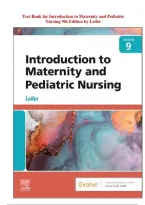
Test Bank for Introduction to Maternity and Pediatric Nursing 9th Edition by Leifer – Product Description and Tags
Comprehensive Maternity and Pediatric Nursing Study Resource The Test Bank for Introduction to Maternity and Pediatric Nursing, 9th Edition by Leifer is a study-resource listing intended for nursing students who want to strengthen their understanding of maternal health, pregnancy, childbirth, newborn care, and pediatric nursing. Maternity and pediatric nursing are essential areas of nursing education because they focus on the health and well-being of mothers, infants, children, and families throughout important stages of development. Students studying these subjects must understand normal physiological processes, recognize common health concerns, apply nursing assessment principles, and identify appropriate interventions for patients with different care needs. Reviewing these topics through structured study activities can help learners connect classroom concepts with practical nursing situations. This resource is intended to complement textbook reading, lecture notes, classroom assignments, laboratory activities, and instructor-provided practice questions. Students should verify the contents, edition compatibility, question count, and availability of answer explanations before purchasing. Maternity Nursing and Reproductive Health Maternity nursing focuses on caring for women before, during, and after pregnancy. Nurses must understand the physiological changes associated with pregnancy, recognize potential complications, promote maternal health, and support families as they prepare for childbirth and parenthood. Relevant study areas may include reproductive anatomy and physiology, conception, fetal development, prenatal assessment, maternal nutrition, pregnancy discomforts, and routine prenatal care. Students can also review the importance of collecting accurate health histories, identifying maternal risk factors, providing patient education, and recognizing warning signs that require prompt evaluation. Important concepts for maternity nursing study include: Reproductive health and conception Normal changes during pregnancy Prenatal assessment and maternal health education Fetal growth and development Nutrition and lifestyle considerations during pregnancy Common pregnancy discomforts Recognition of selected pregnancy complications Maternal emotional health and family support Preparation for childbirth and parenthood Understanding these concepts helps students develop a foundation for safe, respectful, and evidence-based maternity nursing care. Labor, Delivery, and Intrapartum Nursing Labor and delivery require nurses to assess maternal and fetal well-being, observe changes in labor progression, communicate relevant findings, and support the patient throughout childbirth. Students should review the stages of labor, common maternal assessment findings, fetal monitoring fundamentals, pain-management approaches, and nursing responsibilities during the intrapartum period. Study topics may include the recognition of labor, assessment of contractions, maternal vital signs, fetal heart rate monitoring, comfort measures, and communication with the healthcare team. Learning activities involving clinical scenarios can help students consider how maternal history, labor progression, fetal status, and other findings influence nursing priorities. The goal is to build sound clinical reasoning and reinforce the importance of timely assessment, accurate documentation, teamwork, and patient-centered care. Postpartum Care and Maternal Recovery Postpartum nursing focuses on the mother's physical recovery, emotional adjustment, and transition to caring for a newborn. Nurses assess maternal condition, provide education, support feeding decisions, and help families recognize warning signs after delivery. Relevant topics include postpartum assessment, uterine involution, lochia, perineal care, breastfeeding support, pain management, maternal nutrition, and emotional well-being. Students should also understand the importance of recognizing possible postpartum complications and escalating concerning findings according to clinical protocols. Family education is another important component of postpartum care. Nurses help parents understand recovery expectations, newborn care basics, follow-up appointments, and circumstances that require medical attention. Reviewing these concepts can help learners appreciate the connection between maternal assessment, preventive education, family support, and continuity of care. Newborn Nursing and Neonatal Assessment Newborn nursing involves assessing the infant's transition to life outside the uterus and supporting healthy development during the early neonatal period. Students should become familiar with newborn vital signs, physical assessment, thermoregulation, feeding, elimination, skin care, and routine preventive care. They should also understand the importance of observing for abnormalities and communicating concerns promptly. Potential study areas include: Initial newborn assessment Normal newborn characteristics Temperature regulation Feeding and nutritional needs Breastfeeding education and support Newborn hygiene and cord care Safe sleep education Recognition of selected neonatal warning signs Parent-infant bonding Discharge preparation and caregiver education Understanding normal newborn findings provides a foundation for recognizing changes that may require additional evaluation. Pediatric Nursing and Growth and Development Pediatric nursing addresses the changing physical, cognitive, emotional, and social needs of infants, children, and adolescents. Nursing care must be adapted to the child's developmental stage, communication abilities, family environment, and health status. Growth and development are central to pediatric assessment. Students should review developmental milestones, age-appropriate communication, nutrition, injury prevention, immunization principles, and health promotion. Other useful study topics include: Infant, toddler, preschool, school-age, and adolescent development Pediatric vital signs and physical assessment Age-appropriate communication techniques Pediatric nutrition and hydration Medication safety in children Pain assessment in pediatric patients Common childhood illnesses Infection prevention and control Family-centered nursing care Health promotion and anticipatory guidance These concepts help learners understand how nursing interventions differ according to age, developmental level, and individual patient needs. Pediatric Illness and Nursing Interventions Children may present with symptoms that require careful assessment and prompt recognition of potential complications. Nursing students must learn to gather relevant information, assess hydration and respiratory status, identify concerning changes, and communicate findings appropriately. Pediatric study may include respiratory disorders, gastrointestinal conditions, fever, dehydration, infectious illnesses, and selected chronic health conditions. Students should also understand medication administration principles, weight-based dosing calculations, safety checks, and the importance of following current prescribing instructions and institutional protocols. Practice scenarios can encourage students to identify relevant assessment findings, establish nursing priorities, evaluate responses to interventions, and determine when additional clinical evaluation is needed. These learning activities should reinforce safe nursing practice rather than replace supervised clinical education or professional judgment. Nursing Process and Clinical Judgment A strong understanding of the nursing process is important throughout maternity and pediatric care. Students should be able to collect assessment data, identify patient needs, establish appropriate goals, select nursing interventions, and evaluate outcomes. Clinical scenarios can be used to practice prioritization, patient safety, therapeutic communication, documentation, and collaboration with the healthcare team. When reviewing a practice question, learners should consider the patient's age, developmental stage, clinical presentation, relevant history, and potential risks. They should also examine why one nursing action may be more appropriate than another in a particular situation. A structured approach to practice helps students move beyond memorization and develop the analytical skills needed for clinical coursework and nursing examinations. Effective Study Strategies for Nursing Students Students can use a maternity and pediatric study resource as part of a structured revision plan. Begin by reviewing one topic at a time, then use practice questions to identify areas of strength and weakness. Consider the following study methods: Read the corresponding textbook chapter and summarize its key concepts. Review important definitions, assessment findings, and nursing interventions. Complete practice questions independently when available. Explain the reasoning behind each answer. Revisit incorrect responses and consult reliable nursing references. Create short review notes for challenging concepts. Repeat practice activities to evaluate progress. Use instructor feedback and current clinical guidance to clarify uncertainties. Students should confirm that any purchased question resource corresponds to the correct textbook edition and contains the materials advertised in the product listing. Who Can Benefit From This Study Resource? This listing may be relevant to: Nursing students studying maternity and pediatric nursing Students reviewing maternal-newborn nursing concepts Learners preparing for nursing course examinations Students strengthening pediatric assessment knowledge Nursing learners reviewing growth and development Students seeking supplementary practice for clinical coursework Learners organizing their maternity and pediatric revision schedule The resource is best used alongside assigned textbooks, instructor guidance, clinical learning activities, and reputable educational references. Product Benefits A well-organized maternity and pediatric nursing study resource can help students review essential concepts, reinforce terminology, recognize knowledge gaps, and prepare for classroom assessments. Potential learning benefits include: Structured review of maternal and child health concepts Reinforcement of pregnancy and childbirth knowledge Review of postpartum and newborn nursing care Improved understanding of pediatric growth and development Practice with assessment and clinical reasoning principles Greater familiarity with common nursing priorities Support for independent revision and group study Better organization of nursing examination preparation The actual question format, chapter coverage, explanations, and downloadable materials depend on the product supplied. Buyers should confirm these details before purchase. Important Product Disclaimer This listing describes an independent educational study resource and should not be presented as an official publisher product unless authorization has been established. It should not be advertised as containing guaranteed examination answers, leaked questions, or official examination content without reliable evidence. No study guide can guarantee a passing score or a particular examination result. Students should use current clinical guidelines, instructor-approved materials, and authoritative nursing references to verify clinical information. Conclusion The Test Bank for Introduction to Maternity and Pediatric Nursing, 9th Edition by Leifer listing is designed for learners seeking supplementary support while studying maternal, newborn, and pediatric nursing concepts. A consistent approach combining textbook review, practice activities, clinical reasoning, and targeted revision can help students strengthen their knowledge and prepare more effectively for nursing coursework. Whether reviewing prenatal care, labor and delivery, postpartum recovery, newborn assessment, or pediatric development, learners should focus on understanding the rationale behind nursing interventions and applying knowledge safely to individual patient situations. Use this study resource as a supplement to comprehensive nursing education, verify the supplied materials before purchase, and continue building the clinical judgment needed to provide safe, compassionate, family-centered care.
Document information
- Uploaded on
- October 9, 2026
- Number of pages
- 334
- Written in
- 2026/2027
- Type
- Exam (elaborations)
- Contains
- Questions & answers


