
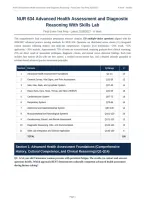
NUR 634 Advanced Health Assessment and Diagnostic Reasoning - Final Exam Test Prep 2026/2027 A Work - Verified
NUR 634 Advanced Health Assessment and Diagnostic
Reasoning With Skills Lab
Final Exam Test Prep - Latest 2026/2027 - A Work
This comprehensive final examination preparation resource contains 150 multiple-choice questions aligned with the
2026/2027 advanced practice nursing standards for NUR 634. Questions are distributed across eleven (11) integrated
content domains reflecting didactic and skills-lab competencies. Cognitive level distribution: ~25% recall, ~55%
application, ~20% analysis. Approximately 75% of items are scenario-based, requiring graduate-level clinical reasoning;
25% are direct recall of assessment techniques, diagnostic criteria, and normal versus abnormal findings. Each item
includes four options (A-D) with one best answer, a verified correct-answer key, and a detailed rationale grounded in
evidence-based advanced practice assessment principles.
Section Domain Q Range #
1 Advanced Health Assessment Foundations Q1-14 14
2 General Survey, Vital Signs, and Pain Assessment Q15-26 12
3 Skin, Hair, Nails, and Lymphatic System Q27-40 14
4 Head, Eyes, Ears, Nose, Throat, and Neck (HEENT) Q41-56 16
5 Cardiovascular System Q57-72 16
6 Respiratory System Q73-86 14
7 Abdominal and Gastrointestinal System Q87-100 14
8 Musculoskeletal and Neurological Systems Q101-120 20
9 Genitourinary, Breast, and Rectal Assessment Q121-132 12
10 Diagnostic Reasoning, DDx, and Documentation Q133-144 12
11 Skills Lab Integration and Clinical Application Q145-150 6
TOTAL 150
Section 1: Advanced Health Assessment Foundations (Comprehensive
History, Cultural Competence, and Clinical Reasoning) (Q1-Q14)
Q1: A 54-year-old Vietnamese woman presents with persistent fatigue. She avoids eye contact and answers
questions briefly. Which approach BEST demonstrates culturally competent advanced health assessment
during history-taking?
Page 1
,NUR 634 Advanced Health Assessment and Diagnostic Reasoning - Final Exam Test Prep 2026/2027 A Work - Verified
A. Insist on direct eye contact to establish rapport and ensure accurate history.
B. Use the LEARN model (Listen, Explain, Acknowledge, Recommend, Negotiate) to integrate her health
beliefs into the assessment. [CORRECT]
C. Immediately involve a family member to translate without first assessing the patient's own English proficiency and
preference.
D. Document her brief responses as a sign of depression and proceed directly to the physical examination.
Correct Answer: B
Rationale: The LEARN model is an evidence-based framework for culturally competent care that actively integrates the
patient's explanatory model. Avoiding eye contact may reflect cultural respect rather than pathology, so pathologizing it is
incorrect. Family interpreters should be used only after assessing language preference and confidentiality concerns, and
skipping the history violates the comprehensive assessment standard.
Q2: When obtaining the History of Present Illness (HPI), the advanced practice nurse should use the
OLDCARTS mnemonic. Which element of OLDCARTS is MOST critical for narrowing a differential
diagnosis of acute chest pain?
A. Onset, because sudden onset is characteristic of aortic dissection versus gradual onset of stable angina.
[CORRECT]
B. Treatment, because prior self-treatment predicts future adherence.
C. Severity on a 0-10 scale, because it is the only quantifiable element.
D. Timing, because it has no overlap with other elements.
Correct Answer: A
Rationale: Onset (sudden vs. gradual) is a key discriminator in chest pain differential diagnosis - sudden, tearing pain
suggests aortic dissection, while gradual, exertional pain suggests angina. Treatment history does not narrow the differential
diagnostically, severity alone is subjective, and timing overlaps substantially with onset and duration.
Q3: A 67-year-old man with type 2 diabetes presents for a comprehensive visit. Which component MUST be
included in the Past Medical History (PMH) at a graduate-level advanced practice standard?
A. Childhood immunizations only, since adult immunizations are documented separately.
B. Current medications, allergies (with reaction type), chronic illnesses, hospitalizations, surgeries, and
immunization status. [CORRECT]
C. Family history of diabetes only, given his current diagnosis.
D. A complete review of systems to identify any unrelated complaints.
Correct Answer: B
Rationale: PMH at the advanced practice level includes chronic illnesses, hospitalizations, surgeries, immunizations,
medications, and allergies with reaction type (not just the allergen). Documenting only childhood immunizations is
incomplete, family history is a separate section, and review of systems is its own distinct component of the comprehensive
history.
Q4: A patient reports allergies to penicillin (rash) and sulfa (anaphylaxis). Which documentation is MOST
appropriate and safe?
Page 2
,NUR 634 Advanced Health Assessment and Diagnostic Reasoning - Final Exam Test Prep 2026/2027 A Work - Verified
A. "Allergic to penicillin and sulfa."
B. "PCN - rash; Sulfa - anaphylaxis." with an anaphylaxis alert prominently flagged in the chart. [CORRECT]
C. "Penicillin allergy" in the PMH only; sulfa documented in the medication reconciliation.
D. Defer documentation until allergy testing confirms the reaction.
Correct Answer: B
Rationale: Documentation must specify the allergen AND the reaction type because the severity drives clinical decisions -
anaphylaxis to sulfa contraindicates the entire class permanently. Generic "allergy" entries without reaction type are unsafe
and a common pitfall. Deferring documentation until testing is dangerous, and separating allergies across sections creates
discontinuity in the safety record.
Q5: A 42-year-old woman reports a 3-day history of worsening dyspnea, orthopnea, and bilateral lower
extremity edema. Using hypothetico-deductive clinical reasoning, what is the NEXT best step?
A. Generate multiple competing hypotheses (e.g., heart failure, COPD exacerbation, PE, anemia) and use
focused history, exam, and diagnostics to test each. [CORRECT]
B. Anchor on the most common diagnosis (COPD) and empirically treat with steroids and bronchodilators.
C. Order a comprehensive battery of labs and imaging without forming hypotheses first.
D. Refer immediately to cardiology without further assessment.
Correct Answer: A
Rationale: Hypothetico-deductive reasoning requires forming multiple plausible hypotheses and systematically testing them
through focused data collection - this prevents premature closure and diagnostic anchoring. Empiric treatment without
testing hypotheses risks harm, blanket test ordering is inefficient and poor stewardship, and premature referral bypasses the
APN's diagnostic role.
Q6: An experienced APN evaluates a 28-year-old with classic presentation of strep throat (fever, tonsillar
exudate, tender anterior cervical adenopathy, absence of cough). She diagnoses strep without ordering a rapid
test. Which reasoning model is she applying, and what is its primary risk?
A. Hypothetico-deductive reasoning; primary risk is over-testing.
B. Pattern recognition (illness scripts); primary risk is premature closure if atypical features are overlooked.
[CORRECT]
C. Bayesian reasoning; primary risk is anchoring bias.
D. Algorithmic reasoning; primary risk is ignoring clinical guidelines.
Correct Answer: B
Rationale: Pattern recognition uses accumulated illness scripts to rapidly identify familiar presentations - efficient but
vulnerable to premature closure when atypical features are missed. Hypothetico-deductive reasoning explicitly tests
hypotheses, not pattern matching. Bayesian reasoning applies probability updating, and algorithmic reasoning follows fixed
decision rules (e.g., Centor score itself).
Q7: A 35-year-old presents with acute calf pain and swelling after a long flight. The APN calculates a Wells
score of 2.5 (moderate risk). Which clinical decision rule application is MOST appropriate?
Page 3
, NUR 634 Advanced Health Assessment and Diagnostic Reasoning - Final Exam Test Prep 2026/2027 A Work - Verified
A. Skip D-dimer and proceed directly to anticoagulation.
B. Order a high-sensitivity D-dimer; if positive, perform compression ultrasonography of the lower extremity.
[CORRECT]
C. Empirically order CT pulmonary angiogram regardless of risk.
D. Apply ice and re-evaluate in 48 hours.
Correct Answer: B
Rationale: Wells score stratifies pretest probability; moderate risk warrants a high-sensitivity D-dimer, with ultrasound
follow-up only if D-dimer is positive - this is the evidence-based algorithmic pathway. Skipping D-dimer in moderate-risk
patients exposes them to unnecessary anticoagulation, CT angiography is reserved for suspected PE with high risk or
positive D-dimer, and watchful waiting misses potentially fatal DVT.
Q8: Which of the following BEST reflects the correct sequence of a comprehensive health history?
A. Chief complaint, ROS, HPI, PMH, family history, psychosocial, biographic data.
B. Biographic data, chief complaint, HPI, PMH, family history, ROS, psychosocial/social history. [CORRECT]
C. HPI, chief complaint, PMH, biographic data, family history, ROS.
D. Biographic data, ROS, HPI, chief complaint, PMH, family history.
Correct Answer: B
Rationale: The standard sequence begins with biographic data, then chief complaint, HPI, PMH, family history, ROS, and
social/psychosocial history - this builds from identifying information and presenting problem to broader context. The other
options either place ROS prematurely or invert the chief complaint and HPI, disrupting the logical flow of history-taking.
Q9: When assessing health literacy in a patient with newly diagnosed heart failure, which approach is MOST
consistent with evidence-based practice?
A. Ask directly, "Can you read and write well?"
B. Use the Single Item Health Literacy Screener (SILS): "How confident are you filling out medical forms by
yourself?" [CORRECT]
C. Administer the TOFHLA at every visit for objective measurement.
D. Assume adequate literacy if the patient completed high school.
Correct Answer: B
Rationale: The SILS ("How confident are you filling out medical forms by yourself?") is a validated brief screening tool
appropriate for routine advanced practice use. Direct questioning causes embarrassment, the TOFHLA is too lengthy for
routine use, and educational attainment does not reliably predict health literacy - a common pitfall.
Q10: A 60-year-old African American man has a BP of 156/94 mmHg on two separate visits. He has no
cardiovascular disease. Considering health disparities and JNC-8 / ACC-AHA 2017 guidelines, what is the
BEST initial approach?
A. Initiate two antihypertensives immediately given his demographic risk.
B. Confirm readings with out-of-office BP monitoring (ABPM or home BP), reinforce lifestyle modification,
and begin pharmacotherapy if confirmed elevated. [CORRECT]
C. Defer treatment because African American patients have a lower cardiovascular risk threshold.
D. Treat only if diastolic exceeds 100 mmHg.
Correct Answer: B
Rationale: Out-of-office confirmation is recommended to rule out white-coat hypertension before initiating lifelong therapy,
particularly important given documented racial disparities in hypertension outcomes. African American patients actually
have higher CVD risk, not lower, so deferring is harmful. Initiation of two agents is reserved for stage 2 (>=140/90 with
CVD or >=160/100) and a diastolic threshold of 100 alone ignores systolic burden.
Page 4
NUR 634 Advanced Health Assessment and Diagnostic
Reasoning With Skills Lab
Final Exam Test Prep - Latest 2026/2027 - A Work
This comprehensive final examination preparation resource contains 150 multiple-choice questions aligned with the
2026/2027 advanced practice nursing standards for NUR 634. Questions are distributed across eleven (11) integrated
content domains reflecting didactic and skills-lab competencies. Cognitive level distribution: ~25% recall, ~55%
application, ~20% analysis. Approximately 75% of items are scenario-based, requiring graduate-level clinical reasoning;
25% are direct recall of assessment techniques, diagnostic criteria, and normal versus abnormal findings. Each item
includes four options (A-D) with one best answer, a verified correct-answer key, and a detailed rationale grounded in
evidence-based advanced practice assessment principles.
Section Domain Q Range #
1 Advanced Health Assessment Foundations Q1-14 14
2 General Survey, Vital Signs, and Pain Assessment Q15-26 12
3 Skin, Hair, Nails, and Lymphatic System Q27-40 14
4 Head, Eyes, Ears, Nose, Throat, and Neck (HEENT) Q41-56 16
5 Cardiovascular System Q57-72 16
6 Respiratory System Q73-86 14
7 Abdominal and Gastrointestinal System Q87-100 14
8 Musculoskeletal and Neurological Systems Q101-120 20
9 Genitourinary, Breast, and Rectal Assessment Q121-132 12
10 Diagnostic Reasoning, DDx, and Documentation Q133-144 12
11 Skills Lab Integration and Clinical Application Q145-150 6
TOTAL 150
Section 1: Advanced Health Assessment Foundations (Comprehensive
History, Cultural Competence, and Clinical Reasoning) (Q1-Q14)
Q1: A 54-year-old Vietnamese woman presents with persistent fatigue. She avoids eye contact and answers
questions briefly. Which approach BEST demonstrates culturally competent advanced health assessment
during history-taking?
Page 1
,NUR 634 Advanced Health Assessment and Diagnostic Reasoning - Final Exam Test Prep 2026/2027 A Work - Verified
A. Insist on direct eye contact to establish rapport and ensure accurate history.
B. Use the LEARN model (Listen, Explain, Acknowledge, Recommend, Negotiate) to integrate her health
beliefs into the assessment. [CORRECT]
C. Immediately involve a family member to translate without first assessing the patient's own English proficiency and
preference.
D. Document her brief responses as a sign of depression and proceed directly to the physical examination.
Correct Answer: B
Rationale: The LEARN model is an evidence-based framework for culturally competent care that actively integrates the
patient's explanatory model. Avoiding eye contact may reflect cultural respect rather than pathology, so pathologizing it is
incorrect. Family interpreters should be used only after assessing language preference and confidentiality concerns, and
skipping the history violates the comprehensive assessment standard.
Q2: When obtaining the History of Present Illness (HPI), the advanced practice nurse should use the
OLDCARTS mnemonic. Which element of OLDCARTS is MOST critical for narrowing a differential
diagnosis of acute chest pain?
A. Onset, because sudden onset is characteristic of aortic dissection versus gradual onset of stable angina.
[CORRECT]
B. Treatment, because prior self-treatment predicts future adherence.
C. Severity on a 0-10 scale, because it is the only quantifiable element.
D. Timing, because it has no overlap with other elements.
Correct Answer: A
Rationale: Onset (sudden vs. gradual) is a key discriminator in chest pain differential diagnosis - sudden, tearing pain
suggests aortic dissection, while gradual, exertional pain suggests angina. Treatment history does not narrow the differential
diagnostically, severity alone is subjective, and timing overlaps substantially with onset and duration.
Q3: A 67-year-old man with type 2 diabetes presents for a comprehensive visit. Which component MUST be
included in the Past Medical History (PMH) at a graduate-level advanced practice standard?
A. Childhood immunizations only, since adult immunizations are documented separately.
B. Current medications, allergies (with reaction type), chronic illnesses, hospitalizations, surgeries, and
immunization status. [CORRECT]
C. Family history of diabetes only, given his current diagnosis.
D. A complete review of systems to identify any unrelated complaints.
Correct Answer: B
Rationale: PMH at the advanced practice level includes chronic illnesses, hospitalizations, surgeries, immunizations,
medications, and allergies with reaction type (not just the allergen). Documenting only childhood immunizations is
incomplete, family history is a separate section, and review of systems is its own distinct component of the comprehensive
history.
Q4: A patient reports allergies to penicillin (rash) and sulfa (anaphylaxis). Which documentation is MOST
appropriate and safe?
Page 2
,NUR 634 Advanced Health Assessment and Diagnostic Reasoning - Final Exam Test Prep 2026/2027 A Work - Verified
A. "Allergic to penicillin and sulfa."
B. "PCN - rash; Sulfa - anaphylaxis." with an anaphylaxis alert prominently flagged in the chart. [CORRECT]
C. "Penicillin allergy" in the PMH only; sulfa documented in the medication reconciliation.
D. Defer documentation until allergy testing confirms the reaction.
Correct Answer: B
Rationale: Documentation must specify the allergen AND the reaction type because the severity drives clinical decisions -
anaphylaxis to sulfa contraindicates the entire class permanently. Generic "allergy" entries without reaction type are unsafe
and a common pitfall. Deferring documentation until testing is dangerous, and separating allergies across sections creates
discontinuity in the safety record.
Q5: A 42-year-old woman reports a 3-day history of worsening dyspnea, orthopnea, and bilateral lower
extremity edema. Using hypothetico-deductive clinical reasoning, what is the NEXT best step?
A. Generate multiple competing hypotheses (e.g., heart failure, COPD exacerbation, PE, anemia) and use
focused history, exam, and diagnostics to test each. [CORRECT]
B. Anchor on the most common diagnosis (COPD) and empirically treat with steroids and bronchodilators.
C. Order a comprehensive battery of labs and imaging without forming hypotheses first.
D. Refer immediately to cardiology without further assessment.
Correct Answer: A
Rationale: Hypothetico-deductive reasoning requires forming multiple plausible hypotheses and systematically testing them
through focused data collection - this prevents premature closure and diagnostic anchoring. Empiric treatment without
testing hypotheses risks harm, blanket test ordering is inefficient and poor stewardship, and premature referral bypasses the
APN's diagnostic role.
Q6: An experienced APN evaluates a 28-year-old with classic presentation of strep throat (fever, tonsillar
exudate, tender anterior cervical adenopathy, absence of cough). She diagnoses strep without ordering a rapid
test. Which reasoning model is she applying, and what is its primary risk?
A. Hypothetico-deductive reasoning; primary risk is over-testing.
B. Pattern recognition (illness scripts); primary risk is premature closure if atypical features are overlooked.
[CORRECT]
C. Bayesian reasoning; primary risk is anchoring bias.
D. Algorithmic reasoning; primary risk is ignoring clinical guidelines.
Correct Answer: B
Rationale: Pattern recognition uses accumulated illness scripts to rapidly identify familiar presentations - efficient but
vulnerable to premature closure when atypical features are missed. Hypothetico-deductive reasoning explicitly tests
hypotheses, not pattern matching. Bayesian reasoning applies probability updating, and algorithmic reasoning follows fixed
decision rules (e.g., Centor score itself).
Q7: A 35-year-old presents with acute calf pain and swelling after a long flight. The APN calculates a Wells
score of 2.5 (moderate risk). Which clinical decision rule application is MOST appropriate?
Page 3
, NUR 634 Advanced Health Assessment and Diagnostic Reasoning - Final Exam Test Prep 2026/2027 A Work - Verified
A. Skip D-dimer and proceed directly to anticoagulation.
B. Order a high-sensitivity D-dimer; if positive, perform compression ultrasonography of the lower extremity.
[CORRECT]
C. Empirically order CT pulmonary angiogram regardless of risk.
D. Apply ice and re-evaluate in 48 hours.
Correct Answer: B
Rationale: Wells score stratifies pretest probability; moderate risk warrants a high-sensitivity D-dimer, with ultrasound
follow-up only if D-dimer is positive - this is the evidence-based algorithmic pathway. Skipping D-dimer in moderate-risk
patients exposes them to unnecessary anticoagulation, CT angiography is reserved for suspected PE with high risk or
positive D-dimer, and watchful waiting misses potentially fatal DVT.
Q8: Which of the following BEST reflects the correct sequence of a comprehensive health history?
A. Chief complaint, ROS, HPI, PMH, family history, psychosocial, biographic data.
B. Biographic data, chief complaint, HPI, PMH, family history, ROS, psychosocial/social history. [CORRECT]
C. HPI, chief complaint, PMH, biographic data, family history, ROS.
D. Biographic data, ROS, HPI, chief complaint, PMH, family history.
Correct Answer: B
Rationale: The standard sequence begins with biographic data, then chief complaint, HPI, PMH, family history, ROS, and
social/psychosocial history - this builds from identifying information and presenting problem to broader context. The other
options either place ROS prematurely or invert the chief complaint and HPI, disrupting the logical flow of history-taking.
Q9: When assessing health literacy in a patient with newly diagnosed heart failure, which approach is MOST
consistent with evidence-based practice?
A. Ask directly, "Can you read and write well?"
B. Use the Single Item Health Literacy Screener (SILS): "How confident are you filling out medical forms by
yourself?" [CORRECT]
C. Administer the TOFHLA at every visit for objective measurement.
D. Assume adequate literacy if the patient completed high school.
Correct Answer: B
Rationale: The SILS ("How confident are you filling out medical forms by yourself?") is a validated brief screening tool
appropriate for routine advanced practice use. Direct questioning causes embarrassment, the TOFHLA is too lengthy for
routine use, and educational attainment does not reliably predict health literacy - a common pitfall.
Q10: A 60-year-old African American man has a BP of 156/94 mmHg on two separate visits. He has no
cardiovascular disease. Considering health disparities and JNC-8 / ACC-AHA 2017 guidelines, what is the
BEST initial approach?
A. Initiate two antihypertensives immediately given his demographic risk.
B. Confirm readings with out-of-office BP monitoring (ABPM or home BP), reinforce lifestyle modification,
and begin pharmacotherapy if confirmed elevated. [CORRECT]
C. Defer treatment because African American patients have a lower cardiovascular risk threshold.
D. Treat only if diastolic exceeds 100 mmHg.
Correct Answer: B
Rationale: Out-of-office confirmation is recommended to rule out white-coat hypertension before initiating lifelong therapy,
particularly important given documented racial disparities in hypertension outcomes. African American patients actually
have higher CVD risk, not lower, so deferring is harmful. Initiation of two agents is reserved for stage 2 (>=140/90 with
CVD or >=160/100) and a diastolic threshold of 100 alone ignores systolic burden.
Page 4


