
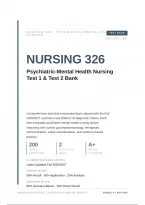
N U R S I N G 3 2 6 · P S Y C H I A T R I C - M E N T A L H E A LTTE H
ST BANK
NURSING
FA L L 2 0 2 0 2 7
NURSING 326
Psychiatric-Mental Health Nursing
Test 1 & Test 2 Bank
Comprehensive dual-test examination bank aligned with the Fall
2026/2027 curriculum and DSM-5-TR diagnostic criteria. Each
item integrates psychiatric-mental health nursing clinical
reasoning with current psychopharmacology, therapeutic
communication, safety considerations, and evidence-based
practice.
200 2 A+
T O TA L TESTS (100 GRADE
QUESTIONS EACH) S TA N D A R D
E X A M I N AT I O N B A N K E D I T I O N
Latest Updated Fall 2026/2027
COGNITIVE MIX
30% Recall · 50% Application · 20% Analysis
QUESTION STYLE
80% Scenario-Based · 20% Direct Recall
N U R S I N G E D U C AT I O N · P S Y C H I AT R I C - M E N TA L H E A LT H GRADE A+ EDITION
,NURSING 326 - Fall 2026/2027 Grade A+ Test Bank
NURSING 326
Psychiatric-Mental Health Nursing
Test 1 & Test 2 - Comprehensive Test Bank
Fall 2026/2027 | Grade A+ Examination Bank
200 Questions Total | Test 1: 100 Questions | Test 2: 100 Questions
Document NURSING 326 Psychiatric-Mental Health Nursing Tests 1 & 2
Edition Latest Updated Fall 2026/2027 Test Bank
Standard Grade A+ - Expert-Level Clinical Reasoning
Total Questions 200 (Test 1: 100 | Test 2: 100)
Question Format Multiple Choice (4 options, one correct)
Cognitive Mix 30% Recall | 50% Application | 20% Analysis
Question Style 80% Scenario-Based | 20% Direct Recall
Rationale Each question includes detailed psychiatric nursing rationale
Examination Instructions: This test bank contains 200 multiple-choice questions divided into two tests of 100 questions each.
Each question has four options (A-D) with exactly one correct answer. Rationales follow each question and integrate
psychiatric-mental health nursing principles including therapeutic communication, safety considerations, psychopharmacology,
legal/ethical standards, and evidence-based interventions per current DSM-5-TR and APA practice guidelines. The correct
answer is explicitly marked with [CORRECT] and a summary line reading Correct Answer: X.
NURSING 326 Psychiatric-Mental Health Nursing Test Bank | Page 1
,NURSING 326 - Fall 2026/2027 Grade A+ Test Bank
TEST 1 (Questions 1-100)
Test 1 covers foundations, therapeutic communication, psychiatric assessment, legal/ethical issues, anxiety/OCD/trauma,
mood disorders and suicide, schizophrenia, and psychopharmacology foundations.
Section 1A: Foundations of Psychiatric-Mental Health Nursing (Mental Health
Concepts, Recovery Model, Therapeutic Milieu, & Nursing Roles)
Q1. A psychiatric-mental health nurse is orienting to a new inpatient unit. Which statement best reflects the
principles of the Recovery Model as defined by SAMHSA?
A. Recovery is a clinical process focused on symptom elimination through medication adherence.
B. Recovery is a journey of self-directed healing in which the person lives a meaningful life despite the
presence of a mental illness. [CORRECT]
C. Recovery requires the client to achieve full remission before resuming community living.
D. Recovery is achieved only when the interdisciplinary team agrees the client no longer needs services.
Correct Answer: B
Rationale: The SAMHSA Recovery Model defines recovery as a self-directed journey of healing in which individuals live
meaningful, purposeful lives despite mental illness. It emphasizes hope, empowerment, self-determination, and resilience rather
than symptom elimination alone. Options A, C, and D reflect a disease-centered model that contradicts the person-centered,
strengths-based foundation of recovery-oriented care.
Q2. A client newly diagnosed with major depressive disorder tells the nurse, 'I will never get better, so what
is the point?' Applying the mental health continuum concept, which nursing response is most appropriate?
A. Assure the client that the medication will resolve the symptoms within two weeks.
B. Explain that mental health exists on a continuum and that fluctuation is expected during recovery.
[CORRECT]
C. Document the statement as hopelessness and notify the provider for possible medication change.
D. Tell the client that negative thinking is a symptom and will improve with therapy.
Correct Answer: B
Rationale: The mental health continuum acknowledges that individuals move along a spectrum from mental health to mental
illness, and that fluctuation is normal and expected. Educating the client about this continuum validates their experience while
instilling realistic hope. Option A is false reassurance; option C is premature escalation without addressing the client's perception;
option D dismisses the client's feelings rather than providing therapeutic education.
Q3. A nurse is caring for a client with schizophrenia whose family consistently refers to the client as 'a
schizophrenic.' Which nursing action best addresses the impact of stigma?
A. Document the family's language and report it to the unit manager for intervention.
B. Privately educate the family on person-first language, explaining how labels can internalize stigma and
hinder recovery. [CORRECT]
C. Ignore the language because the family's intent is not malicious.
D. Ask the client how they feel about being called a schizophrenic and document their response.
Correct Answer: B
Rationale: Stigma arises when individuals are reduced to their diagnosis rather than recognized as whole persons. Person-first
language (e.g., 'a person with schizophrenia') reinforces dignity and supports recovery-oriented care. The nurse's role includes
educating families about the impact of language on self-esteem and treatment outcomes. Options A, C, and D avoid the
therapeutic opportunity to reduce stigma through education.
NURSING 326 Psychiatric-Mental Health Nursing Test Bank | Page 2
, NURSING 326 - Fall 2026/2027 Grade A+ Test Bank
Q4. A 17-year-old client with a history of trauma and self-harm is admitted to the psychiatric unit. Which
intervention by the nurse best promotes resilience?
A. Restrict all visitors to maintain a controlled, low-stimulation environment.
B. Help the client identify personal strengths, coping strategies, and supportive relationships. [CORRECT]
C. Encourage the client to avoid discussing past trauma during hospitalization.
D. Assign the client to a quiet room away from peer interaction to reduce triggers.
Correct Answer: B
Rationale: Resilience is the capacity to adapt and recover from adversity, and it is strengthened by identifying personal
strengths, adaptive coping strategies, and social support. Facilitating this strengths-based self-reflection is a core psychiatric
nursing intervention. Options A, C, and D isolate the client and suppress therapeutic processing, which can worsen outcomes and
undermine resilience.
Q5. Which statement by a new graduate nurse indicates correct understanding of the therapeutic milieu?
A. The milieu is the physical environment of the unit including furniture and lighting.
B. The milieu is a structured environment that uses all interactions and activities as therapeutic opportunities
for growth. [CORRECT]
C. The milieu refers only to scheduled group therapy sessions on the unit.
D. The milieu is the rules and policies that govern patient behavior on the unit.
Correct Answer: B
Rationale: A therapeutic milieu is a structured, safe environment in which every interaction, activity, and routine is intentionally
used as a therapeutic tool to promote coping, socialization, and recovery. It encompasses physical, social, and psychological
dimensions. Options A, C, and D each describe only one fragment of the milieu rather than its holistic, therapeutic purpose.
Q6. A client on an inpatient psychiatric unit becomes increasingly agitated and begins pacing the hallway.
Which nursing intervention is the priority action consistent with milieu safety?
A. Administer a PRN anxiolytic immediately to prevent escalation.
B. Approach the client calmly, lower stimuli, and use verbal de-escalation techniques. [CORRECT]
C. Call a code and prepare for physical restraint application.
D. Direct the client to return to their room and lock the door from outside.
Correct Answer: B
Rationale: Maintaining safety within the therapeutic milieu begins with the least restrictive intervention: calm verbal approach,
environmental modification, and de-escalation. Medication and restraints are reserved for imminent danger when less
restrictive measures fail. Options A, C, and D escalate prematurely to restrictive measures that violate the least-restrictive
principle and may worsen agitation.
Q7. During a community meeting on an inpatient psychiatric unit, several clients complain that the
morning schedule is too rushed. Which response by the nurse leader best demonstrates the principle of
milieu structure and norms?
A. The nurse adjusts the schedule unilaterally to give clients more time in the morning.
B. The nurse facilitates a discussion allowing clients to propose and vote on schedule modifications within
safety limits. [CORRECT]
C. The nurse explains that the schedule cannot be changed and redirects clients to individual goals.
D. The nurse refers the complaint to the unit manager and defers action until the next staff meeting.
Correct Answer: B
Rationale: Community meetings are a core milieu structure that empowers clients, reinforces democratic norms, and develops
problem-solving skills within safe boundaries. Facilitating client participation models therapeutic community principles. Option
A removes client autonomy; option C dismisses client input; option D delays therapeutic engagement and undermines the milieu's
purpose.
NURSING 326 Psychiatric-Mental Health Nursing Test Bank | Page 3
ST BANK
NURSING
FA L L 2 0 2 0 2 7
NURSING 326
Psychiatric-Mental Health Nursing
Test 1 & Test 2 Bank
Comprehensive dual-test examination bank aligned with the Fall
2026/2027 curriculum and DSM-5-TR diagnostic criteria. Each
item integrates psychiatric-mental health nursing clinical
reasoning with current psychopharmacology, therapeutic
communication, safety considerations, and evidence-based
practice.
200 2 A+
T O TA L TESTS (100 GRADE
QUESTIONS EACH) S TA N D A R D
E X A M I N AT I O N B A N K E D I T I O N
Latest Updated Fall 2026/2027
COGNITIVE MIX
30% Recall · 50% Application · 20% Analysis
QUESTION STYLE
80% Scenario-Based · 20% Direct Recall
N U R S I N G E D U C AT I O N · P S Y C H I AT R I C - M E N TA L H E A LT H GRADE A+ EDITION
,NURSING 326 - Fall 2026/2027 Grade A+ Test Bank
NURSING 326
Psychiatric-Mental Health Nursing
Test 1 & Test 2 - Comprehensive Test Bank
Fall 2026/2027 | Grade A+ Examination Bank
200 Questions Total | Test 1: 100 Questions | Test 2: 100 Questions
Document NURSING 326 Psychiatric-Mental Health Nursing Tests 1 & 2
Edition Latest Updated Fall 2026/2027 Test Bank
Standard Grade A+ - Expert-Level Clinical Reasoning
Total Questions 200 (Test 1: 100 | Test 2: 100)
Question Format Multiple Choice (4 options, one correct)
Cognitive Mix 30% Recall | 50% Application | 20% Analysis
Question Style 80% Scenario-Based | 20% Direct Recall
Rationale Each question includes detailed psychiatric nursing rationale
Examination Instructions: This test bank contains 200 multiple-choice questions divided into two tests of 100 questions each.
Each question has four options (A-D) with exactly one correct answer. Rationales follow each question and integrate
psychiatric-mental health nursing principles including therapeutic communication, safety considerations, psychopharmacology,
legal/ethical standards, and evidence-based interventions per current DSM-5-TR and APA practice guidelines. The correct
answer is explicitly marked with [CORRECT] and a summary line reading Correct Answer: X.
NURSING 326 Psychiatric-Mental Health Nursing Test Bank | Page 1
,NURSING 326 - Fall 2026/2027 Grade A+ Test Bank
TEST 1 (Questions 1-100)
Test 1 covers foundations, therapeutic communication, psychiatric assessment, legal/ethical issues, anxiety/OCD/trauma,
mood disorders and suicide, schizophrenia, and psychopharmacology foundations.
Section 1A: Foundations of Psychiatric-Mental Health Nursing (Mental Health
Concepts, Recovery Model, Therapeutic Milieu, & Nursing Roles)
Q1. A psychiatric-mental health nurse is orienting to a new inpatient unit. Which statement best reflects the
principles of the Recovery Model as defined by SAMHSA?
A. Recovery is a clinical process focused on symptom elimination through medication adherence.
B. Recovery is a journey of self-directed healing in which the person lives a meaningful life despite the
presence of a mental illness. [CORRECT]
C. Recovery requires the client to achieve full remission before resuming community living.
D. Recovery is achieved only when the interdisciplinary team agrees the client no longer needs services.
Correct Answer: B
Rationale: The SAMHSA Recovery Model defines recovery as a self-directed journey of healing in which individuals live
meaningful, purposeful lives despite mental illness. It emphasizes hope, empowerment, self-determination, and resilience rather
than symptom elimination alone. Options A, C, and D reflect a disease-centered model that contradicts the person-centered,
strengths-based foundation of recovery-oriented care.
Q2. A client newly diagnosed with major depressive disorder tells the nurse, 'I will never get better, so what
is the point?' Applying the mental health continuum concept, which nursing response is most appropriate?
A. Assure the client that the medication will resolve the symptoms within two weeks.
B. Explain that mental health exists on a continuum and that fluctuation is expected during recovery.
[CORRECT]
C. Document the statement as hopelessness and notify the provider for possible medication change.
D. Tell the client that negative thinking is a symptom and will improve with therapy.
Correct Answer: B
Rationale: The mental health continuum acknowledges that individuals move along a spectrum from mental health to mental
illness, and that fluctuation is normal and expected. Educating the client about this continuum validates their experience while
instilling realistic hope. Option A is false reassurance; option C is premature escalation without addressing the client's perception;
option D dismisses the client's feelings rather than providing therapeutic education.
Q3. A nurse is caring for a client with schizophrenia whose family consistently refers to the client as 'a
schizophrenic.' Which nursing action best addresses the impact of stigma?
A. Document the family's language and report it to the unit manager for intervention.
B. Privately educate the family on person-first language, explaining how labels can internalize stigma and
hinder recovery. [CORRECT]
C. Ignore the language because the family's intent is not malicious.
D. Ask the client how they feel about being called a schizophrenic and document their response.
Correct Answer: B
Rationale: Stigma arises when individuals are reduced to their diagnosis rather than recognized as whole persons. Person-first
language (e.g., 'a person with schizophrenia') reinforces dignity and supports recovery-oriented care. The nurse's role includes
educating families about the impact of language on self-esteem and treatment outcomes. Options A, C, and D avoid the
therapeutic opportunity to reduce stigma through education.
NURSING 326 Psychiatric-Mental Health Nursing Test Bank | Page 2
, NURSING 326 - Fall 2026/2027 Grade A+ Test Bank
Q4. A 17-year-old client with a history of trauma and self-harm is admitted to the psychiatric unit. Which
intervention by the nurse best promotes resilience?
A. Restrict all visitors to maintain a controlled, low-stimulation environment.
B. Help the client identify personal strengths, coping strategies, and supportive relationships. [CORRECT]
C. Encourage the client to avoid discussing past trauma during hospitalization.
D. Assign the client to a quiet room away from peer interaction to reduce triggers.
Correct Answer: B
Rationale: Resilience is the capacity to adapt and recover from adversity, and it is strengthened by identifying personal
strengths, adaptive coping strategies, and social support. Facilitating this strengths-based self-reflection is a core psychiatric
nursing intervention. Options A, C, and D isolate the client and suppress therapeutic processing, which can worsen outcomes and
undermine resilience.
Q5. Which statement by a new graduate nurse indicates correct understanding of the therapeutic milieu?
A. The milieu is the physical environment of the unit including furniture and lighting.
B. The milieu is a structured environment that uses all interactions and activities as therapeutic opportunities
for growth. [CORRECT]
C. The milieu refers only to scheduled group therapy sessions on the unit.
D. The milieu is the rules and policies that govern patient behavior on the unit.
Correct Answer: B
Rationale: A therapeutic milieu is a structured, safe environment in which every interaction, activity, and routine is intentionally
used as a therapeutic tool to promote coping, socialization, and recovery. It encompasses physical, social, and psychological
dimensions. Options A, C, and D each describe only one fragment of the milieu rather than its holistic, therapeutic purpose.
Q6. A client on an inpatient psychiatric unit becomes increasingly agitated and begins pacing the hallway.
Which nursing intervention is the priority action consistent with milieu safety?
A. Administer a PRN anxiolytic immediately to prevent escalation.
B. Approach the client calmly, lower stimuli, and use verbal de-escalation techniques. [CORRECT]
C. Call a code and prepare for physical restraint application.
D. Direct the client to return to their room and lock the door from outside.
Correct Answer: B
Rationale: Maintaining safety within the therapeutic milieu begins with the least restrictive intervention: calm verbal approach,
environmental modification, and de-escalation. Medication and restraints are reserved for imminent danger when less
restrictive measures fail. Options A, C, and D escalate prematurely to restrictive measures that violate the least-restrictive
principle and may worsen agitation.
Q7. During a community meeting on an inpatient psychiatric unit, several clients complain that the
morning schedule is too rushed. Which response by the nurse leader best demonstrates the principle of
milieu structure and norms?
A. The nurse adjusts the schedule unilaterally to give clients more time in the morning.
B. The nurse facilitates a discussion allowing clients to propose and vote on schedule modifications within
safety limits. [CORRECT]
C. The nurse explains that the schedule cannot be changed and redirects clients to individual goals.
D. The nurse refers the complaint to the unit manager and defers action until the next staff meeting.
Correct Answer: B
Rationale: Community meetings are a core milieu structure that empowers clients, reinforces democratic norms, and develops
problem-solving skills within safe boundaries. Facilitating client participation models therapeutic community principles. Option
A removes client autonomy; option C dismisses client input; option D delays therapeutic engagement and undermines the milieu's
purpose.
NURSING 326 Psychiatric-Mental Health Nursing Test Bank | Page 3


