
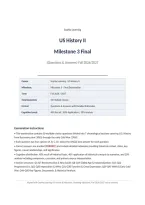
Sophia Learning
US History II
Milestone 3 Final
(Questions & Answers) Fall 2026/2027
Course Sophia Learning - US History II
Milestone Milestone 3 - Final Examination
Term Fall
Total Questions 50 Multiple Choice
Format Questions & Answers with Detailed Rationales
Cognitive Levels 40% Recall | 40% Application | 20% Analysis
Examination Instructions
• This examination contains 50 multiple-choice questions divided into 7 chronological sections covering U.S. History
from Reconstruction (1865) through the early Cold War (1960).
• Each question has four options (A, B, C, D). Select the SINGLE best answer for each question.
• Correct answers are marked [CORRECT] and include detailed rationales providing historical context, dates, key
figures, causal relationships, and significance.
• Cognitive distribution: 40% recall of historical facts, 40% application of historical concepts to scenarios, and 20%
analysis including comparison, causation, and primary-source interpretation.
• Section structure: Q1-Q7 Reconstruction & New South; Q8-Q14 Gilded Age & Industrialization; Q15-Q22
Progressive Era; Q23-Q30 Imperialism & WWI; Q31-Q38 Twenties & Great Depression; Q39-Q45 WWII & Early Cold
War; Q46-Q50 Key Figures, Documents, & Historical Analysis.
Aligned with Sophia Learning US History II Milestone 3 learning objectives, Fall 2026/2027 course content.
,Sophia - US History II - Milestone 3 Final | Fall 2026/2027 Questions & Answers
Section 1: Reconstruction and the New South (1865-1900)
Reconstruction Amendments, Freedmen's Bureau, & Jim Crow | Q1 - Q7
Q1: Which constitutional amendment, ratified in December 1865, formally abolished slavery throughout
the United States and its territories?
A. The Tenth Amendment, which reserved powers to the states
B. The Thirteenth Amendment, which prohibited slavery and involuntary servitude [CORRECT]
C. The Fourteenth Amendment, which granted citizenship to all persons born or naturalized in the United
States
D. The Fifteenth Amendment, which prohibited denying the right to vote based on race, color, or previous
condition of servitude
Correct Answer: B
Rationale: The Thirteenth Amendment, ratified on December 6, 1865, was the first of the three Reconstruction
Amendments and formally abolished slavery and involuntary servitude except as punishment for a crime. The
Fourteenth (1868) addressed citizenship and equal protection, the Fifteenth (1870) addressed voting rights, and the
Tenth (1791) long predated the Civil War.
Q2: Which statement BEST describes the key difference between Presidential Reconstruction under Andrew
Johnson and Congressional (Radical) Reconstruction?
A. Presidential Reconstruction sought to punish former Confederate leaders severely, while Congressional
Reconstruction offered immediate pardons to all southerners.
B. Presidential Reconstruction was lenient toward the South and required minimal protections for
freedmen, while Congressional Reconstruction imposed military districts and enforced civil rights
protections for African Americans. [CORRECT]
C. Presidential Reconstruction redistributed plantation land to freedmen, while Congressional Reconstruction
returned all land to former Confederate owners.
D. Presidential Reconstruction was led by Radical Republicans in Congress, while Congressional Reconstruction
was controlled entirely by the executive branch.
Correct Answer: B
Rationale: Andrew Johnson's Presidential Reconstruction (1865-1866) offered generous pardons to former
Confederates and required only minimal loyalty oaths, leaving freedmen with few federal protections. Congressional
Reconstruction, driven by Radical Republicans from 1867, divided the South into five military districts and required
new state constitutions guaranteeing Black male suffrage and ratification of the Fourteenth Amendment.
Page 2
, Sophia - US History II - Milestone 3 Final | Fall 2026/2027 Questions & Answers
Q3: What was the PRIMARY purpose of the Freedmen's Bureau, established by Congress in March 1865?
A. To redistribute plantation lands to formerly enslaved people across the South
B. enforce federal tax collection in the defeated Confederate states
C. To provide food, shelter, medical care, education, and legal assistance to newly freed African Americans
and poor whites in the South [CORRECT]
D. To oversee the withdrawal of federal troops from the southern states
Correct Answer: C
Rationale: The Bureau of Refugees, Freedmen, and Abandoned Lands, created on March 3, 1865, was the first major
federal social welfare agency. It provided food, clothing, medical care, established schools (including partnerships
with Howard University), and helped negotiate labor contracts. Although it did not redistribute plantation land
broadly (option A), it was a critical but short-lived institution, ending in 1872.
Q4: The Fourteenth Amendment (ratified 1868) is BEST understood as the constitutional foundation for
which of the following principles?
A. States' rights to nullify federal laws they deemed unconstitutional
B. The abolition of slavery in all U.S. territories and possessions
C. Universal voting rights for all citizens regardless of gender
D. Birthright citizenship, due process, and equal protection under the law [CORRECT]
Correct Answer: D
Rationale: The Fourteenth Amendment's Citizenship Clause established birthright citizenship, its Due Process Clause
prohibited states from depriving any person of life, liberty, or property without due process, and its Equal Protection
Clause required states to provide equal protection under the law. These clauses became the foundation for landmark
later rulings including Brown v. Board (1954). Slavery was addressed by the Thirteenth, and voting rights by the
Fifteenth; the Nineteenth (1920) addressed gender.
Q5: Which statement BEST describes the historical significance of the Fifteenth Amendment (1870)?
A. It granted voting rights to all women regardless of race.
B. It prohibited denying the right to vote based on race, color, or previous condition of servitude, though it
was widely circumvented in the South through poll taxes, literacy tests, and grandfather clauses. [CORRECT]
C. It established the direct election of U.S. Senators by popular vote.
D. It lowered the voting age to eighteen years.
Correct Answer: B
Rationale: Ratified on March 30, 1870, the Fifteenth Amendment declared that the right to vote could not be denied
on account of race, color, or previous condition of servitude. Despite its promise, southern states systematically
circumvented it through poll taxes, literacy tests, white primaries, and grandfather clauses until the Voting Rights Act
of 1965 enforced its provisions. Women's suffrage came with the Nineteenth Amendment (1920), direct election of
senators with the Seventeenth (1913), and the voting age was lowered by the Twenty-sixth (1971).
Page 3
US History II
Milestone 3 Final
(Questions & Answers) Fall 2026/2027
Course Sophia Learning - US History II
Milestone Milestone 3 - Final Examination
Term Fall
Total Questions 50 Multiple Choice
Format Questions & Answers with Detailed Rationales
Cognitive Levels 40% Recall | 40% Application | 20% Analysis
Examination Instructions
• This examination contains 50 multiple-choice questions divided into 7 chronological sections covering U.S. History
from Reconstruction (1865) through the early Cold War (1960).
• Each question has four options (A, B, C, D). Select the SINGLE best answer for each question.
• Correct answers are marked [CORRECT] and include detailed rationales providing historical context, dates, key
figures, causal relationships, and significance.
• Cognitive distribution: 40% recall of historical facts, 40% application of historical concepts to scenarios, and 20%
analysis including comparison, causation, and primary-source interpretation.
• Section structure: Q1-Q7 Reconstruction & New South; Q8-Q14 Gilded Age & Industrialization; Q15-Q22
Progressive Era; Q23-Q30 Imperialism & WWI; Q31-Q38 Twenties & Great Depression; Q39-Q45 WWII & Early Cold
War; Q46-Q50 Key Figures, Documents, & Historical Analysis.
Aligned with Sophia Learning US History II Milestone 3 learning objectives, Fall 2026/2027 course content.
,Sophia - US History II - Milestone 3 Final | Fall 2026/2027 Questions & Answers
Section 1: Reconstruction and the New South (1865-1900)
Reconstruction Amendments, Freedmen's Bureau, & Jim Crow | Q1 - Q7
Q1: Which constitutional amendment, ratified in December 1865, formally abolished slavery throughout
the United States and its territories?
A. The Tenth Amendment, which reserved powers to the states
B. The Thirteenth Amendment, which prohibited slavery and involuntary servitude [CORRECT]
C. The Fourteenth Amendment, which granted citizenship to all persons born or naturalized in the United
States
D. The Fifteenth Amendment, which prohibited denying the right to vote based on race, color, or previous
condition of servitude
Correct Answer: B
Rationale: The Thirteenth Amendment, ratified on December 6, 1865, was the first of the three Reconstruction
Amendments and formally abolished slavery and involuntary servitude except as punishment for a crime. The
Fourteenth (1868) addressed citizenship and equal protection, the Fifteenth (1870) addressed voting rights, and the
Tenth (1791) long predated the Civil War.
Q2: Which statement BEST describes the key difference between Presidential Reconstruction under Andrew
Johnson and Congressional (Radical) Reconstruction?
A. Presidential Reconstruction sought to punish former Confederate leaders severely, while Congressional
Reconstruction offered immediate pardons to all southerners.
B. Presidential Reconstruction was lenient toward the South and required minimal protections for
freedmen, while Congressional Reconstruction imposed military districts and enforced civil rights
protections for African Americans. [CORRECT]
C. Presidential Reconstruction redistributed plantation land to freedmen, while Congressional Reconstruction
returned all land to former Confederate owners.
D. Presidential Reconstruction was led by Radical Republicans in Congress, while Congressional Reconstruction
was controlled entirely by the executive branch.
Correct Answer: B
Rationale: Andrew Johnson's Presidential Reconstruction (1865-1866) offered generous pardons to former
Confederates and required only minimal loyalty oaths, leaving freedmen with few federal protections. Congressional
Reconstruction, driven by Radical Republicans from 1867, divided the South into five military districts and required
new state constitutions guaranteeing Black male suffrage and ratification of the Fourteenth Amendment.
Page 2
, Sophia - US History II - Milestone 3 Final | Fall 2026/2027 Questions & Answers
Q3: What was the PRIMARY purpose of the Freedmen's Bureau, established by Congress in March 1865?
A. To redistribute plantation lands to formerly enslaved people across the South
B. enforce federal tax collection in the defeated Confederate states
C. To provide food, shelter, medical care, education, and legal assistance to newly freed African Americans
and poor whites in the South [CORRECT]
D. To oversee the withdrawal of federal troops from the southern states
Correct Answer: C
Rationale: The Bureau of Refugees, Freedmen, and Abandoned Lands, created on March 3, 1865, was the first major
federal social welfare agency. It provided food, clothing, medical care, established schools (including partnerships
with Howard University), and helped negotiate labor contracts. Although it did not redistribute plantation land
broadly (option A), it was a critical but short-lived institution, ending in 1872.
Q4: The Fourteenth Amendment (ratified 1868) is BEST understood as the constitutional foundation for
which of the following principles?
A. States' rights to nullify federal laws they deemed unconstitutional
B. The abolition of slavery in all U.S. territories and possessions
C. Universal voting rights for all citizens regardless of gender
D. Birthright citizenship, due process, and equal protection under the law [CORRECT]
Correct Answer: D
Rationale: The Fourteenth Amendment's Citizenship Clause established birthright citizenship, its Due Process Clause
prohibited states from depriving any person of life, liberty, or property without due process, and its Equal Protection
Clause required states to provide equal protection under the law. These clauses became the foundation for landmark
later rulings including Brown v. Board (1954). Slavery was addressed by the Thirteenth, and voting rights by the
Fifteenth; the Nineteenth (1920) addressed gender.
Q5: Which statement BEST describes the historical significance of the Fifteenth Amendment (1870)?
A. It granted voting rights to all women regardless of race.
B. It prohibited denying the right to vote based on race, color, or previous condition of servitude, though it
was widely circumvented in the South through poll taxes, literacy tests, and grandfather clauses. [CORRECT]
C. It established the direct election of U.S. Senators by popular vote.
D. It lowered the voting age to eighteen years.
Correct Answer: B
Rationale: Ratified on March 30, 1870, the Fifteenth Amendment declared that the right to vote could not be denied
on account of race, color, or previous condition of servitude. Despite its promise, southern states systematically
circumvented it through poll taxes, literacy tests, white primaries, and grandfather clauses until the Voting Rights Act
of 1965 enforced its provisions. Women's suffrage came with the Nineteenth Amendment (1920), direct election of
senators with the Seventeenth (1913), and the voting age was lowered by the Twenty-sixth (1971).
Page 3


