
Q1.
(a) Sucrose, maltose and lactose are disaccharides.
(i) Sucrase is an enzyme. It hydrolyses sucrose during digestion. Name the
products of this reaction.
_________________________ and _________________________
(2)
(ii) Sucrase does not hydrolyse lactose. Use your knowledge of the way in
which enzymes work to explain why.
______________________________________________________________
______________________________________________________________
______________________________________________________________
______________________________________________________________
(2)
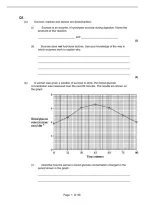
(b) A woman was given a solution of sucrose to drink. Her blood glucose
concentration was measured over the next 90 minutes. The results are shown on
the graph.
(i) Describe how the woman’s blood glucose concentration changed in the
period shown in the graph.
______________________________________________________________
______________________________________________________________
Page 1 of 89
, ______________________________________________________________
______________________________________________________________
(2)
(ii) Explain the results shown on the graph.
______________________________________________________________
______________________________________________________________
______________________________________________________________
______________________________________________________________
(2)
(Total 8 marks)
Q2.
A test has been developed to determine if a person is infected with variant CJD (vCJD),
the human form of BSE (mad cow disease). The test detects the protein which causes
vCJD in a urine sample.
The test kit contains the following components.
(a) Complete the flow chart to describe how this test would be used.
Urine sample is added to well in test plate
↓
Plate is washed to remove unbound vCJD protein
↓
↓
↓
Page 2 of 89
, (3)
(b) Explain why this test would detect vCJD, but not other antigens in the urine.
___________________________________________________________________
___________________________________________________________________
___________________________________________________________________
___________________________________________________________________
(2)
(Total 5 marks)
Q3.
Read the following passage.
The plasma membrane plays a vital role in microorganisms. It forms a
barrier between the cell and its environment, controlling the entry and exit
of solutes.
This makes bacteria vulnerable to a range of antiseptics and antibiotics.
When bacteria are treated with antiseptics, the antiseptics bind to the 5
proteins in the membrane and create tiny holes. Bacteria contain
potassium ions at a concentration many times that outside the cell.
Because of the small size of these ions and their concentration in the cell,
the first observable sign of antiseptic damage to the plasma membrane is
the leaking of potassium ions from the cell. Some antibiotics damage the 10
plasma membrane in a similar way. One of these is tyrocidin. This is a
cyclic polypeptide consisting of a ring of ten amino acids. Tyrocidin and
other polypeptide antibiotics are of little use in medicine.
Other antibiotics also increase the rate of potassium movement from cells.
It is thought that potassium ions are very important in energy release and 15
protein synthesis, and a loss of potassium ions would lead to cell death.
Gramicidin A coils to form a permanent pore passing through the plasma
membrane. This pore enables potassium ions to be conducted from the
inside of the cell into the surrounding medium. Vanilomycin also facilitates
the passage of potassium ions from the cell. 20
A molecule of vanilomycin forms a complex with a potassium ion and
transports it across the membrane. The potassium ion is released on the
outside and the vanilomycin is free to return and pick up another
potassium ion. Vanilomycin depends on the fluid nature of the plasma
membrane in order to function.
25
Polyene antibiotics have flattened ring-shaped molecules. The two sides
of the ring differ from each other. One side consists of an unsaturated
carbon chain. This part is strongly hydrophobic and rigid. The opposite
side is a flexible, strongly hydrophilic region. It has been shown that
polyene antibiotics bind only to sterols. Sterols are lipids found in the
membranes of eukaryotes but not in the membranes of prokaryotic
Page 3 of 89
, organisms. It is thought that several sterol-polyene complexes come
together.
The plasma membranes of eukaryotic cells treated with these polyene
antibiotics lose the ability to act as selective barriers and small ions and
molecules rapidly leak out.
Use information in the passage and your own knowledge to answer the questions.
(a) By what process do potassium ions normally enter a bacterial cell? Explain the
evidence for your answer.
___________________________________________________________________
___________________________________________________________________
___________________________________________________________________
___________________________________________________________________
(2)
(b) (i) Draw a peptide bond showing how the COOH group of one amino acid
joins to the NH2 group of another.
(1)
(ii) How many peptide bonds are there in a molecule of tyrocidin (lines 9 - 10)?
______________________________________________________________
(1)
(c) Experiments have shown that vanilomycin is unable to transport potassium ions
across a membrane when it is cooled. Gramicidin A continues to facilitate the
movement of potassium ions at these low temperatures. Explain these results.
___________________________________________________________________
___________________________________________________________________
___________________________________________________________________
___________________________________________________________________
___________________________________________________________________
___________________________________________________________________
(3)
(d) Draw a simple diagram of one of the phospholipid layers to show how polyene
antibiotics allow small ions and molecules to leak rapidly through a plasma
membrane. Use the following symbols to represent the different molecules.
Page 4 of 89


