
Q1.
(a) Omega-3 fatty acids are unsaturated. What is an unsaturated fatty acid?
___________________________________________________________________
___________________________________________________________________
___________________________________________________________________
___________________________________________________________________
(2)
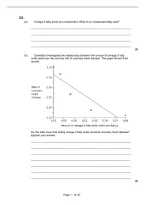
(b) Scientists investigated the relationship between the amount of omega-3 fatty
acids eaten per day and the risk of coronary heart disease. The graph shows their
results.
Do the data show that eating omega-3 fatty acids prevents coronary heart disease?
Explain your answer.
___________________________________________________________________
___________________________________________________________________
___________________________________________________________________
___________________________________________________________________
___________________________________________________________________
___________________________________________________________________
___________________________________________________________________
(3)
Page 1 of 67
, (c) Olestra is an artificial lipid. It is made by attaching fatty acids, by condensation, to
a sucrose molecule. The diagram shows the structure of olestra. The letter R shows
where a fatty acid molecule has attached.
(i) Name bond X.
______________________________________________________________
(1)
(ii) A triglyceride does not contain sucrose or bond X. Give one other way in
which the structure of a triglyceride is different to olestra.
______________________________________________________________
______________________________________________________________
(1)
(iii) Starting with separate molecules of glucose, fructose and fatty acids, how
many molecules of water would be produced when one molecule of olestra is
formed?
(1)
(Total 8 marks)
Q2.
The diagrams show four types of linkage, A to D, which occur in biological molecules.
Page 2 of 67
, (a) Name the chemical process involved in the formation of linkage B.
___________________________________________________________________
(1)
(b) Give the letter of the linkage which
(i) occurs in a triglyceride molecule;
______________________________________________________________
(1)
(ii) might be broken down by the enzyme amylase;
______________________________________________________________
(1)
(iii) may occur in the tertiary, but not the primary structure of protein.
______________________________________________________________
(1)
(c) Describe how a saturated fatty acid differs in molecular structure from an
unsaturated fatty acid.
___________________________________________________________________
___________________________________________________________________
___________________________________________________________________
___________________________________________________________________
(2)
(Total 6 marks)
Q3.
(a) Starch and protein are biologically important polymers.
Page 3 of 67
, (i) Explain what is meant by a polymer.
______________________________________________________________
______________________________________________________________
(1)
(ii) Give one example of a biologically important polymer other than starch or
protein.
______________________________________________________________
(1)
(b) In an investigation, the enzyme amylase was mixed in a test tube with a buffer
solution and a suspension of starch. The amylase broke down the starch to maltose.
When all the starch had been broken down, a sample was removed from the test
tube and tested with biuret reagent.
(i) Explain why a buffer solution was added to the amylase-starch mixture.
______________________________________________________________
______________________________________________________________
______________________________________________________________
(2)
(ii) What colour would you expect the sample to go when tested with biuret
reagent?
______________________________________________________________
(1)
(iii) Give an explanation for your answer to part (ii)
______________________________________________________________
______________________________________________________________
______________________________________________________________
(2)
(Total 7 marks)
Q4.
Read the following passage.
Straw consists of three main organic substances – cellulose, hemicellulose and lignin.
Cellulose molecules form chains which pack together into fibres. Hemicellulose is a small
molecule formed mainly from five-carbon (pentose) sugar monomers. It acts as a cement
holding cellulose fibres together. Like hemicellulose, lignin is a polymer, but it is not a
5 carbohydrate. It covers the cellulose in the cell wall and supplies additional strength. In
addition to these three substances, there are small amounts of other biologically important
polymers present.
The other main component of straw is water. Water content is variable but may be determined
by heating a known mass of straw at between 80 and 90°C until it reaches a constant mass.
The loss in mass is the water content.
Page 4 of 67


