
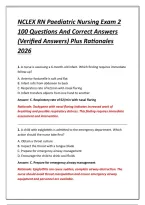
NCLEX RN Paediatric Nursing Exam 2
100 Questions And Correct Answers
(Verified Answers) Plus Rationales
2026
1. A nurse is assessing a 6-month-old infant. Which finding requires immediate
follow-up?
A. Anterior fontanelle is soft and flat
B. Infant rolls from abdomen to back
C. Respiratory rate of 62/min with nasal flaring
D. Infant transfers objects from one hand to another
Answer: C. Respiratory rate of 62/min with nasal flaring
Rationale: Tachypnea with nasal flaring indicates increased work of
breathing and possible respiratory distress. This finding requires immediate
assessment and intervention.
2. A child with epiglottitis is admitted to the emergency department. Which
action should the nurse take first?
A. Obtain a throat culture
B. Inspect the throat with a tongue blade
C. Prepare for emergency airway management
D. Encourage the child to drink cool fluids
Answer: C. Prepare for emergency airway management
Rationale: Epiglottitis can cause sudden, complete airway obstruction. The
nurse should avoid throat manipulation and ensure emergency airway
equipment and personnel are available.
,3. A nurse is caring for a child with cystic fibrosis. Which intervention is most
appropriate?
A. Restrict dietary fat
B. Encourage a high-calorie, high-protein diet
C. Limit fluid intake
D. Avoid pancreatic enzyme replacement
Answer: B. Encourage a high-calorie, high-protein diet
Rationale: Children with cystic fibrosis have increased energy requirements
and malabsorption. High-calorie, high-protein nutrition and pancreatic
enzymes help promote growth and nutrient absorption.
4. A child with nephrotic syndrome has generalized edema. Which assessment
finding is most important for the nurse to monitor?
A. Hair texture
B. Daily weight
C. Visual acuity
D. Bowel sounds
Answer: B. Daily weight
Rationale: Daily weight is one of the most sensitive indicators of fluid
retention or fluid loss in children with nephrotic syndrome.
5. A child with type 1 diabetes mellitus is pale, shaky, and diaphoretic. Which
action should the nurse take?
A. Administer regular insulin
B. Give a rapid source of glucose
C. Encourage exercise
D. Restrict oral fluids
Answer: B. Give a rapid source of glucose
,Rationale: Pallor, tremors, and diaphoresis are manifestations of
hypoglycemia. If the child is conscious and able to swallow, a rapid-acting
carbohydrate should be given immediately.
6. A nurse is teaching parents about preventing lead poisoning. Which
statement indicates correct understanding?
A. “We should allow our child to play with old painted windows.”
B. “We should use hot tap water for preparing infant formula.”
C. “We should wash our child's hands frequently.”
D. “Lead exposure occurs only in contaminated food.”
Answer: C. “We should wash our child's hands frequently.”
Rationale: Hand hygiene reduces ingestion of lead-containing dust and soil.
Children may be exposed to lead through deteriorating paint, contaminated
soil, dust, and water.
7. A child with sickle cell disease is experiencing a vaso-occlusive crisis. Which
intervention is appropriate?
A. Restrict fluids
B. Encourage hydration and administer prescribed analgesics
C. Apply prolonged cold therapy
D. Encourage strenuous activity
Answer: B. Encourage hydration and administer prescribed analgesics
Rationale: Hydration helps reduce blood viscosity, while appropriate
analgesia treats severe pain associated with vaso-occlusion.
8. A nurse is assessing a child with increased intracranial pressure. Which
finding is most concerning?
A. Headache
B. Vomiting
, C. Altered level of consciousness
D. Increased appetite
Answer: C. Altered level of consciousness
Rationale: A decreasing level of consciousness is an important sign of
worsening intracranial pressure and possible neurological deterioration.
9. A child with Kawasaki disease is receiving treatment. Which complication is
the nurse most concerned about preventing?
A. Coronary artery aneurysm
B. Appendicitis
C. Renal stones
D. Cataracts
Answer: A. Coronary artery aneurysm
Rationale: Kawasaki disease causes systemic vasculitis and can damage the
coronary arteries. Treatment reduces the risk of coronary artery
complications.
10. Which finding is expected in a child with iron-deficiency anemia?
A. Increased hemoglobin
B. Pallor and fatigue
C. Bradycardia with hypertension
D. Increased muscle strength
Answer: B. Pallor and fatigue
Rationale: Iron deficiency decreases hemoglobin production and oxygen-
carrying capacity, commonly causing pallor, weakness, fatigue, and reduced
activity tolerance.
Questions 11–20


