
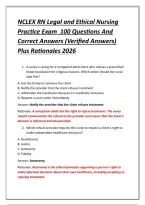
NCLEX RN Legal and Ethical Nursing
Practice Exam 100 Questions And
Correct Answers (Verified Answers)
Plus Rationales 2026
1. A nurse is caring for a competent adult client who refuses a prescribed
blood transfusion for religious reasons. Which action should the nurse
take first?
A. Ask the family to convince the client
B. Notify the provider that the client refuses treatment
C. Administer the transfusion because it is medically necessary
D. Request a court order immediately
Answer: Notify the provider that the client refuses treatment.
Rationale: A competent adult has the right to refuse treatment. The nurse
should communicate the refusal to the provider and ensure that the client's
decision is informed and documented.
2. Which ethical principle requires the nurse to respect a client's right to
make independent healthcare decisions?
A. Beneficence
B. Justice
C. Autonomy
D. Fidelity
Answer: Autonomy.
Rationale: Autonomy is the ethical principle supporting a person's right to
make informed decisions about their own healthcare, including accepting or
refusing treatment.
, 3. A nurse accidentally administers the wrong medication dose to a client.
What is the nurse's priority action?
A. Document that the medication was administered correctly
B. Assess the client for adverse effects
C. Wait to see whether symptoms develop
D. Ask another nurse to correct the documentation
Answer: Assess the client for adverse effects.
Rationale: Client safety is the priority after a medication error. The nurse
should assess the client, notify the appropriate provider, follow agency policy,
and complete required reporting and documentation.
4. Which action by a nurse is an example of negligence?
A. Following the provider's prescription
B. Failing to implement appropriate fall precautions for a high-risk client
C. Reporting a suspected medication error
D. Obtaining informed consent from a client
Answer: Failing to implement appropriate fall precautions for a high-risk
client.
Rationale: Negligence occurs when a nurse fails to provide the reasonable
standard of care expected under the circumstances, resulting in potential or
actual harm.
5. A client tells the nurse, "I do not want surgery." The provider has already
obtained informed consent. What should the nurse do?
A. Proceed because the consent form is signed
B. Respect the client's current refusal and notify the provider
C. Ask the client's spouse to provide consent
D. Tell the client that refusing surgery is irresponsible
Answer: Respect the client's current refusal and notify the provider.
Rationale: Consent must be voluntary and ongoing. A client can withdraw
consent at any time before or during a procedure, provided the client has
decision-making capacity.
, 6. Which situation best illustrates the ethical principle of beneficence?
A. Allowing a competent client to refuse treatment
B. Treating clients fairly regardless of financial status
C. Acting to promote the client's well-being
D. Maintaining confidentiality
Answer: Acting to promote the client's well-being.
Rationale: Beneficence means taking actions intended to benefit the client
and promote positive health outcomes.
7. A nurse discusses a client's diagnosis with another nurse in a crowded
elevator. Which legal concern is demonstrated?
A. Malpractice
B. Breach of confidentiality
C. False imprisonment
D. Informed consent
Answer: Breach of confidentiality.
Rationale: Discussing identifiable client information in a public area can
violate confidentiality and privacy protections.
8. Which statement about informed consent is correct?
A. The nurse is always responsible for explaining all risks of surgery
B. The provider performing the procedure generally obtains informed consent
C. Family members must sign consent for all adult clients
D. A signed form eliminates the need for client understanding
Answer: The provider performing the procedure generally obtains informed
consent.
Rationale: The provider performing the procedure is generally responsible for
explaining the procedure, risks, benefits, and alternatives. The nurse may
witness the signature and verify that the client appears informed and
voluntary.
9. A nurse refuses to participate in a procedure because it conflicts with the
nurse's deeply held ethical beliefs. Which action is most appropriate?
, A. Abandon the client
B. Prevent the procedure from occurring
C. Notify the supervisor promptly and request an appropriate alternative
assignment
D. Tell the client that the procedure is unethical
Answer: Notify the supervisor promptly and request an appropriate
alternative assignment.
Rationale: A nurse should not abandon a client or impose personal beliefs on
the client. Ethical concerns should be communicated through appropriate
professional channels while maintaining continuity of care.
10.Which situation is an example of battery?
A. Threatening to administer an injection
B. Administering an injection after the client clearly refused it
C. Failing to monitor a client
D. Making an inaccurate statement about a client
Answer: Administering an injection after the client clearly refused it.
Rationale: Battery involves intentional, unauthorized physical contact.
Providing a treatment without valid consent can constitute battery.
11.A nurse tells a client, "If you don't take this medication, I will restrain
you." Which intentional tort may this statement represent?
A. Assault
B. Battery
C. Negligence
D. Malpractice
Answer: Assault.
Rationale: Assault is an intentional threat or action that creates a reasonable
fear of imminent harmful or unwanted contact.
12.Which action is most appropriate when a nurse suspects that an older
adult is being abused?


