
• Wrong document? Swap it for free
  • Written by students who passed
  • Immediately available after payment
  • Read online or as PDF
Sell
Where do you study
Your language
Document preview thumbnail
Preview 4 out of 169 pages
Exam (elaborations)

Mass Psychology & Jurisprudence Exam Questions And Correct Verified Solutions Latest Update This Year- Just Released.pdf

Document preview thumbnail
Preview 4 out of 169 pages

Tap on AVAILABLE IN BUNDLE / PACKAGE DEAL to unlock free bonus exams and everything you need. MASS PSYCHOLOGY & JURISPRUDENCE EXAM QUESTIONS AND CORRECT VERIFIED SOLUTIONS LATEST UPDATE THIS YEAR – JUST RELEASED The Mass Psychology & Jurisprudence Exam resource is designed for candidates preparing for the Massachusetts psychology jurisprudence examination and reviewing the laws, regulations, ethical responsibilities, and professional-practice requirements governing psychologists in Massachusetts. The Massachusetts Board of Registration of Psychologists identifies statutes, regulations, policies, guidelines, and the Psychology Jurisprudence Book as key regulatory resources for psychologists. This resource provides exam-style questions with correct answers and detailed rationales covering **psychologist licensing and registration, professional conduct, disciplinary requirements, confidentiality, privilege, mandated reporting, vulnerable-person protections, child welfare, elder protection, disabled-person protection, and other Massachusetts legal requirements affecting psychological practice**. A major focus is **Massachusetts psychologist licensure and professional regulation**. Questions address registration requirements, qualifications, renewal concepts, professional responsibilities, prohibited conduct, disciplinary actions, and circumstances that may affect a psychologist's ability to practice. The material is designed to help learners understand how statutory requirements and Board regulations apply to professional practice. The resource also emphasizes **professional conduct and ethical responsibilities**. Scenario-based questions address appropriate professional behavior, competence, boundaries, impairment, unauthorized practice, regulatory violations, and situations that may result in disciplinary action. Learners are encouraged to distinguish between appropriate professional judgment and conduct that may violate Massachusetts requirements. **Confidentiality, privilege, and disclosure of psychological information** receive extensive attention. Questions examine circumstances in which information may be protected, situations requiring or permitting disclosure, court-related requests, forensic evaluations, patient claims involving mental health, and exceptions to ordinary confidentiality protections. Another important area is **mandated reporting and protection of vulnerable populations**. Questions address reporting responsibilities involving suspected abuse or neglect, applicable reporting procedures, required information, agency responsibilities, and circumstances involving elderly persons, children, and persons with disabilities. The material provides focused review of **elder abuse and protective services**. Questions cover statutory definitions, financial exploitation, emergency situations, protective-service procedures, guardianship and conservatorship concepts, reporting obligations, and the responsibilities of agencies responding to suspected abuse. **Child protection and family-related law** are also incorporated. Questions address definitions and legal concepts involving custody, child protection, neglect, abuse, foster care, court intervention, parental rights, reunification, and circumstances in which special legal procedures may apply. The resource further examines **protection of persons with disabilities**, including reporting obligations, investigative procedures, protective services, and responsibilities associated with suspected abuse or neglect. Scenario-based questions encourage candidates to identify when a professional's legal duties are triggered and what procedural steps may be required. **Duty to warn and related professional responsibilities** are also emphasized. Questions address circumstances involving threats of serious harm, identifiable potential victims, dangerous behavior, and situations in which confidentiality may interact with a psychologist's legal responsibilities. Learners are encouraged to carefully distinguish ordinary confidentiality from legally recognized exceptions. The material includes **forensic and court-related psychology concepts**, including compelled evaluations, court orders, custody proceedings, legal claims involving mental health, and circumstances in which psychological records or testimony may become relevant to a legal proceeding. Questions also address **professional advertising, practice limitations, continuing education, and regulated professional activities**. These areas help candidates understand the boundaries surrounding professional representation, competence, specialized services, and continuing compliance with Massachusetts regulatory requirements. The resource emphasizes **specific statutory definitions and procedural timelines**, which are particularly important in jurisprudence examinations. Questions may require learners to identify the meaning of legally defined terms, determine when a report must be made, distinguish between verbal and written reporting requirements, or identify the appropriate agency or authority involved in a particular situation. Recent study materials for the Massachusetts psychology jurisprudence examination similarly emphasize elder protection, disabled-person protection, health-care-provider record requirements, psychologist registration and licensing, child protection, mandated reporting, confidentiality, and professional legal responsibilities. Each question includes a **clear correct answer and detailed rationale** explaining the relevant legal or professional principle. The rationales are designed to help candidates understand why an answer is appropriate and distinguish closely related statutory requirements, reporting duties, exceptions, and procedural rules. The Massachusetts Board maintains **251 CMR 1**, addressing ethical standards, professional conduct, and disciplinary procedures; **251 CMR 3**, addressing registration of psychologists; and **251 CMR 4**, addressing continuing education. The Board also provides its Psychology Jurisprudence Book as an official regulatory study resource. Overall, this study resource provides comprehensive preparation across **Massachusetts psychologist licensing, registration, professional conduct, disciplinary procedures, continuing education, confidentiality, privilege, mandated reporting, elder abuse, financial exploitation, disabled-person protection, child abuse and neglect, custody, protective services, duty to warn, forensic psychology, psychological records, court proceedings, professional boundaries, and legal responsibilities**, with detailed answers and rationales throughout.

Content preview

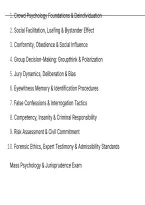
1. Crowd Psychology Foundations & Deindividuation

2. Social Facilitation, Loafing & Bystander Effect

3. Conformity, Obedience & Social Influence

4. Group Decision-Making: Groupthink & Polarization

5. Jury Dynamics, Deliberation & Bias

6. Eyewitness Memory & Identification Procedures

7. False Confessions & Interrogation Tactics

8. Competency, Insanity & Criminal Responsibility

9. Risk Assessment & Civil Commitment

10. Forensic Ethics, Expert Testimony & Admissibility Standards

Mass Psychology & Jurisprudence Exam

,1. Which classical theorist argued that individuals in a crowd lose
their conscious personality and become subject to a collective racial
unconscious that makes them emotionally inferior to isolated
individuals?
A. Gabriel Tarde
B. Gustave Le Bon
C. Sigmund Freud
D. Floyd Allport
Answer: B
Rationale: Le Bon's foundational crowd theory posited that immersion
in a crowd causes individuals to regress, losing rational restraint and
becoming susceptible to contagion and suggestion, thereby producing
a collective mind that is intellectually inferior and emotionally more
primitive than the sum of its parts 3 .

,2. In Festinger, Pepitone, and Newcomb's deindividuation
experiment, what specific manipulation was used as the independent
variable to reduce inner restraints among group members?
A. Administering electric shocks to confederates
B. Having participants wear identical lab coats and hoods
C. Asking participants to discuss their parents in a dimly lit room
D. Showing violent film clips before group discussion
Answer: C
Rationale: The original deindividuation study manipulated whether
group members could be identified when discussing negative feelings
about their parents; the dimly lit condition reduced identifiability and
increased negative remarks, demonstrating that deindividuation
loosens normal behavioral constraints 3 .

3. According to Zimbardo's Stanford Prison Experiment, which
situational factor most powerfully facilitated the rapid adoption of

, abusive guard behavior toward prisoners?
A. Pre-existing personality traits of authoritarianism among guards
B. Financial incentives offered for maintaining order
C. Deindividuation through uniforms, sunglasses, and group identity
D. Explicit instructions from researchers to inflict psychological harm
Answer: C
Rationale: Zimbardo's study demonstrated that deindividuation—
created by anonymity-conferring uniforms, mirrored sunglasses, and a
shared group identity as "guards"—was the critical situational variable
that enabled ordinary students to engage in degrading and abusive
conduct 20 .

4. Which theoretical perspective posits that crowd behavior is not
irrational but rather a rational response to emerging group norms that
develop through social interaction and communication among
participants?


Document information

Uploaded on
October 8, 2026
Number of pages
169
Written in
2026/2027
Type
Exam (elaborations)
Contains
Questions & answers
$31.99

Wrong document? Swap it for free Within 14 days of purchase and before downloading, you can choose a different document. You can simply spend the amount again.
Written by students who passed
Immediately available after payment
Read online or as PDF

Seller avatar
Reputation scores are based on the amount of documents a seller has sold for a fee and the reviews they have received for those documents. There are three levels: Bronze, Silver and Gold. The better the reputation, the more your can rely on the quality of the sellers work.
surepass
4.9
(396)
Sold
6718
Followers
24
Items
4623
Last sold
3 days ago


Why students choose Stuvia

Created by fellow students, verified by reviews

Quality you can trust: written by students who passed their tests and reviewed by others who've used these notes.

Didn't get what you expected? Choose another document

No worries! You can instantly pick a different document that better fits what you're looking for.

Pay as you like, start learning right away

No subscription, no commitments. Pay the way you're used to via credit card and download your PDF document instantly.

Student with book image

“Bought, downloaded, and aced it. It really can be that simple.”

Alisha Student

Working on your references?

Create accurate citations in APA, MLA and Harvard with our free citation generator.

Working on your references?

Frequently asked questions
