
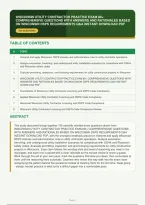
WISCONSIN UTILITY CONTRACTOR PRACTICE EXAM 80+
COMPREHENSIVE QUESTIONS WITH ANSWERS AND RATIONALES BASED
ON WISCONSIN DSPS REQUIREMENTS Q&A INSTANT DOWNLOAD PDF
100 QUESTIONS
TABLE OF CONTENTS
# TOPIC
1 Interpret and apply Wisconsin DSPS statutes and administrative rules to utility contractor operations
2 Analyze excavation, trenching, and underground utility installation scenarios for compliance with OSHA
and Wisconsin safety codes
3 Evaluate permitting, inspection, and licensing requirements for utility construction projects in Wisconsin
4 WISCONSIN UTILITY CONTRACTOR PRACTICE EXAM 80+ COMPREHENSIVE QUESTIONS WITH
ANSWERS AND RATIONALES BASED ON WISCONSIN DSPS REQUIREMENTS Q&A INSTANT
DOWNLOAD PDF
5 Foundations of Wisconsin Utility Contractor Licensing and DSPS Code Compliance
6 Applied Wisconsin Utility Contractor Licensing and DSPS Code Compliance
7 Advanced Wisconsin Utility Contractor Licensing and DSPS Code Compliance
8 Wisconsin Utility Contractor Licensing and DSPS Code Compliance Review
ABSTRACT
This study document brings together 100 carefully worded exam questions drawn from
WISCONSIN UTILITY CONTRACTOR PRACTICE EXAM 80+ COMPREHENSIVE QUESTIONS
WITH ANSWERS AND RATIONALES BASED ON WISCONSIN DSPS REQUIREMENTS Q&A
INSTANT DOWNLOAD PDF, with the strongest emphasis placed on Interpret and apply Wisconsin
DSPS statutes and administrative rules to utility contractor operations, Analyze excavation,
trenching, and underground utility installation scenarios for compliance with OSHA and Wisconsin
safety codes, Evaluate permitting, inspection and and licensing requirements for utility construction
projects in Wisconsin. Every item follows the wording style and level of reasoning you meet in the
real paper, and each one is paired with a clear rationale so the correct choice is never a guess.
Work through the set at your own pace, mark the questions that slow you down, then come back to
them until the reasoning feels automatic. Learners who revise this way walk into the exam room
recognising the pattern behind the questions instead of meeting them for the first time. Keep going
- steady, honest practice is what turns a difficult paper into a comfortable pass.
Page 1
,Q1 INTERPRET AND APPLY WISCONSIN DSPS STATUTES AND ADMINISTRATIVE RULES TO
UTILITY CONTRACTOR OPERATIONS
A utility contractor is installing a new 8-inch water main in a Wisconsin
municipality. The trench depth is 6 feet, and the soil is classified as Type B.
According to OSHA 1926 Subpart P and Wisconsin DSPS adopted standards,
which protective system is minimally required if no sloping or benching is used?
A. Trench box or shield designed for the depth and soil type CORRECT
B. Hydraulic shoring with vertical uprights spaced at 8 feet
C. Aluminum hydraulic shoring with 4-foot spacing
D. No protective system required for depths under 8 feet
RATIONALE: For trenches 5 to 20 feet deep in Type B soil, OSHA requires a protective system
such as a trench box, shield, or shoring. A trench box is the most common and must be designed
for the depth and soil. Options B and C specify shoring but lack design specifics; D is incorrect
because protection is required at 5 feet or deeper.
Q2 INTERPRET AND APPLY WISCONSIN DSPS STATUTES AND ADMINISTRATIVE RULES TO
UTILITY CONTRACTOR OPERATIONS
Under Wisconsin Administrative Code SPS 305, which of the following activities
requires a licensed utility contractor when performed on a public right-of-way?
A. Installing a private septic system on residential property
B. Repairing a water service line from the main to the curb stop CORRECT
C. Constructing a new electrical transmission line for a utility
D. Performing landscaping around an existing utility easement
RATIONALE: SPS 305 requires a licensed utility contractor for work on water service lines from
the main to the curb stop in public rights-of-way. Private septic systems are regulated under
plumbing codes, transmission lines under PSC, and landscaping is not utility contracting.
Page 2
,Q3 INTERPRET AND APPLY WISCONSIN DSPS STATUTES AND ADMINISTRATIVE RULES TO
UTILITY CONTRACTOR OPERATIONS
A contractor is backfilling a trench for a gas distribution line. According to
Wisconsin DSPS and PHMSA regulations, what is the minimum cover required
over the top of the pipe in a residential area without external load considerations?
A. 12 inches
B. 18 inches CORRECT
C. 24 inches
D. 30 inches
RATIONALE: PHMSA and Wisconsin DSPS require a minimum cover of 18 inches over gas
distribution lines in residential areas. 12 inches is insufficient, while 24 and 30 inches are for
other conditions or higher load areas.
Q4 INTERPRET AND APPLY WISCONSIN DSPS STATUTES AND ADMINISTRATIVE RULES TO
UTILITY CONTRACTOR OPERATIONS
An electrical utility contractor is installing conduit for a 15 kV primary distribution
line. Per Wisconsin DSPS and NEC, what is the minimum burial depth for
direct-buried conduit under a street?
A. 18 inches
B. 24 inches
C. 30 inches
D. 36 inches CORRECT
RATIONALE: NEC Table 300.5 requires 36 inches of cover for direct-buried conduit under streets
for over 600V. 18, 24, and 30 inches are for other locations or lower voltages.
Page 3
, Q5 INTERPRET AND APPLY WISCONSIN DSPS STATUTES AND ADMINISTRATIVE RULES TO
UTILITY CONTRACTOR OPERATIONS
A utility contractor is preparing to excavate near a marked gas line. According to
Wisconsin's Digger's Hotline law (Wis. Stat. § 182.0175), what is the minimum
advance notice required before excavation?
A. 1 business day
B. 2 business days
C. 3 business days CORRECT
D. 5 business days
RATIONALE: Wisconsin law requires at least 3 business days' notice to Digger's Hotline before
excavation. 1 or 2 days is insufficient; 5 days is not required but may be used for scheduling.
Q6 INTERPRET AND APPLY WISCONSIN DSPS STATUTES AND ADMINISTRATIVE RULES TO
UTILITY CONTRACTOR OPERATIONS
A contractor is installing a new sanitary sewer lateral. The local municipality
requires a permit. Which Wisconsin DSPS code primarily governs the installation?
A. SPS 382 - Plumbing Code CORRECT
B. SPS 384 - Private Sewage Systems
C. SPS 305 - Licenses, Certifications, and Registrations
D. SPS 320 - Uniform Dwelling Code
RATIONALE: SPS 382 governs plumbing, including sanitary sewer laterals. SPS 384 is for
private sewage systems, SPS 305 for licensing, and SPS 320 for one- and two-family dwellings.
Page 4


