
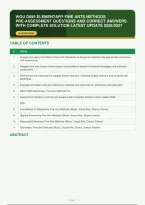
WGU D695 ELEMENTARY FINE ARTS METHODS
PRE-ASSESSMENT QUESTIONS AND CORRECT ANSWERS
WITH COMPLETE SOLUTION LATEST UPDATE 2026/2027
98 QUESTIONS
TABLE OF CONTENTS
# TOPIC
1 Analyze and apply the National Core Arts Standards to design developmentally appropriate elementary
arts experiences
2 Integrate fine arts across content areas using evidence-based instructional strategies and authentic
assessment
3 Differentiate arts instruction to support diverse learners, including English learners and students with
disabilities
4 Evaluate and select culturally responsive materials and resources for elementary arts education
5 WGU D695 Elementary Fine Arts Methods Pre
6 assessment Questions and Correct Answers with Complete Solution Latest Update 2026
7 2027
8 Foundations of Elementary Fine Arts Methods (Music, Visual Arts, Drama, Dance)
9 Applied Elementary Fine Arts Methods (Music, Visual Arts, Drama, Dance)
10 Advanced Elementary Fine Arts Methods (Music, Visual Arts, Drama, Dance)
11 Elementary Fine Arts Methods (Music, Visual Arts, Drama, Dance) Review
ABSTRACT
Page 1
,This study document brings together 98 carefully worded exam questions drawn from WGU D695
Elementary Fine Arts Methods Pre-assessment Questions and Correct Answers with Complete
Solution Latest Update 2026/2027, with the strongest emphasis placed on Analyze and apply the
National Core Arts Standards to design developmentally appropriate elementary arts experiences,
Integrate fine arts across content areas using evidence-based instructional strategies and
authentic assessment, Differentiate arts instruction to support diverse learners and including
English learners and students with disabilities. Every item follows the wording style and level of
reasoning you meet in the real paper, and each one is paired with a clear rationale so the correct
choice is never a guess. Work through the set at your own pace, mark the questions that slow you
down, then come back to them until the reasoning feels automatic. Learners who revise this way
walk into the exam room recognising the pattern behind the questions instead of meeting them for
the first time. Keep going - steady, honest practice is what turns a difficult paper into a comfortable
pass.
Q1 ANALYZE AND APPLY THE NATIONAL CORE ARTS STANDARDS TO DESIGN
DEVELOPMENTALLY APPROPRIATE ELEMENTARY ARTS EXPERIENCES
A teacher planning a unit on the National Core Arts Standards for visual arts wants
to ensure students engage in the 'Creating' process. Which instructional sequence
best reflects the anchor standard 'Generate and conceptualize artistic ideas and
work'?
A. Provide step-by-step directions for replicating a famous painting, then display all works
identically.
B. Ask students to brainstorm multiple solutions to a design challenge, experiment with
materials, and refine their ideas based on peer feedback. CORRECT
C. Show a video of an artist at work and have students write a summary of the techniques
observed.
D. Assign students to color a pre-drawn template of a landscape using a specified color scheme.
RATIONALE: The 'Creating' process emphasizes generating ideas, experimenting, and refining,
which aligns with option B. Options A and D are teacher-directed replication tasks that limit
conceptualization. Option C focuses on observation and summary, not active creation.
Page 2
,Q2 ANALYZE AND APPLY THE NATIONAL CORE ARTS STANDARDS TO DESIGN
DEVELOPMENTALLY APPROPRIATE ELEMENTARY ARTS EXPERIENCES
Which assessment strategy most authentically measures students' ability to apply
the elements of dance (body, action, space, time, energy) in a choreographic
composition?
A. A multiple-choice test identifying definitions of each element.
B. A performance rubric that evaluates the presence and manipulation of each element in a
student-created dance phrase. CORRECT
C. A written reflection describing a professional dance performance viewed in class.
D. A checklist marking whether students attended rehearsals regularly.
RATIONALE: A performance rubric directly assesses the application of dance elements in a
composition, providing valid and reliable evidence. Multiple-choice tests and reflections assess
recall or observation, not application. Attendance is unrelated to artistic skill.
Q3 ANALYZE AND APPLY THE NATIONAL CORE ARTS STANDARDS TO DESIGN
DEVELOPMENTALLY APPROPRIATE ELEMENTARY ARTS EXPERIENCES
When integrating drama into a social studies unit on historical perspectives, which
strategy best promotes perspective-taking and empathy while addressing drama
standards?
A. Having students memorize and recite a timeline of events.
B. Using process drama where students role-play as historical figures to explore multiple
viewpoints on an event. CORRECT
C. Assigning students to illustrate a single historical scene based on a textbook description.
D. Conducting a teacher-led lecture with slides about key figures.
RATIONALE: Process drama immerses students in roles and situations, fostering empathy and
multiple perspectives, aligning with drama standards. Options A, C, and D are passive or
teacher-centered and do not engage students in dramatic inquiry.
Page 3
, Q4 ANALYZE AND APPLY THE NATIONAL CORE ARTS STANDARDS TO DESIGN
DEVELOPMENTALLY APPROPRIATE ELEMENTARY ARTS EXPERIENCES
A music teacher wants to develop students' audiation skills in a general music
class. Which activity is most effective for this purpose?
A. Having students echo rhythmic patterns immediately after the teacher performs them.
B. Asking students to sing a familiar song while reading its notation.
C. Engaging students in inner hearing by having them silently read a short melody and then sing
it aloud. CORRECT
D. Playing a recording and asking students to identify the instruments they hear.
RATIONALE: Audiation involves hearing and comprehending music inwardly without external
sound; silent reading followed by singing demonstrates this. Echoing (A) is imitation, not
audiation. Singing while reading (B) may rely on notation, and instrument identification (D) is
listening discrimination.
Q5 ANALYZE AND APPLY THE NATIONAL CORE ARTS STANDARDS TO DESIGN
DEVELOPMENTALLY APPROPRIATE ELEMENTARY ARTS EXPERIENCES
In a diverse elementary classroom, a teacher plans a visual arts lesson on
self-portraits. Which adaptation best supports an English learner at the early
production stage of language acquisition?
A. Requiring a written artist statement of at least one paragraph.
B. Providing visual exemplars, a word bank with key vocabulary, and allowing oral or drawn
responses. CORRECT
C. Assigning a partner to translate all instructions into the student's home language.
D. Excusing the student from the writing component entirely.
RATIONALE: Visual supports, vocabulary scaffolds, and multiple response modes align with best
practices for English learners at early production. Option A demands advanced writing, C relies
solely on translation without building English, and D lowers expectations rather than scaffolding.
Page 4


