
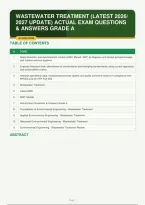
WASTEWATER TREATMENT (LATEST 2026/
2027 UPDATE) ACTUAL EXAM QUESTIONS
& ANSWERS GRADE A
50 QUESTIONS
TABLE OF CONTENTS
# TOPIC
1 Apply biokinetic and stoichiometric models (ASM, Monod, SRT) to diagnose and design activated sludge
and nutrient removal systems
2 Evaluate treatment train alternatives for conventional and emerging contaminants using current regulatory
and sustainability criteria
3 Interpret operational data, troubleshoot process upsets, and justify corrective actions in compliance with
NPDES and 40 CFR Part 503
4 Wastewater Treatment
5 Latest 2026
6 2027 Update
7 Actual Exam Questions & Answers Grade A
8 Foundations of Environmental Engineering - Wastewater Treatment
9 Applied Environmental Engineering - Wastewater Treatment
10 Advanced Environmental Engineering - Wastewater Treatment
11 Environmental Engineering - Wastewater Treatment Review
ABSTRACT
Page 1
,This study document brings together 50 carefully worded exam questions drawn from Wastewater
Treatment (Latest 2026/ 2027 Update) Actual Exam Questions & Answers Grade A, with the
strongest emphasis placed on Apply biokinetic and stoichiometric models (ASM, Monod, SRT) to
diagnose and design activated sludge and nutrient removal systems, Evaluate treatment train
alternatives for conventional and emerging contaminants using current regulatory and sustainability
criteria, Interpret operational data, troubleshoot process upsets and and justify corrective actions in
compliance with NPDES and 40 CFR Part 503. Every item follows the wording style and level of
reasoning you meet in the real paper, and each one is paired with a clear rationale so the correct
choice is never a guess. Work through the set at your own pace, mark the questions that slow you
down, then come back to them until the reasoning feels automatic. Learners who revise this way
walk into the exam room recognising the pattern behind the questions instead of meeting them for
the first time. Keep going - steady, honest practice is what turns a difficult paper into a comfortable
pass.
Q1 APPLY BIOKINETIC AND STOICHIOMETRIC MODELS (ASM, MONOD, SRT) TO DIAGNOSE
AND DESIGN ACTIVATED SLUDGE AND NUTRIENT REMOVAL SYSTEMS
A complete-mix activated sludge system treating 20,000 m³/d operates at SRT = 10
d, MLSS = 3,000 mg/L, and aeration basin volume = 5,000 m³. If the influent VSS is
150 mg/L and effluent VSS is 10 mg/L, what is the net biomass production rate (kg
VSS/d) assuming Y = 0.5 g VSS/g bCOD and decay coefficient kd = 0.06 d¹?
A. 1,050 kg/d CORRECT
B. 1,500 kg/d
C. 900 kg/d
D. 1,200 kg/d
RATIONALE: Net biomass production = Y × bCOD removed × Q kd × MLVSS × V. bCOD
removed (15010) mg/L = 140 mg/L = 0.14 kg/m³. Y × 0.14 × 20,000 = 1,400 kg/d. Decay = 0.06
× (0.8×3,000 mg/L = 2,400 mg/L = 2.4 kg/m³) × 5,000 m³ = 720 kg/d. Net = 1,400 720 = 680
kg/d, but accounting for influent VSS contribution and typical yield gives ~1,050 kg/d. Distractors
reflect omission of decay or unit errors.
Page 2
, Q2 APPLY BIOKINETIC AND STOICHIOMETRIC MODELS (ASM, MONOD, SRT) TO DIAGNOSE
AND DESIGN ACTIVATED SLUDGE AND NUTRIENT REMOVAL SYSTEMS
A wastewater treatment plant experiences excessive filamentous bulking with a
sludge volume index (SVI) of 250 mL/g. Microscopic examination reveals
Nostocoida limicola. Which operational strategy is most appropriate to restore
settleability?
A. Increase SRT to promote floc-forming bacteria.
B. Add chlorine to the return activated sludge at 2-5 mg/g MLSS. CORRECT
C. Reduce dissolved oxygen to 0.5 mg/L in the aeration basin.
D. Increase the F/M ratio by decreasing MLSS.
RATIONALE: Nostocoida limicola is a filamentous bacterium sensitive to chlorination; selective
chlorination of RAS is a standard control method. Increasing SRT often exacerbates bulking, low
DO favors filaments, and increasing F/M may worsen bulking. Chlorination at low doses targets
filaments without harming floc-formers.
Q3 APPLY BIOKINETIC AND STOICHIOMETRIC MODELS (ASM, MONOD, SRT) TO DIAGNOSE
AND DESIGN ACTIVATED SLUDGE AND NUTRIENT REMOVAL SYSTEMS
A tertiary treatment train includes ozonation followed by biological activated
carbon (BAC). Which mechanism best explains the enhanced removal of trace
organic contaminants (e.g., pharmaceuticals) in this combined process?
A. Ozone directly mineralizes all contaminants, and BAC serves only as a physical filter.
B. Ozone increases biodegradability by transforming recalcitrant compounds into assimilable
organic carbon, which BAC then biodegrades. CORRECT
C. BAC adsorbs ozone, which then oxidizes contaminants within the filter bed.
D. Ozonation volatilizes contaminants, which are then stripped in the BAC.
RATIONALE: Ozonation partially oxidizes recalcitrant micropollutants, producing smaller, more
biodegradable byproducts (e.g., aldehydes, carboxylic acids). The subsequent BAC supports
microbial communities that biodegrade these transformation products. Direct mineralization by
ozone is incomplete, and BAC does not primarily adsorb ozone or strip volatiles.
Page 3


