
SPI PRACTICE (ARDMS A & B) QUESTIONS
AND CORRECT ANSWER PLUS RATIONALE
LATEST 2026-2027 UPDATE
47 QUESTIONS
TABLE OF CONTENTS
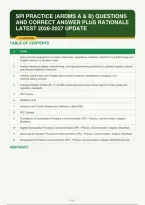
# TOPIC
1 Apply acoustic propagation principles (attenuation, impedance, reflection, refraction) to predict image and
Doppler behavior in complex media
2 Analyze transducer design, beamforming, and signal processing parameters to optimize spatial, contrast,
and temporal resolution trade-offs
3 Interpret spectral and color Doppler data to resolve aliasing, hemodynamic ambiguity, and
machine-setting conflicts
4 Evaluate bioeffect indices (MI, TI, ALARA) and quality-assurance metrics against current safety and
regulatory standards
5 SPI Practice
6 ARDMS A & B
7 Questions and Correct Answer plus Rationale Latest 2026
8 2027 Update
9 Foundations of Sonography Principles & Instrumentation (SPI) - Physics, Instrumentation, Doppler,
Bioeffects
10 Applied Sonography Principles & Instrumentation (SPI) - Physics, Instrumentation, Doppler, Bioeffects
11 Advanced Sonography Principles & Instrumentation (SPI) - Physics, Instrumentation, Doppler, Bioeffects
12 Sonography Principles & Instrumentation (SPI) - Physics, Instrumentation, Doppler, Bioeffects Review
ABSTRACT
Page 1
,This study document brings together 47 carefully worded exam questions drawn from SPI Practice
(ARDMS A & B) Questions and Correct Answer plus Rationale Latest 2026-2027 Update, with the
strongest emphasis placed on Apply acoustic propagation principles (attenuation, impedance,
reflection, refraction) to predict image and Doppler behavior in complex media, Analyze transducer
design, beamforming, and signal processing parameters to optimize spatial, contrast, and temporal
resolution trade-offs, Interpret spectral and color Doppler data to resolve aliasing, hemodynamic
ambiguity and and machine-setting conflicts. Every item follows the wording style and level of
reasoning you meet in the real paper, and each one is paired with a clear rationale so the correct
choice is never a guess. Work through the set at your own pace, mark the questions that slow you
down, then come back to them until the reasoning feels automatic. Learners who revise this way
walk into the exam room recognising the pattern behind the questions instead of meeting them for
the first time. Keep going - steady, honest practice is what turns a difficult paper into a comfortable
pass.
Q1 APPLY ACOUSTIC PROPAGATION PRINCIPLES (ATTENUATION, IMPEDANCE,
REFLECTION, REFRACTION) TO PREDICT IMAGE AND DOPPLER BEHAVIOR IN COMPLEX
MEDIA
A 5 MHz transducer insonifies soft tissue, then the same beam traverses 2 cm of
fat before reaching a target. Compared with an all-soft-tissue path of identical
length, the echo returning from the target will demonstrate which change?
A. Increased attenuation because fat has a higher attenuation coefficient than soft tissue at 5
MHz
B. Decreased attenuation because fat attenuates less than soft tissue at diagnostic frequencies
CORRECT
C. No change because attenuation depends only on total path length, not medium
D. Increased attenuation due to higher acoustic impedance of fat causing greater reflection
RATIONALE: At diagnostic frequencies, fat has a lower attenuation coefficient (~0.6 dB/cm/MHz)
than average soft tissue (~0.5-0.7 dB/cm/MHz but generally higher for liver/muscle), so
substituting fat reduces round-trip attenuation. Attenuation is medium- and frequency-dependent,
not purely length-dependent, and impedance mismatch governs reflection amplitude rather than
attenuation rate. Thus B is correct; A, C, and D misstate the physics.
Page 2
, Q2 APPLY ACOUSTIC PROPAGATION PRINCIPLES (ATTENUATION, IMPEDANCE,
REFLECTION, REFRACTION) TO PREDICT IMAGE AND DOPPLER BEHAVIOR IN COMPLEX
MEDIA
A spectral Doppler tracing of the internal carotid artery shows the peak systolic
frequency exceeding the Nyquist limit. Which adjustment most directly resolves
the aliasing while preserving the Doppler angle?
A. Increase the Doppler transmit frequency
B. Decrease the pulse repetition frequency
C. Increase the pulse repetition frequency CORRECT
D. Increase the wall filter setting
RATIONALE: Aliasing occurs when the Doppler shift exceeds half the PRF (Nyquist limit).
Increasing PRF raises the Nyquist limit and eliminates aliasing without changing the angle.
Increasing transmit frequency worsens aliasing, decreasing PRF lowers the Nyquist limit, and
wall filters remove low-frequency clutter rather than resolving aliasing.
Q3 APPLY ACOUSTIC PROPAGATION PRINCIPLES (ATTENUATION, IMPEDANCE,
REFLECTION, REFRACTION) TO PREDICT IMAGE AND DOPPLER BEHAVIOR IN COMPLEX
MEDIA
During quality assurance of an ultrasound system, the axial resolution is
measured at 1.2 mm with a 5 MHz transducer. If the transducer is replaced with a
10 MHz probe and all other factors remain constant, the expected axial resolution
is approximately:
A. 0.6 mm CORRECT
B. 1.2 mm
C. 2.4 mm
D. 0.3 mm
RATIONALE: Axial resolution is approximately equal to half the spatial pulse length (SPL), and
SPL decreases proportionally with wavelength as frequency increases. Doubling frequency from
5 to 10 MHz halves the wavelength and thus halves axial resolution to ~0.6 mm. Options B, C,
and D misapply the inverse relationship.
Page 3


