
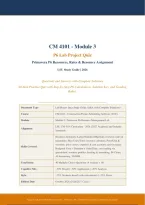
CM 4101 - Module 3
P6 Lab Project Quiz
Primavera P6 Resources, Rates & Resource Assignment
LSU Study Guide | 2026
Questions and Answers with Complete Solutions
40-Item Practice Quiz with Step-by-Step P6 Calculations, Solution Key, and Grading
Rubric
Document Type Lab Project Quiz Study Guide (Q&A with Complete Solutions)
Course CM 4101 - Construction Project Scheduling Software (LSU)
Module Module 3: Primavera P6 Resource Management Lab
LSU CM 4101 Curriculum - 2026 | 2027 Academic and Industry
Alignment
Standards
Resource dictionary (Labor/Nonlabor/Material); resource codes &
hierarchies; Max Units/Time; resource calendars; Price/Unit &
overtime; price curves; expenses & cost accounts; activity types;
Skills Covered
Budgeted Units = Duration x Units/Time; cost loading via
spreadsheet; resource profiles; leveling & smoothing; P6 Cloud;
AI forecasting; 5D BIM
Total Items 40 Multiple-Choice Questions (4 sections x 10)
Cognitive Mix ~30% Recall | ~50% Application | ~20% Analysis
Style ~75% Scenario-based (with calculations) | ~25% Direct
Edition Date October 2026 (2026/2027 Cycle)
Aligned with LSU CM 4101 Curriculum - Primavera P6 - 2026/2027 Academic and Industry Standards
,CM 4101 Module 3 P6 Lab Quiz - Primavera P6 Resources, Rates & Assignment - LSU - 2026 P6 Resource Management
Abstract
This study guide presents a 40-item multiple-choice lab quiz aligned with the LSU CM 4101 Module 3
P6 Lab curriculum and the 2026/2027 academic and industry cycle, focused on Primavera P6
resource management: the resource dictionary and catalog setup; resource rates, cost accounts, and
expense management; resource assignment, profile generation, and cost loading; and resource
leveling, optimization, and 2026 P6 updates. Items are distributed across four domains: defining
Labor, Nonlabor, and Material resources; resource codes and hierarchies; maximum units/time and
resource calendars; Price/Unit and overtime rates; price curves and multi-currency; cost accounts
and independent expense items; activity types (Task Dependent, Resource Dependent, milestones); the
Budgeted Units = Duration x Units/Time formula; resource profiles and the cost-loading spreadsheet;
and leveling, smoothing, P6 Cloud, AI-driven forecasting, and 5D BIM integration. Each item
provides a four-option stem with a single best answer and a layered rationale that derives the P6
calculation or navigation step and identifies why each distractor represents a common P6 user error
or flawed scheduling logic. The instrument targets a cognitive distribution of approximately 30%
recall, 50% application, and 20% analysis, with roughly 75% of items scenario-based to mirror real
P6 lab practice. A complete solution key and a 100-point grading rubric (2.5 points per item, with
partial-credit guidance for P6 calculation scenarios) accompany the quiz, and a mastery threshold of
75% is recommended for passing/proficient performance on the CM 4101 Module 3 P6 Lab Quiz.
Keywords
Primavera P6; resource dictionary; Labor/Nonlabor/Material; resource codes; Max Units/Time; Price/Unit; cost
accounts; expense items; activity types; Budgeted Units; resource profile; cost loading; resource leveling;
resource smoothing; P6 Cloud; AI forecasting; 5D BIM; LSU CM 4101; 2026/2027.
How to Use This Guide
Candidates should attempt all 40 items under timed conditions (approximately 45 seconds per recall item and
90 seconds per scenario or calculation item, for a total of roughly 45 minutes) before consulting the rationales.
For calculation items, work the Budgeted Units, Budgeted Cost, and variance computations on scratch paper
before selecting an answer. After scoring, items answered incorrectly should be re-studied by reading both the
correct rationale and the distractor explanations, because the distractors in this instrument are deliberately
engineered to reflect common P6 user errors (e.g., confusing Duration x Units/Time with Duration x Price/Unit,
or maximizing rather than minimizing at a leveling burst). The solution key and grading rubric that follow the
quiz support both self-assessment and instructor-led administration.
Part 1 - Practice Quiz (40 Items)
Instructions: Select the single best answer (A-D) for each item. Scenario-based items require step-by-step P6
calculation or navigation/logic analysis. Answers and full rationales are printed immediately beneath each item
to support study-mode learning.
Section 1: Primavera P6 Resource Dictionary & Catalog Setup
Page 2
, CM 4101 Module 3 P6 Lab Quiz - Primavera P6 Resources, Rates & Assignment - LSU - 2026 P6 Resource Management
Q1: In Primavera P6, the three primary resource types are: (Recall) (Direct)
A. Labor, Nonlabor, and Material [CORRECT]
B. People, Equipment, and Supplies
C. Cost, Time, and Quantity
D. Internal, External, and Contract
Correct Answer: A
Rationale: P6 classifies resources as Labor (people, time-based), Nonlabor (equipment/machinery, time-based),
and Material (consumable, quantity-based). Options B, C, and D are non-P6 taxonomies that do not match the
official resource-type schema.
Q2: In P6, the key distinction between Labor and Nonlabor resources is: (Recall) (Direct)
A. Labor represents people; Nonlabor represents equipment/machinery - both are time-based with
units/time [CORRECT]
B. Labor is consumable; Nonlabor is permanent
C. Labor has no cost; Nonlabor has cost
D. Labor is project-level; Nonlabor is enterprise-level
Correct Answer: A
Rationale: Both Labor and Nonlabor are time-based resources with units/time and cost. Labor = people;
Nonlabor = equipment/machinery. Material is the consumable category. Both can be enterprise or project
resources; both carry cost.
Q3: Material resources in P6 are best characterized as: (Recall) (Direct)
A. Quantity-based consumables (e.g., concrete cubic yards) without time-based availability [CORRECT]
B. Time-based resources identical to Labor
C. Equipment with availability calendars
D. Resources that cannot have cost
Correct Answer: A
Rationale: Material resources are quantity-based (consumed, not time-allocated). They carry a Price/Unit cost.
They are distinct from Labor and Nonlabor, which are time-based with availability calendars.
Q4: A scheduler wants to organize resources by trade (Civil, Electrical, Mechanical). The best P6
mechanism is to: (Application) (Scenario)
A. Create resource codes (e.g., Trade = Civil/Electrical/Mechanical) and apply them to resources
[CORRECT]
B. Create separate EPS nodes for each trade
C. Create three separate projects, one per trade
D. Use only resource hierarchies without codes
Correct Answer: A
Rationale: Resource codes are user-defined classification attributes (Trade, Location) that allow filtering and
grouping. EPS nodes are for projects, not resources; separate projects fragment data; hierarchies alone do not
support multi-dimensional classification.
Page 3
P6 Lab Project Quiz
Primavera P6 Resources, Rates & Resource Assignment
LSU Study Guide | 2026
Questions and Answers with Complete Solutions
40-Item Practice Quiz with Step-by-Step P6 Calculations, Solution Key, and Grading
Rubric
Document Type Lab Project Quiz Study Guide (Q&A with Complete Solutions)
Course CM 4101 - Construction Project Scheduling Software (LSU)
Module Module 3: Primavera P6 Resource Management Lab
LSU CM 4101 Curriculum - 2026 | 2027 Academic and Industry
Alignment
Standards
Resource dictionary (Labor/Nonlabor/Material); resource codes &
hierarchies; Max Units/Time; resource calendars; Price/Unit &
overtime; price curves; expenses & cost accounts; activity types;
Skills Covered
Budgeted Units = Duration x Units/Time; cost loading via
spreadsheet; resource profiles; leveling & smoothing; P6 Cloud;
AI forecasting; 5D BIM
Total Items 40 Multiple-Choice Questions (4 sections x 10)
Cognitive Mix ~30% Recall | ~50% Application | ~20% Analysis
Style ~75% Scenario-based (with calculations) | ~25% Direct
Edition Date October 2026 (2026/2027 Cycle)
Aligned with LSU CM 4101 Curriculum - Primavera P6 - 2026/2027 Academic and Industry Standards
,CM 4101 Module 3 P6 Lab Quiz - Primavera P6 Resources, Rates & Assignment - LSU - 2026 P6 Resource Management
Abstract
This study guide presents a 40-item multiple-choice lab quiz aligned with the LSU CM 4101 Module 3
P6 Lab curriculum and the 2026/2027 academic and industry cycle, focused on Primavera P6
resource management: the resource dictionary and catalog setup; resource rates, cost accounts, and
expense management; resource assignment, profile generation, and cost loading; and resource
leveling, optimization, and 2026 P6 updates. Items are distributed across four domains: defining
Labor, Nonlabor, and Material resources; resource codes and hierarchies; maximum units/time and
resource calendars; Price/Unit and overtime rates; price curves and multi-currency; cost accounts
and independent expense items; activity types (Task Dependent, Resource Dependent, milestones); the
Budgeted Units = Duration x Units/Time formula; resource profiles and the cost-loading spreadsheet;
and leveling, smoothing, P6 Cloud, AI-driven forecasting, and 5D BIM integration. Each item
provides a four-option stem with a single best answer and a layered rationale that derives the P6
calculation or navigation step and identifies why each distractor represents a common P6 user error
or flawed scheduling logic. The instrument targets a cognitive distribution of approximately 30%
recall, 50% application, and 20% analysis, with roughly 75% of items scenario-based to mirror real
P6 lab practice. A complete solution key and a 100-point grading rubric (2.5 points per item, with
partial-credit guidance for P6 calculation scenarios) accompany the quiz, and a mastery threshold of
75% is recommended for passing/proficient performance on the CM 4101 Module 3 P6 Lab Quiz.
Keywords
Primavera P6; resource dictionary; Labor/Nonlabor/Material; resource codes; Max Units/Time; Price/Unit; cost
accounts; expense items; activity types; Budgeted Units; resource profile; cost loading; resource leveling;
resource smoothing; P6 Cloud; AI forecasting; 5D BIM; LSU CM 4101; 2026/2027.
How to Use This Guide
Candidates should attempt all 40 items under timed conditions (approximately 45 seconds per recall item and
90 seconds per scenario or calculation item, for a total of roughly 45 minutes) before consulting the rationales.
For calculation items, work the Budgeted Units, Budgeted Cost, and variance computations on scratch paper
before selecting an answer. After scoring, items answered incorrectly should be re-studied by reading both the
correct rationale and the distractor explanations, because the distractors in this instrument are deliberately
engineered to reflect common P6 user errors (e.g., confusing Duration x Units/Time with Duration x Price/Unit,
or maximizing rather than minimizing at a leveling burst). The solution key and grading rubric that follow the
quiz support both self-assessment and instructor-led administration.
Part 1 - Practice Quiz (40 Items)
Instructions: Select the single best answer (A-D) for each item. Scenario-based items require step-by-step P6
calculation or navigation/logic analysis. Answers and full rationales are printed immediately beneath each item
to support study-mode learning.
Section 1: Primavera P6 Resource Dictionary & Catalog Setup
Page 2
, CM 4101 Module 3 P6 Lab Quiz - Primavera P6 Resources, Rates & Assignment - LSU - 2026 P6 Resource Management
Q1: In Primavera P6, the three primary resource types are: (Recall) (Direct)
A. Labor, Nonlabor, and Material [CORRECT]
B. People, Equipment, and Supplies
C. Cost, Time, and Quantity
D. Internal, External, and Contract
Correct Answer: A
Rationale: P6 classifies resources as Labor (people, time-based), Nonlabor (equipment/machinery, time-based),
and Material (consumable, quantity-based). Options B, C, and D are non-P6 taxonomies that do not match the
official resource-type schema.
Q2: In P6, the key distinction between Labor and Nonlabor resources is: (Recall) (Direct)
A. Labor represents people; Nonlabor represents equipment/machinery - both are time-based with
units/time [CORRECT]
B. Labor is consumable; Nonlabor is permanent
C. Labor has no cost; Nonlabor has cost
D. Labor is project-level; Nonlabor is enterprise-level
Correct Answer: A
Rationale: Both Labor and Nonlabor are time-based resources with units/time and cost. Labor = people;
Nonlabor = equipment/machinery. Material is the consumable category. Both can be enterprise or project
resources; both carry cost.
Q3: Material resources in P6 are best characterized as: (Recall) (Direct)
A. Quantity-based consumables (e.g., concrete cubic yards) without time-based availability [CORRECT]
B. Time-based resources identical to Labor
C. Equipment with availability calendars
D. Resources that cannot have cost
Correct Answer: A
Rationale: Material resources are quantity-based (consumed, not time-allocated). They carry a Price/Unit cost.
They are distinct from Labor and Nonlabor, which are time-based with availability calendars.
Q4: A scheduler wants to organize resources by trade (Civil, Electrical, Mechanical). The best P6
mechanism is to: (Application) (Scenario)
A. Create resource codes (e.g., Trade = Civil/Electrical/Mechanical) and apply them to resources
[CORRECT]
B. Create separate EPS nodes for each trade
C. Create three separate projects, one per trade
D. Use only resource hierarchies without codes
Correct Answer: A
Rationale: Resource codes are user-defined classification attributes (Trade, Location) that allow filtering and
grouping. EPS nodes are for projects, not resources; separate projects fragment data; hierarchies alone do not
support multi-dimensional classification.
Page 3


