
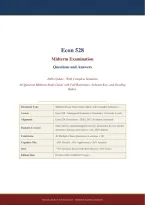
Econ 528
Midterm Examination
Questions and Answers
2026 Update - With Complete Solutions
40-Question Midterm Study Guide with Full Rationales, Solution Key, and Grading
Rubric
Document Type Midterm Exam Study Guide (Q&A with Complete Solutions)
Course Econ 528 - Managerial Economics (Graduate / University Level)
Alignment Econ 528 Curriculum - 2026 | 2027 Academic Standards
Micro theory; demand/supply/elasticity; production & cost; market
Domains Covered
structures; pricing; game theory; risk; 2026 updates
Total Items 40 Multiple-Choice Questions (4 sections x 10)
Cognitive Mix ~30% Recall | ~50% Application | ~20% Analysis
Style ~75% Scenario-based (with derivations) | ~25% Direct
Edition Date October 2026 (2026/2027 Cycle)
Aligned with Econ 528 Curriculum - 2026/2027 Academic Standards
,Econ 528 Midterm Exam - Questions and Answers - 2026 Update - Ull. Managerial Economics
Abstract
This study guide presents a 40-item multiple-choice midterm examination aligned with the Econ 528
Managerial Economics curriculum and the 2026/2027 academic cycle. Items are distributed across
four domains: demand, supply, elasticity, and market equilibrium; production theory, cost analysis,
and economies of scale; market structures and advanced pricing strategies; and game theory, risk
analysis, and 2026 economic updates including AI-driven dynamic pricing, modern antitrust
considerations in tech markets, and behavioral economics applications. Each item provides a
four-option stem with a single best answer and a layered rationale that derives the governing
economic mechanism or mathematical result step-by-step and identifies why each distractor
represents a calculation error or flawed economic reasoning. The instrument targets a cognitive
distribution of approximately 30% recall, 50% application, and 20% analysis, with roughly 75% of
items scenario-based to mirror real-world managerial decision-making. A complete solution key and
a 100-point grading rubric (2.5 points per item, with partial-credit guidance for quantitative
scenarios) accompany the examination, and a mastery threshold of 75% is recommended for
passing/proficient performance on the Econ 528 midterm.
Keywords
Managerial economics; price elasticity; consumer and producer surplus; cost minimization; economies of scale;
monopoly; price discrimination; two-part tariff; bundling; Nash equilibrium; risk aversion; AI dynamic pricing;
behavioral economics; 2026/2027.
How to Use This Guide
Candidates should attempt all 40 items under timed conditions (approximately 45 seconds per recall item and
90 seconds per scenario or quantitative item, for a total of roughly 45 minutes) before consulting the rationales.
After scoring, items answered incorrectly should be re-studied by reading both the correct rationale and the
distractor explanations, because the distractors in this instrument are deliberately engineered to reflect common
mathematical and conceptual errors. The solution key and grading rubric that follow the examination support
both self-assessment and instructor-led administration.
Part 1 - Practice Examination (40 Items)
Instructions: Select the single best answer (A-D) for each item. Scenario-based items require step-by-step
economic or mathematical derivation. Answers and full rationales are printed immediately beneath each item to
support study-mode learning.
Section 1: Demand, Supply, Elasticity, and Market Equilibrium
Page 2
, Econ 528 Midterm Exam - Questions and Answers - 2026 Update - Ull. Managerial Economics
Q1: The price elasticity of demand is correctly calculated as: (Recall) (Direct)
A. The percentage change in quantity demanded divided by the percentage change in price [CORRECT]
B. The percentage change in price divided by the percentage change in quantity demanded
C. The change in quantity divided by the change in price
D. Quantity multiplied by price
Correct Answer: A
Rationale: Price elasticity of demand is defined as Ed = (%∆Qd)/(%∆P); by convention the absolute value is
reported. Option B inverts the ratio (giving a number relevant to supply-side elasticity); C is the slope of the
demand curve, not elasticity; D is total revenue, an unrelated concept.
Q2: A firm raises price from $8 to $10 and quantity demanded falls from 140 to 100. Using the midpoint
method, the price elasticity of demand is approximately: (Application) (Scenario)
A. 1.5 (elastic) [CORRECT]
B. 2.0 (using simple percentages)
C. 0.67 (inelastic)
D. 0.83
Correct Answer: A
Rationale: Midpoint: %∆Q = (100-140)/120 = -33.3%; %∆P = (10-8)/9 = 22.2%; |Ed| = 33.3/22.2 = 1.5. Option
B uses simple percentages (40%/20% = 2.0), a common midpoint-method error; C inverts the ratio; D
miscalculates the denominator.
Q3: A good has an income elasticity of demand of -0.6. This indicates the good is: (Application)
(Scenario)
A. An inferior good [CORRECT]
B. A normal necessity
C. A luxury good
D. A Giffen good
Correct Answer: A
Rationale: Negative income elasticity signals an inferior good (demand falls as income rises). Normal
necessities have positive elasticity between 0 and 1; luxuries exceed 1; a Giffen good is a special inferior case
with an upward-sloping demand curve, not implied merely by a negative income elasticity.
Q4: The cross-price elasticity of demand between goods X and Y is -1.5. This means: (Application)
(Scenario)
A. X and Y are complements; a 10% rise in the price of Y reduces demand for X by 15% [CORRECT]
B. X and Y are substitutes
C. X and Y are unrelated goods
D. X and Y are inferior goods
Correct Answer: A
Rationale: A negative cross-price elasticity identifies complements; the magnitude 1.5 implies a 10% increase in
Py reduces Qx by 15%. Substitutes have positive cross-price elasticity; unrelated goods have approximately zero;
inferior relates to income elasticity, not cross-price.
Page 3
Midterm Examination
Questions and Answers
2026 Update - With Complete Solutions
40-Question Midterm Study Guide with Full Rationales, Solution Key, and Grading
Rubric
Document Type Midterm Exam Study Guide (Q&A with Complete Solutions)
Course Econ 528 - Managerial Economics (Graduate / University Level)
Alignment Econ 528 Curriculum - 2026 | 2027 Academic Standards
Micro theory; demand/supply/elasticity; production & cost; market
Domains Covered
structures; pricing; game theory; risk; 2026 updates
Total Items 40 Multiple-Choice Questions (4 sections x 10)
Cognitive Mix ~30% Recall | ~50% Application | ~20% Analysis
Style ~75% Scenario-based (with derivations) | ~25% Direct
Edition Date October 2026 (2026/2027 Cycle)
Aligned with Econ 528 Curriculum - 2026/2027 Academic Standards
,Econ 528 Midterm Exam - Questions and Answers - 2026 Update - Ull. Managerial Economics
Abstract
This study guide presents a 40-item multiple-choice midterm examination aligned with the Econ 528
Managerial Economics curriculum and the 2026/2027 academic cycle. Items are distributed across
four domains: demand, supply, elasticity, and market equilibrium; production theory, cost analysis,
and economies of scale; market structures and advanced pricing strategies; and game theory, risk
analysis, and 2026 economic updates including AI-driven dynamic pricing, modern antitrust
considerations in tech markets, and behavioral economics applications. Each item provides a
four-option stem with a single best answer and a layered rationale that derives the governing
economic mechanism or mathematical result step-by-step and identifies why each distractor
represents a calculation error or flawed economic reasoning. The instrument targets a cognitive
distribution of approximately 30% recall, 50% application, and 20% analysis, with roughly 75% of
items scenario-based to mirror real-world managerial decision-making. A complete solution key and
a 100-point grading rubric (2.5 points per item, with partial-credit guidance for quantitative
scenarios) accompany the examination, and a mastery threshold of 75% is recommended for
passing/proficient performance on the Econ 528 midterm.
Keywords
Managerial economics; price elasticity; consumer and producer surplus; cost minimization; economies of scale;
monopoly; price discrimination; two-part tariff; bundling; Nash equilibrium; risk aversion; AI dynamic pricing;
behavioral economics; 2026/2027.
How to Use This Guide
Candidates should attempt all 40 items under timed conditions (approximately 45 seconds per recall item and
90 seconds per scenario or quantitative item, for a total of roughly 45 minutes) before consulting the rationales.
After scoring, items answered incorrectly should be re-studied by reading both the correct rationale and the
distractor explanations, because the distractors in this instrument are deliberately engineered to reflect common
mathematical and conceptual errors. The solution key and grading rubric that follow the examination support
both self-assessment and instructor-led administration.
Part 1 - Practice Examination (40 Items)
Instructions: Select the single best answer (A-D) for each item. Scenario-based items require step-by-step
economic or mathematical derivation. Answers and full rationales are printed immediately beneath each item to
support study-mode learning.
Section 1: Demand, Supply, Elasticity, and Market Equilibrium
Page 2
, Econ 528 Midterm Exam - Questions and Answers - 2026 Update - Ull. Managerial Economics
Q1: The price elasticity of demand is correctly calculated as: (Recall) (Direct)
A. The percentage change in quantity demanded divided by the percentage change in price [CORRECT]
B. The percentage change in price divided by the percentage change in quantity demanded
C. The change in quantity divided by the change in price
D. Quantity multiplied by price
Correct Answer: A
Rationale: Price elasticity of demand is defined as Ed = (%∆Qd)/(%∆P); by convention the absolute value is
reported. Option B inverts the ratio (giving a number relevant to supply-side elasticity); C is the slope of the
demand curve, not elasticity; D is total revenue, an unrelated concept.
Q2: A firm raises price from $8 to $10 and quantity demanded falls from 140 to 100. Using the midpoint
method, the price elasticity of demand is approximately: (Application) (Scenario)
A. 1.5 (elastic) [CORRECT]
B. 2.0 (using simple percentages)
C. 0.67 (inelastic)
D. 0.83
Correct Answer: A
Rationale: Midpoint: %∆Q = (100-140)/120 = -33.3%; %∆P = (10-8)/9 = 22.2%; |Ed| = 33.3/22.2 = 1.5. Option
B uses simple percentages (40%/20% = 2.0), a common midpoint-method error; C inverts the ratio; D
miscalculates the denominator.
Q3: A good has an income elasticity of demand of -0.6. This indicates the good is: (Application)
(Scenario)
A. An inferior good [CORRECT]
B. A normal necessity
C. A luxury good
D. A Giffen good
Correct Answer: A
Rationale: Negative income elasticity signals an inferior good (demand falls as income rises). Normal
necessities have positive elasticity between 0 and 1; luxuries exceed 1; a Giffen good is a special inferior case
with an upward-sloping demand curve, not implied merely by a negative income elasticity.
Q4: The cross-price elasticity of demand between goods X and Y is -1.5. This means: (Application)
(Scenario)
A. X and Y are complements; a 10% rise in the price of Y reduces demand for X by 15% [CORRECT]
B. X and Y are substitutes
C. X and Y are unrelated goods
D. X and Y are inferior goods
Correct Answer: A
Rationale: A negative cross-price elasticity identifies complements; the magnitude 1.5 implies a 10% increase in
Py reduces Qx by 15%. Substitutes have positive cross-price elasticity; unrelated goods have approximately zero;
inferior relates to income elasticity, not cross-price.
Page 3


