
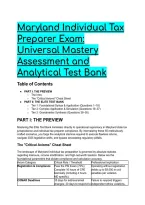
Maryland Individual Tax
Preparer Exam:
Universal Mastery
Assessment and
Analytical Test Bank
Table of Contents
● PART I: THE PREVIEW
○ The Intro
○ The "Critical Axioms" Cheat Sheet
● PART II: THE ELITE TEST BANK
○ Tier 1: Foundational Syntax & Application (Questions 1–18)
○ Tier 2: Complex Application & Simulation (Questions 19–37)
○ Tier 3: Grandmaster Synthesis (Questions 38–55)
PART I: THE PREVIEW
Mastering this Elite Test Bank translates directly to operational supremacy in Maryland state tax
jurisprudence and individual tax preparer compliance. By internalizing these 55 meticulously
crafted scenarios, you forge the analytical stamina required to execute flawless returns,
navigate 2025 legislative shifts, and bypass devastating regulatory pitfalls.
The "Critical Axioms" Cheat Sheet
The landscape of Maryland individual tax preparation is governed by absolute statutes
regarding licensure, income modification, and high-net-worth taxation. Below are the
foundational parameters that dictate compliance and calculation accuracy.
Axiom Category Critical Rule / Threshold Professional Implication
Registration & Compliance Pass the PSI Exam (70%); Operating without registration
Complete 16 hours of CPE yields up to $5,000 in civil
biennially (including 4 hours penalties per violation.
MD specific).
COMAR Deadlines 15 days for address/email Failure to respond triggers
changes; 30 days to respond to independent ethics violations,
,Axiom Category Critical Rule / Threshold Professional Implication
a Board inquiry. license suspension, or fines.
Pension Exclusion (TY2025) Maximum $41,200 exclusion for Must be offset dollar-for-dollar
taxpayers aged 65+ or totally by Social Security and Railroad
disabled. Retirement benefits.
Capital Gains Surtax 2% additional tax on net capital Triggers strictly when Federal
gains. Adjusted Gross Income (FAGI)
exceeds $350,000.
Itemized Phaseouts Reductions begin at $200,000 High-net-worth itemizers lose
FAGI ($100,000 for Married standard leverage and must
Filing Separately). add back federal SALT
deductions.
PART II: THE ELITE TEST BANK
Tier 1: Foundational Syntax & Application
Q1: An unregistered financial consultant prepares a Maryland individual tax return for a client
and charges a $500 flat fee. The consultant is not a CPA, Enrolled Agent, or attorney. Based on
the principles of Maryland Board of Individual Tax Preparers enforcement, which penalty is the
MOST LIKELY immediate consequence? A) A criminal misdemeanor charge carrying a
mandatory 1-year prison sentence. B) Disbarment from practicing before the IRS under Circular
230. C) A civil penalty assessed by the Board not exceeding $5,000 per violation. D) A written
warning requiring registration within 90 days prior to fine assessment.
● Answer: C (A civil penalty assessed by the Board not exceeding $5,000 per violation.)
● Distractor Analysis:
○ A is incorrect: While severe, the Board's immediate primary enforcement
mechanism against unregistered preparers is civil monetary penalties, not criminal
prosecution for a first offense.
○ B is incorrect: The Maryland Board regulates state registration; it does not have the
authority to disbar a practitioner from IRS practice under Circular 230.
○ D is incorrect: The Board does not issue "grace period" warnings for unauthorized
practice for compensation; it issues civil penalties immediately upon adjudication.
The Mentor's Analysis: Preparing tax returns for compensation in Maryland without registration
or a valid exemption is a direct violation of the Business Occupations and Professions Article.
The Board possesses the authority to levy civil penalties up to $5,000 per infraction. By knowing
the exact statutory penalty limits, practitioners respect the gravity of state-level licensure.
Professional Intuition: Never prepare a Maryland return for compensation without active,
verified registration or a statutory exemption.
Q2: A registered Maryland Individual Tax Preparer moves their primary office to a new suite
across town. According to the Code of Maryland Regulations (COMAR), what is the MAXIMUM
timeframe allowed for the preparer to notify the Board of this change? A) 10 days B) 15 days C)
30 days D) Prior to the next biennial license renewal
● Answer: B (15 days)
● Distractor Analysis:
○ A is incorrect: Ten days is a common timeline in corporate compliance, but COMAR
specifically grants slightly more time for tax practitioners.
○ C is incorrect: Thirty days is the required response time for written communications
, or audit inquiries from the Board, not for an address change.
○ D is incorrect: Waiting until renewal violates the strict reporting requirement and can
result in disciplinary action.
The Mentor's Analysis: Administrative compliance is as critical as tax law mastery. COMAR
09.38.01.05 strictly requires notification of any change in business or home address, telephone
number, or email within 15 days. By adhering to this, preparers avoid trivial procedural violations
that invite deeper audits. Professional Intuition: Address and contact updates must hit the
Board's desk within 15 days of the move; treat administrative deadlines with the same
urgency as the April 15th tax deadline.
Q3: A Maryland taxpayer receives an extension to file their federal income tax return (Form
4868). They expect to owe a balance to the State of Maryland. Based on the principles of
Maryland filing requirements, which action is the MOST APPROPRIATE? A) The federal
extension automatically grants a Maryland extension, requiring no further action until October
15. B) File Form 502E to request a 6-month extension to file, and remit the estimated tax due by
April 15. C) File Form 502EXT and pay a 10% penalty on the estimated balance to secure the
extension. D) The taxpayer cannot file a Maryland extension if they owe tax; they must file a
complete Form 502 by April 15.
● Answer: B (File Form 502E to request a 6-month extension to file, and remit the estimated
tax due by April 15.)
● Distractor Analysis:
○ A is incorrect: A federal extension automatically extends the Maryland filing
deadline only if no state tax is due. If tax is owed, a separate state extension is
mandatory.
○ C is incorrect: Form 502E is the correct form, not 502EXT, and there is no
automatic 10% penalty simply for filing an extension with payment.
○ D is incorrect: Taxpayers owing a balance absolutely can and should file extensions
accompanied by their payment to avoid failure-to-file penalties.
The Mentor's Analysis: Extensions provide time to file, never time to pay. When a balance is
owed, relying on the federal extension creates a fatal trap for state penalties. The taxpayer must
file Form 502E and satisfy the anticipated liability by the original April deadline. Professional
Intuition: An extension of time to file is not an extension of time to pay; remit Maryland
liabilities with Form 502E by April 15.
Q4: A 66-year-old single taxpayer in Maryland receives $25,000 in Social Security benefits and
$30,000 in a qualified pension distribution. Based on the principles of the Maryland Pension
Exclusion (assuming a $41,200 maximum for TY2025), what is the CORRECT exclusion
calculation? A) $0 B) $16,200 C) $30,000 D) $41,200
● Answer: B ($16,200)
● Distractor Analysis:
○ A is incorrect: The exclusion is not fully eliminated because the Social Security
received ($25,000) is less than the maximum exclusion ($41,200).
○ C is incorrect: This ignores the mandatory statutory offset for Social Security
benefits received.
○ D is incorrect: This is the maximum theoretical exclusion space, which must be
offset by Social Security benefits and limited to actual pension income.
The Mentor's Analysis: The Maryland Pension Exclusion requires a two-step limitation
calculation. First, subtract the Social Security benefits received from the statutory maximum
exclusion ($41,200 - $25,000 = $16,200). The taxpayer may exclude the lesser of this result or
their actual taxable pension income ($30,000). Thus, $16,200 is permitted. Professional
Preparer Exam:
Universal Mastery
Assessment and
Analytical Test Bank
Table of Contents
● PART I: THE PREVIEW
○ The Intro
○ The "Critical Axioms" Cheat Sheet
● PART II: THE ELITE TEST BANK
○ Tier 1: Foundational Syntax & Application (Questions 1–18)
○ Tier 2: Complex Application & Simulation (Questions 19–37)
○ Tier 3: Grandmaster Synthesis (Questions 38–55)
PART I: THE PREVIEW
Mastering this Elite Test Bank translates directly to operational supremacy in Maryland state tax
jurisprudence and individual tax preparer compliance. By internalizing these 55 meticulously
crafted scenarios, you forge the analytical stamina required to execute flawless returns,
navigate 2025 legislative shifts, and bypass devastating regulatory pitfalls.
The "Critical Axioms" Cheat Sheet
The landscape of Maryland individual tax preparation is governed by absolute statutes
regarding licensure, income modification, and high-net-worth taxation. Below are the
foundational parameters that dictate compliance and calculation accuracy.
Axiom Category Critical Rule / Threshold Professional Implication
Registration & Compliance Pass the PSI Exam (70%); Operating without registration
Complete 16 hours of CPE yields up to $5,000 in civil
biennially (including 4 hours penalties per violation.
MD specific).
COMAR Deadlines 15 days for address/email Failure to respond triggers
changes; 30 days to respond to independent ethics violations,
,Axiom Category Critical Rule / Threshold Professional Implication
a Board inquiry. license suspension, or fines.
Pension Exclusion (TY2025) Maximum $41,200 exclusion for Must be offset dollar-for-dollar
taxpayers aged 65+ or totally by Social Security and Railroad
disabled. Retirement benefits.
Capital Gains Surtax 2% additional tax on net capital Triggers strictly when Federal
gains. Adjusted Gross Income (FAGI)
exceeds $350,000.
Itemized Phaseouts Reductions begin at $200,000 High-net-worth itemizers lose
FAGI ($100,000 for Married standard leverage and must
Filing Separately). add back federal SALT
deductions.
PART II: THE ELITE TEST BANK
Tier 1: Foundational Syntax & Application
Q1: An unregistered financial consultant prepares a Maryland individual tax return for a client
and charges a $500 flat fee. The consultant is not a CPA, Enrolled Agent, or attorney. Based on
the principles of Maryland Board of Individual Tax Preparers enforcement, which penalty is the
MOST LIKELY immediate consequence? A) A criminal misdemeanor charge carrying a
mandatory 1-year prison sentence. B) Disbarment from practicing before the IRS under Circular
230. C) A civil penalty assessed by the Board not exceeding $5,000 per violation. D) A written
warning requiring registration within 90 days prior to fine assessment.
● Answer: C (A civil penalty assessed by the Board not exceeding $5,000 per violation.)
● Distractor Analysis:
○ A is incorrect: While severe, the Board's immediate primary enforcement
mechanism against unregistered preparers is civil monetary penalties, not criminal
prosecution for a first offense.
○ B is incorrect: The Maryland Board regulates state registration; it does not have the
authority to disbar a practitioner from IRS practice under Circular 230.
○ D is incorrect: The Board does not issue "grace period" warnings for unauthorized
practice for compensation; it issues civil penalties immediately upon adjudication.
The Mentor's Analysis: Preparing tax returns for compensation in Maryland without registration
or a valid exemption is a direct violation of the Business Occupations and Professions Article.
The Board possesses the authority to levy civil penalties up to $5,000 per infraction. By knowing
the exact statutory penalty limits, practitioners respect the gravity of state-level licensure.
Professional Intuition: Never prepare a Maryland return for compensation without active,
verified registration or a statutory exemption.
Q2: A registered Maryland Individual Tax Preparer moves their primary office to a new suite
across town. According to the Code of Maryland Regulations (COMAR), what is the MAXIMUM
timeframe allowed for the preparer to notify the Board of this change? A) 10 days B) 15 days C)
30 days D) Prior to the next biennial license renewal
● Answer: B (15 days)
● Distractor Analysis:
○ A is incorrect: Ten days is a common timeline in corporate compliance, but COMAR
specifically grants slightly more time for tax practitioners.
○ C is incorrect: Thirty days is the required response time for written communications
, or audit inquiries from the Board, not for an address change.
○ D is incorrect: Waiting until renewal violates the strict reporting requirement and can
result in disciplinary action.
The Mentor's Analysis: Administrative compliance is as critical as tax law mastery. COMAR
09.38.01.05 strictly requires notification of any change in business or home address, telephone
number, or email within 15 days. By adhering to this, preparers avoid trivial procedural violations
that invite deeper audits. Professional Intuition: Address and contact updates must hit the
Board's desk within 15 days of the move; treat administrative deadlines with the same
urgency as the April 15th tax deadline.
Q3: A Maryland taxpayer receives an extension to file their federal income tax return (Form
4868). They expect to owe a balance to the State of Maryland. Based on the principles of
Maryland filing requirements, which action is the MOST APPROPRIATE? A) The federal
extension automatically grants a Maryland extension, requiring no further action until October
15. B) File Form 502E to request a 6-month extension to file, and remit the estimated tax due by
April 15. C) File Form 502EXT and pay a 10% penalty on the estimated balance to secure the
extension. D) The taxpayer cannot file a Maryland extension if they owe tax; they must file a
complete Form 502 by April 15.
● Answer: B (File Form 502E to request a 6-month extension to file, and remit the estimated
tax due by April 15.)
● Distractor Analysis:
○ A is incorrect: A federal extension automatically extends the Maryland filing
deadline only if no state tax is due. If tax is owed, a separate state extension is
mandatory.
○ C is incorrect: Form 502E is the correct form, not 502EXT, and there is no
automatic 10% penalty simply for filing an extension with payment.
○ D is incorrect: Taxpayers owing a balance absolutely can and should file extensions
accompanied by their payment to avoid failure-to-file penalties.
The Mentor's Analysis: Extensions provide time to file, never time to pay. When a balance is
owed, relying on the federal extension creates a fatal trap for state penalties. The taxpayer must
file Form 502E and satisfy the anticipated liability by the original April deadline. Professional
Intuition: An extension of time to file is not an extension of time to pay; remit Maryland
liabilities with Form 502E by April 15.
Q4: A 66-year-old single taxpayer in Maryland receives $25,000 in Social Security benefits and
$30,000 in a qualified pension distribution. Based on the principles of the Maryland Pension
Exclusion (assuming a $41,200 maximum for TY2025), what is the CORRECT exclusion
calculation? A) $0 B) $16,200 C) $30,000 D) $41,200
● Answer: B ($16,200)
● Distractor Analysis:
○ A is incorrect: The exclusion is not fully eliminated because the Social Security
received ($25,000) is less than the maximum exclusion ($41,200).
○ C is incorrect: This ignores the mandatory statutory offset for Social Security
benefits received.
○ D is incorrect: This is the maximum theoretical exclusion space, which must be
offset by Social Security benefits and limited to actual pension income.
The Mentor's Analysis: The Maryland Pension Exclusion requires a two-step limitation
calculation. First, subtract the Social Security benefits received from the statutory maximum
exclusion ($41,200 - $25,000 = $16,200). The taxpayer may exclude the lesser of this result or
their actual taxable pension income ($30,000). Thus, $16,200 is permitted. Professional


