
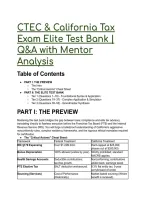
CTEC & California Tax
Exam Elite Test Bank |
Q&A with Mentor
Analysis
Table of Contents
● PART I: THE PREVIEW
○ The Intro
○ The "Critical Axioms" Cheat Sheet
● PART II: THE ELITE TEST BANK
○ Tier 1 (Questions 1–18) - Foundational Syntax & Application
○ Tier 2 (Questions 19–37) - Complex Application & Simulation
○ Tier 3 (Questions 38–55) - Grandmaster Synthesis
PART I: THE PREVIEW
Mastering this test bank bridges the gap between basic compliance and elite tax advisory,
translating directly to flawless execution before the Franchise Tax Board (FTB) and the Internal
Revenue Service (IRS). You will forge a bulletproof understanding of California's aggressive
nonconformity rules, complex residency frameworks, and the rigorous ethical mandates required
for certification.
● The "Critical Axioms" Cheat Sheet:
Framework Federal Treatment California Treatment
IRC §179 Expensing Over $1.22M limit. Hard-capped at $25,000;
phases out at $200,000.
Bonus Depreciation 100% allowed (varies by year). Strictly prohibited; standard
MACRS applies.
Health Savings Accounts Deductible contributions; Nonconforming; contributions
tax-free growth. added back, earnings taxed.
PTE Elective Tax SALT deduction workaround. 9.3% flat entity tax; 5-year
carryforward of credit.
Sourcing (Services) Cost of Performance Market-based sourcing (Where
(Historically). benefit is received).
,PART II: THE ELITE TEST BANK
Tier 1 (Questions 1–18) - Foundational Syntax &
Application
Q1: An aspiring tax professional completes their 60-hour qualifying education (QE) course
required by the California Tax Education Council (CTEC). To legitimately prepare tax returns for
a fee in California, within what timeframe is the ABSOLUTE deadline to register with CTEC
before their educational certificate expires? A) 12 months B) 18 months C) 24 months D) 36
months
● Answer: B (18 months)
● Distractor Analysis:
○ A is incorrect: A 12-month window applies to annual CE, but the initial QE certificate
has a longer shelf life.
○ C is incorrect: Waiting two years voids the QE certificate, requiring the candidate to
retake the 60-hour course.
○ D is incorrect: Tax law changes annually; CTEC does not accept three-year-old
baseline education.
The Mentor's Analysis: California mandates rapid entry into the profession following education
to ensure knowledge remains current. When facing initial certification, the immediate priority is
completing the Live Scan, securing a $5,000 bond, and applying within 18 months of QE
completion. By utilizing the 18-month statutory window, you bypass the common trap of letting
expensive coursework expire. Professional Intuition: Your 60-hour QE certificate is a
perishable asset. Register before the 18-month clock zeroes out.
Q2: A practitioner operates as a paid tax preparer in California but has not passed the CPA
exam or bar exam. Which of the following credentials provides a LEGAL EXEMPTION from the
CTEC registration requirement? A) The IRS Annual Filing Season Program (AFSP) Record of
Completion. B) A Master of Science in Taxation (MST) degree. C) The Enrolled Agent (EA)
credential issued by the U.S. Treasury. D) A valid Preparer Tax Identification Number (PTIN).
● Answer: C (The Enrolled Agent (EA) credential issued by the U.S. Treasury.)
● Distractor Analysis:
○ A is incorrect: The AFSP is a voluntary federal program and does not supersede
state CTEC mandates.
○ B is incorrect: Academic degrees do not grant practice rights or statutory
exemptions in California.
○ D is incorrect: A PTIN is required for all preparers, including CTEC registrants, but
grants no exemptions itself.
The Mentor's Analysis: California strictly limits non-CTEC practice to highly regulated federal
and state fiduciaries. When facing registration requirements, the immediate priority is identifying
the "Big Three" exemptions. By utilizing statutory exemptions, you bypass the common trap of
assuming federal compliance equals state compliance. Professional Intuition: Only CPAs,
Attorneys, and Enrolled Agents escape the CTEC mandate. Everyone else must register.
Q3: A small business in Los Angeles purchases $210,000 of qualifying equipment in 2025. The
owner wishes to maximize first-year deductions. Under California law, what is the allowable
Section 179 deduction for this purchase? A) $25,000 B) $15,000 C) $0 D) $210,000
, ● Answer: B ($15,000)
● Distractor Analysis:
○ A is incorrect: The $25,000 limit must be reduced dollar-for-dollar for purchases
exceeding $200,000.
○ C is incorrect: The deduction does not drop to zero until total purchases reach
$225,000.
○ D is incorrect: This is the federal allowance, reflecting a failure to apply state
nonconformity.
The Mentor's Analysis: California's Section 179 phase-out is an aggressive limitation trap. When
facing equipment purchases over $200,000, the immediate priority is applying the
dollar-for-dollar reduction. By utilizing the CA statutory phase-out, you bypass the common trap
of claiming the full $25,000 simply because purchases are under $225,000. Professional
Intuition: CA Phase-out = Total Cost minus $200,000. Subtract this result from the $25,000
maximum.
Q4: The Franchise Tax Board (FTB) discovers a ghost preparer operating without a valid CTEC
registration. Assuming this is the individual's FIRST offense, what is the mandatory penalty
assessed by the FTB? A) $500 B) $1,000 C) $2,500 D) $5,000
● Answer: C ($2,500)
● Distractor Analysis:
○ A is incorrect: $500 is a standard penalty for minor corporate infractions, not illegal
tax practice.
○ B is incorrect: $1,000 applies to undisclosed reportable transactions under R&TC
19166.
○ D is incorrect: $5,000 is the escalated penalty for subsequent failures to register.
The Mentor's Analysis: The FTB operates a zero-tolerance, self-funded enforcement protocol
against ghost preparers. When facing unregistered practice, the immediate priority is ceasing
operations instantly to avoid compounding fines. By utilizing Business & Professions Code
22253.2, you bypass the common trap of assuming the state issues warnings before levying
fines. Professional Intuition: Strike one costs $2,500. Strike two costs $5,000. Registration
costs $35. The math favors compliance.
Q5: A CTEC Registered Tax Preparer (CRTP) prepares a return utilizing an aggressively
fabricated deduction. The FTB determines this was an "unreasonable position." Under R&TC
19166, what is the standard penalty calculation for this infraction? A) A flat $1,000 fine. B) The
greater of $250 or 75% of the income derived by the tax preparer for that return. C) The greater
of $5,000 or 50% of the income derived. D) $50 per failure, capped at $25,000.
● Answer: B (The greater of $250 or 75% of the income derived by the tax preparer for that
return.)
● Distractor Analysis:
○ A is incorrect: $1,000 applies to aiding and abetting an understatement under
Section 6701.
○ C is incorrect: This harsher metric applies to willful or reckless conduct.
○ D is incorrect: This is the penalty for administrative failures, like omitting a PTIN or
failing to furnish a copy.
The Mentor's Analysis: Preparers hold direct financial liability for the legal integrity of the returns
they sign. When facing questionable client data, the immediate priority is establishing
substantial authority. By utilizing the $% threshold, you bypass the common trap of
assuming only the taxpayer bears the risk of an audit. Professional Intuition: If a position lacks
realistic possibility of success, do not sign. It will cost you 75% of your prep fee.
Exam Elite Test Bank |
Q&A with Mentor
Analysis
Table of Contents
● PART I: THE PREVIEW
○ The Intro
○ The "Critical Axioms" Cheat Sheet
● PART II: THE ELITE TEST BANK
○ Tier 1 (Questions 1–18) - Foundational Syntax & Application
○ Tier 2 (Questions 19–37) - Complex Application & Simulation
○ Tier 3 (Questions 38–55) - Grandmaster Synthesis
PART I: THE PREVIEW
Mastering this test bank bridges the gap between basic compliance and elite tax advisory,
translating directly to flawless execution before the Franchise Tax Board (FTB) and the Internal
Revenue Service (IRS). You will forge a bulletproof understanding of California's aggressive
nonconformity rules, complex residency frameworks, and the rigorous ethical mandates required
for certification.
● The "Critical Axioms" Cheat Sheet:
Framework Federal Treatment California Treatment
IRC §179 Expensing Over $1.22M limit. Hard-capped at $25,000;
phases out at $200,000.
Bonus Depreciation 100% allowed (varies by year). Strictly prohibited; standard
MACRS applies.
Health Savings Accounts Deductible contributions; Nonconforming; contributions
tax-free growth. added back, earnings taxed.
PTE Elective Tax SALT deduction workaround. 9.3% flat entity tax; 5-year
carryforward of credit.
Sourcing (Services) Cost of Performance Market-based sourcing (Where
(Historically). benefit is received).
,PART II: THE ELITE TEST BANK
Tier 1 (Questions 1–18) - Foundational Syntax &
Application
Q1: An aspiring tax professional completes their 60-hour qualifying education (QE) course
required by the California Tax Education Council (CTEC). To legitimately prepare tax returns for
a fee in California, within what timeframe is the ABSOLUTE deadline to register with CTEC
before their educational certificate expires? A) 12 months B) 18 months C) 24 months D) 36
months
● Answer: B (18 months)
● Distractor Analysis:
○ A is incorrect: A 12-month window applies to annual CE, but the initial QE certificate
has a longer shelf life.
○ C is incorrect: Waiting two years voids the QE certificate, requiring the candidate to
retake the 60-hour course.
○ D is incorrect: Tax law changes annually; CTEC does not accept three-year-old
baseline education.
The Mentor's Analysis: California mandates rapid entry into the profession following education
to ensure knowledge remains current. When facing initial certification, the immediate priority is
completing the Live Scan, securing a $5,000 bond, and applying within 18 months of QE
completion. By utilizing the 18-month statutory window, you bypass the common trap of letting
expensive coursework expire. Professional Intuition: Your 60-hour QE certificate is a
perishable asset. Register before the 18-month clock zeroes out.
Q2: A practitioner operates as a paid tax preparer in California but has not passed the CPA
exam or bar exam. Which of the following credentials provides a LEGAL EXEMPTION from the
CTEC registration requirement? A) The IRS Annual Filing Season Program (AFSP) Record of
Completion. B) A Master of Science in Taxation (MST) degree. C) The Enrolled Agent (EA)
credential issued by the U.S. Treasury. D) A valid Preparer Tax Identification Number (PTIN).
● Answer: C (The Enrolled Agent (EA) credential issued by the U.S. Treasury.)
● Distractor Analysis:
○ A is incorrect: The AFSP is a voluntary federal program and does not supersede
state CTEC mandates.
○ B is incorrect: Academic degrees do not grant practice rights or statutory
exemptions in California.
○ D is incorrect: A PTIN is required for all preparers, including CTEC registrants, but
grants no exemptions itself.
The Mentor's Analysis: California strictly limits non-CTEC practice to highly regulated federal
and state fiduciaries. When facing registration requirements, the immediate priority is identifying
the "Big Three" exemptions. By utilizing statutory exemptions, you bypass the common trap of
assuming federal compliance equals state compliance. Professional Intuition: Only CPAs,
Attorneys, and Enrolled Agents escape the CTEC mandate. Everyone else must register.
Q3: A small business in Los Angeles purchases $210,000 of qualifying equipment in 2025. The
owner wishes to maximize first-year deductions. Under California law, what is the allowable
Section 179 deduction for this purchase? A) $25,000 B) $15,000 C) $0 D) $210,000
, ● Answer: B ($15,000)
● Distractor Analysis:
○ A is incorrect: The $25,000 limit must be reduced dollar-for-dollar for purchases
exceeding $200,000.
○ C is incorrect: The deduction does not drop to zero until total purchases reach
$225,000.
○ D is incorrect: This is the federal allowance, reflecting a failure to apply state
nonconformity.
The Mentor's Analysis: California's Section 179 phase-out is an aggressive limitation trap. When
facing equipment purchases over $200,000, the immediate priority is applying the
dollar-for-dollar reduction. By utilizing the CA statutory phase-out, you bypass the common trap
of claiming the full $25,000 simply because purchases are under $225,000. Professional
Intuition: CA Phase-out = Total Cost minus $200,000. Subtract this result from the $25,000
maximum.
Q4: The Franchise Tax Board (FTB) discovers a ghost preparer operating without a valid CTEC
registration. Assuming this is the individual's FIRST offense, what is the mandatory penalty
assessed by the FTB? A) $500 B) $1,000 C) $2,500 D) $5,000
● Answer: C ($2,500)
● Distractor Analysis:
○ A is incorrect: $500 is a standard penalty for minor corporate infractions, not illegal
tax practice.
○ B is incorrect: $1,000 applies to undisclosed reportable transactions under R&TC
19166.
○ D is incorrect: $5,000 is the escalated penalty for subsequent failures to register.
The Mentor's Analysis: The FTB operates a zero-tolerance, self-funded enforcement protocol
against ghost preparers. When facing unregistered practice, the immediate priority is ceasing
operations instantly to avoid compounding fines. By utilizing Business & Professions Code
22253.2, you bypass the common trap of assuming the state issues warnings before levying
fines. Professional Intuition: Strike one costs $2,500. Strike two costs $5,000. Registration
costs $35. The math favors compliance.
Q5: A CTEC Registered Tax Preparer (CRTP) prepares a return utilizing an aggressively
fabricated deduction. The FTB determines this was an "unreasonable position." Under R&TC
19166, what is the standard penalty calculation for this infraction? A) A flat $1,000 fine. B) The
greater of $250 or 75% of the income derived by the tax preparer for that return. C) The greater
of $5,000 or 50% of the income derived. D) $50 per failure, capped at $25,000.
● Answer: B (The greater of $250 or 75% of the income derived by the tax preparer for that
return.)
● Distractor Analysis:
○ A is incorrect: $1,000 applies to aiding and abetting an understatement under
Section 6701.
○ C is incorrect: This harsher metric applies to willful or reckless conduct.
○ D is incorrect: This is the penalty for administrative failures, like omitting a PTIN or
failing to furnish a copy.
The Mentor's Analysis: Preparers hold direct financial liability for the legal integrity of the returns
they sign. When facing questionable client data, the immediate priority is establishing
substantial authority. By utilizing the $% threshold, you bypass the common trap of
assuming only the taxpayer bears the risk of an audit. Professional Intuition: If a position lacks
realistic possibility of success, do not sign. It will cost you 75% of your prep fee.


