
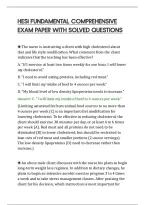
HESI FUNDAMENTAL COMPREHENSIVE
EXAM PAPER WITH SOLVED QUESTIONS
◉ The nurse is instructing a client with high cholesterol about
diet and life style modification. What comment from the client
indicates that the teaching has been effective?
A. "If I exercise at least two times weekly for one hour, I will lower
my cholesterol."
B. "I need to avoid eating proteins, including red meat."
C. "I will limit my intake of beef to 4 ounces per week."
D. "My blood level of low density lipoproteins needs to increase."
Answer: C. "I will limit my intake of beef to 4 ounces per week."
(Limiting saturated fat from animal food sources to no more than
4 ounces per week (C) is an important diet modification for
lowering cholesterol. To be effective in reducing cholesterol, the
client should exercise 30 minutes per day, or at least 4 to 6 times
per week (A). Red meat and all proteins do not need to be
eliminated (B) to lower cholesterol, but should be restricted to
lean cuts of red meat and smaller portions (2-ounce servings).
The low density lipoproteins (D) need to decrease rather than
increase.)
◉ An obese male client discusses with the nurse his plans to begin
long-term weight loss regimen. In addition to dietary changes, he
plans to begin an intensive aerobic exercise program 3 to 4 times
a week and to take stress management classes. After praising the
client for his decision, which instruction is most important for
,the nurse to provide?
A. "Be sure to have a complete physical examination before
beginning your planned exercise program."
B. "Be careful that the exercise program doesn't simply add to
your stress level, making you want to eat more."
C. "Increased exercise helps to reduce stress, so you may not need
to spend money on a stress management class."
D. "Make sure to monitor your weight loss regularly to provide a
sense of accomplishment and motivation."
Answer: A. "Be sure to have a complete physical examination
before your planned exercise program."
(The most important teaching is (A), so that the client will not
begin a dangerous level of exercise when he is not sufficiently fit.
This might result in chest pain, a heart attack, or stroke. (B, C, and
D) are important instructions, but are of less priority than (A). )
◉ The nurse is teaching a client proper use of an inhaler. When
should the client administer the inhaler-delivered medication to
demonstrate correct use of the inhaler?
A. Immediately after exhalation.
B. During the inhalation
C. At the end of three inhalers
D. Immediately after inhalation
Answer: B. During the inhalation.
(The client should be instructed to deliver the medication during
the last part of inhalation (B). After the medication is delivered,
the client should remove the mouthpiece, keeping his/her lips
,closed and breath held for several seconds to allow for
distribution of the medication. The client should not deliver the
dose as started in (A or D), and should deliver no more than two
inhalations at a time (C).)
◉ An IV infusion terbutaline sulfate 5 mg in 500 mL of D5W,
infusing at a rate of 30 mcg/min, is prescribed for a client in
premature labor. How many ml/hr should the nurse set the
infusion pump?
Answer: 180
◉ The healthcare provider prescribes the diuretic metolazone
(Zaroxolyn) 7.5 mg PO. Zaroxoltn is available in 5 mg tablets. How
much should the nurse plan to administer?
Answer: 1 1/2 tablets
◉ The healthcare provider prescribes furosemide (Lasix) 15 mg
IV stat. On hand is Lasix 20 mg/2ml. How many millileters should
the nurse administer?
Answer: 1.5 mL
◉ Heparin 20,000 units in 500 mL D5W at 50 mL/hour has been
infusing for 5.5 hours. How much heparin has the client received?
Answer: 11,000 units
◉ The nurse is caring for a client who is receiving 24-hour total
parenteral nutrition (TPN) via a central line at 54 mL/hr. When
, initially assessing the client, the nurse notes that the TPN solution
has run out and the next TPN solution is not available. What
immediate action should the nurse take?
A. Infuse normal saline at a keep vein open rate.
B. Discontinue the IV and flush the port with heparin.
C. Infuse 10% dextrose and water at 54 mL/hour.
D. Obtain a stat blood glucose level and notify the HCP.
Answer: C. Infuse 10% dextrose and water at 54 mL/hour.
(TPN is discontinued gradually to allow the client to adjust
decreased levels of glucose. Administering 10% dextrose in water
at the prescribed rate (C) will keep the client from experiencing
hypoglycemia until the next TPN solution is available. The client
could experience a hypoglycemic reaction if the current level of
glucose (A) is not maintained or if the TPN is discontinued
abruptly (B). There is no reason to obtain a stat blood-glucose
level (D) and the HCP cannot do anything about this situation.)
◉ Examination of a client complaining of itching on his right arm
reveals a rash made up of multiple flat areas of redness ranging
from pinpoint to 0.5 cm in diameter. How should the nurse record
this finding?
A. Multiple vesicular areas surrounded by redness, ranging in size
from 1 mm to 0.5 cm.
B. Localized red rash comprised of flat areas, pinpoint to 0.5 cm in
diameter.
C. Several areas of red, papular lesions from pinpoint to 0.5 cm in
size.


