
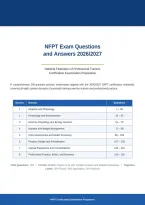
NFPT Exam Questions
and Answers 2026/2027
National Federation of Professional Trainers
Certification Examination Preparation
A comprehensive 150-question practice examination aligned with the 2026/2027 NFPT certification standards,
covering all eight content domains of personal training exercise science and professional practice.
Section Domain Questions
1 Anatomy and Physiology 1 – 28
2 Kinesiology and Biomechanics 29 – 50
3 Exercise Physiology and Energy Systems 51 – 70
4 Nutrition and Weight Management 71 – 88
5 Client Assessment and Health Screening 89 – 106
6 Program Design and Periodization 107 – 128
7 Special Populations and Considerations 129 – 140
8 Professional Practice, Ethics, and Business 141 – 150
Total Questions: 150 | Format: Multiple Choice (A-D) with Verified Answers and Detailed Rationales | Cognitive
Levels: 35% Recall, 50% Application, 15% Analysis
NFPT Certification Examination Preparation
,NFPT Exam Questions and Answers 2026/2027 National Federation of Professional Trainers
Examination Instructions and Overview
Purpose. This practice examination is designed to mirror the content, format, and cognitive demand of the
National Federation of Professional Trainers (NFPT) certification examination for the 2026/2027 cycle. The 150
items span eight content domains reflecting the knowledge, skills, and abilities (KSAs) required of an
entry-to-practice personal trainer. Items include both direct recall of exercise science principles and applied,
scenario-based reasoning consistent with NFPT's practical orientation. Use this examination diagnostically:
complete each section, review the rationales for items answered incorrectly, and identify knowledge gaps before
sitting for the live examination.
Cognitive Level Distribution. Approximately 35% of items assess recall of foundational anatomy, physiology,
kinesiology, and nutrition facts; 50% assess application of these principles to realistic training scenarios (program
design, movement analysis, special-population considerations); and 15% assess analysis, requiring integration of
multiple concepts to solve clinical decision-making items such as 'Which exercise is MOST appropriate?' or 'What
is the FIRST action?' This distribution mirrors the cognitive complexity expected of NFPT-certified trainers.
Format. Each question is presented with a stem, four response options labeled A through D, a verified correct
answer marked [CORRECT] beside the correct option, the 'Correct Answer' line, and a 2-3 sentence rationale
that explains why the correct answer is correct and why the distractors are incorrect. The rationale integrates
anatomical principles, exercise physiology mechanisms, program design standards, safety considerations, and
evidence-based practice references.
How to Use This Document. Work through questions sequentially without consulting the answers until you have
committed to a response. After scoring, study the rationales for both correct and incorrect responses to deepen
your understanding of common NFPT exam pitfalls, such as confusing muscle actions, misidentifying joint
actions, selecting the wrong energy system for a given duration, misapplying FITT-VP principles,
misunderstanding scope of practice limitations, or selecting inappropriate exercise prescriptions for special
populations. Use the section structure to focus study on domains in which you score below 70%.
Disclaimer. This practice examination is an independent study aid and is not affiliated with, endorsed by, or
representative of the official NFPT certification examination. Question content is informed by publicly available
NFPT and ACSM guidelines, contemporary exercise science literature, and standard personal training
competencies. Always consult current NFPT materials and recertification requirements directly from the National
Federation of Professional Trainers for the most authoritative guidance.
Section 1: Anatomy and Physiology
Skeletal, Muscular, Nervous, Cardiovascular, Respiratory, & Endocrine Systems
Question Range: Q1 – Q28
NFPT Certification Examination Preparation • 150 Questions Page 2
,NFPT Exam Questions and Answers 2026/2027 National Federation of Professional Trainers
Q1: A client presents with a rotator cuff injury affecting the glenohumeral joint. Which type of
synovial joint is the glenohumeral joint, and what is its primary functional classification?
A. Hinge joint; uniaxial
B. Pivot joint; uniaxial
C. Ball-and-socket joint; multiaxial [CORRECT]
D. Saddle joint; biaxial
Correct Answer: C
Rationale: The glenohumeral (shoulder) joint is a ball-and-socket synovial joint in which the humeral head
articulates with the glenoid fossa of the scapula. It is multiaxial, permitting flexion/extension, abduction/adduction,
internal/external rotation, and circumduction. Hinge joints (elbow) are uniaxial, pivot joints (proximal radioulnar)
permit rotation only, and saddle joints (carpometacarpal of the thumb) are biaxial. NFPT candidates must
distinguish joint types when selecting exercises that respect anatomical movement capabilities.
Q2: During a squat assessment, a trainer observes that the client's femurs are positioned within the
axial skeleton. Which statement correctly distinguishes the axial from the appendicular skeleton?
A. The axial skeleton contains the skull, vertebral column, rib cage, and sternum; the appendicular
contains the limbs and girdles [CORRECT]
B. The axial skeleton includes the limbs; the appendicular includes the vertebral column
C. The axial skeleton is composed of the pelvic and pectoral girdles only
D. The appendicular skeleton includes only the lower extremities
Correct Answer: A
Rationale: The axial skeleton (80 bones) forms the longitudinal axis: skull, ossicles, hyoid, vertebral column, rib
cage, and sternum. The appendicular skeleton (126 bones) includes the pectoral and pelvic girdles plus the upper
and lower limbs. The femur is part of the appendicular skeleton, not the axial. Misclassifying a structure as axial
when it is appendicular would lead to incorrect cueing during movement analysis, a frequent NFPT exam pitfall.
Q3: A long bone such as the femur is composed of multiple structural layers. Which sequence lists
the layers of bone tissue from outermost to innermost?
A. Endosteum, periosteum, compact bone, spongy bone, medullary cavity
B. Periosteum, compact bone, spongy bone, endosteum, medullary cavity [CORRECT]
C. Compact bone, periosteum, medullary cavity, spongy bone, endosteum
D. Spongy bone, compact bone, periosteum, endosteum, medullary cavity
Correct Answer: B
Rationale: From outermost to innermost, a long bone consists of the periosteum (fibrous outer sheath rich in
blood vessels and nerves), compact bone (dense lamellar tissue providing strength), spongy/cancellous bone
(trabecular lattice housing red marrow), the endosteum (thin lining of inner cavities), and the medullary cavity
(yellow marrow in adults). Knowing this arrangement is essential for understanding stress fractures, bone
remodeling, and the osteogenic response to resistance training emphasized by NFPT.
NFPT Certification Examination Preparation • 150 Questions Page 3
, NFPT Exam Questions and Answers 2026/2027 National Federation of Professional Trainers
Q4: A new client asks why weight-bearing exercise improves bone density. Which cell type is
directly responsible for forming new bone matrix during remodeling?
A. Osteoclasts
B. Osteocytes
C. Osteoblasts [CORRECT]
D. Chondrocytes
Correct Answer: C
Rationale: Osteoblasts are bone-forming cells that synthesize and secrete osteoid (unmineralized matrix) and
regulate mineralization. Osteocytes are mature, embedded osteoblasts that maintain bone and sense mechanical
strain. Osteoclasts resorb bone during remodeling, while chondrocytes produce cartilage. Mechanical loading via
weight-bearing exercise stimulates osteoblast activity, raising bone mineral density through Wolff's law. This
rationale underpins NFPT's emphasis on resistance training for osteoporosis prevention in older adults.
Q5: A trainer is explaining joint mobility. Which structural classification describes a joint united by
fibrous tissue with minimal movement, such as the coronal suture of the skull?
A. Synovial joint
B. Cartilaginous joint (synchondrosis)
C. Fibrous joint (suture) [CORRECT]
D. Synovial joint (plane)
Correct Answer: C
Rationale: Fibrous joints connect bones via dense connective tissue and are mostly immovable (synarthroses).
Sutures of the skull are a classic example. Cartilaginous joints (synchondroses and symphyses) unite bones via
cartilage, allowing slight movement, as at the pubic symphysis. Synovial joints, such as plane (gliding) joints, are
freely movable (diarthroses). Recognizing joint classification guides exercise selection and avoidance of forced
mobility in joints designed to be stable, an important NFPT safety principle.
Q6: Which muscle group is correctly paired with its primary action at the shoulder joint during a
dumbbell lateral raise?
A. Pectoralis major; shoulder flexion
B. Latissimus dorsi; shoulder extension
C. Deltoid (middle fibers); shoulder abduction [CORRECT]
D. Teres major; shoulder internal rotation
Correct Answer: C
Rationale: The middle fibers of the deltoid originate on the acromion process and insert on the deltoid tuberosity
of the humerus, producing shoulder abduction in the frontal plane. The pectoralis major flexes and adducts the
shoulder, the latissimus dorsi extends and internally rotates the shoulder, and the teres major internally rotates
and extends the shoulder. Identifying primary movers by fiber region is a high-yield NFPT anatomy competency
frequently tested in scenario format.
NFPT Certification Examination Preparation • 150 Questions Page 4
and Answers 2026/2027
National Federation of Professional Trainers
Certification Examination Preparation
A comprehensive 150-question practice examination aligned with the 2026/2027 NFPT certification standards,
covering all eight content domains of personal training exercise science and professional practice.
Section Domain Questions
1 Anatomy and Physiology 1 – 28
2 Kinesiology and Biomechanics 29 – 50
3 Exercise Physiology and Energy Systems 51 – 70
4 Nutrition and Weight Management 71 – 88
5 Client Assessment and Health Screening 89 – 106
6 Program Design and Periodization 107 – 128
7 Special Populations and Considerations 129 – 140
8 Professional Practice, Ethics, and Business 141 – 150
Total Questions: 150 | Format: Multiple Choice (A-D) with Verified Answers and Detailed Rationales | Cognitive
Levels: 35% Recall, 50% Application, 15% Analysis
NFPT Certification Examination Preparation
,NFPT Exam Questions and Answers 2026/2027 National Federation of Professional Trainers
Examination Instructions and Overview
Purpose. This practice examination is designed to mirror the content, format, and cognitive demand of the
National Federation of Professional Trainers (NFPT) certification examination for the 2026/2027 cycle. The 150
items span eight content domains reflecting the knowledge, skills, and abilities (KSAs) required of an
entry-to-practice personal trainer. Items include both direct recall of exercise science principles and applied,
scenario-based reasoning consistent with NFPT's practical orientation. Use this examination diagnostically:
complete each section, review the rationales for items answered incorrectly, and identify knowledge gaps before
sitting for the live examination.
Cognitive Level Distribution. Approximately 35% of items assess recall of foundational anatomy, physiology,
kinesiology, and nutrition facts; 50% assess application of these principles to realistic training scenarios (program
design, movement analysis, special-population considerations); and 15% assess analysis, requiring integration of
multiple concepts to solve clinical decision-making items such as 'Which exercise is MOST appropriate?' or 'What
is the FIRST action?' This distribution mirrors the cognitive complexity expected of NFPT-certified trainers.
Format. Each question is presented with a stem, four response options labeled A through D, a verified correct
answer marked [CORRECT] beside the correct option, the 'Correct Answer' line, and a 2-3 sentence rationale
that explains why the correct answer is correct and why the distractors are incorrect. The rationale integrates
anatomical principles, exercise physiology mechanisms, program design standards, safety considerations, and
evidence-based practice references.
How to Use This Document. Work through questions sequentially without consulting the answers until you have
committed to a response. After scoring, study the rationales for both correct and incorrect responses to deepen
your understanding of common NFPT exam pitfalls, such as confusing muscle actions, misidentifying joint
actions, selecting the wrong energy system for a given duration, misapplying FITT-VP principles,
misunderstanding scope of practice limitations, or selecting inappropriate exercise prescriptions for special
populations. Use the section structure to focus study on domains in which you score below 70%.
Disclaimer. This practice examination is an independent study aid and is not affiliated with, endorsed by, or
representative of the official NFPT certification examination. Question content is informed by publicly available
NFPT and ACSM guidelines, contemporary exercise science literature, and standard personal training
competencies. Always consult current NFPT materials and recertification requirements directly from the National
Federation of Professional Trainers for the most authoritative guidance.
Section 1: Anatomy and Physiology
Skeletal, Muscular, Nervous, Cardiovascular, Respiratory, & Endocrine Systems
Question Range: Q1 – Q28
NFPT Certification Examination Preparation • 150 Questions Page 2
,NFPT Exam Questions and Answers 2026/2027 National Federation of Professional Trainers
Q1: A client presents with a rotator cuff injury affecting the glenohumeral joint. Which type of
synovial joint is the glenohumeral joint, and what is its primary functional classification?
A. Hinge joint; uniaxial
B. Pivot joint; uniaxial
C. Ball-and-socket joint; multiaxial [CORRECT]
D. Saddle joint; biaxial
Correct Answer: C
Rationale: The glenohumeral (shoulder) joint is a ball-and-socket synovial joint in which the humeral head
articulates with the glenoid fossa of the scapula. It is multiaxial, permitting flexion/extension, abduction/adduction,
internal/external rotation, and circumduction. Hinge joints (elbow) are uniaxial, pivot joints (proximal radioulnar)
permit rotation only, and saddle joints (carpometacarpal of the thumb) are biaxial. NFPT candidates must
distinguish joint types when selecting exercises that respect anatomical movement capabilities.
Q2: During a squat assessment, a trainer observes that the client's femurs are positioned within the
axial skeleton. Which statement correctly distinguishes the axial from the appendicular skeleton?
A. The axial skeleton contains the skull, vertebral column, rib cage, and sternum; the appendicular
contains the limbs and girdles [CORRECT]
B. The axial skeleton includes the limbs; the appendicular includes the vertebral column
C. The axial skeleton is composed of the pelvic and pectoral girdles only
D. The appendicular skeleton includes only the lower extremities
Correct Answer: A
Rationale: The axial skeleton (80 bones) forms the longitudinal axis: skull, ossicles, hyoid, vertebral column, rib
cage, and sternum. The appendicular skeleton (126 bones) includes the pectoral and pelvic girdles plus the upper
and lower limbs. The femur is part of the appendicular skeleton, not the axial. Misclassifying a structure as axial
when it is appendicular would lead to incorrect cueing during movement analysis, a frequent NFPT exam pitfall.
Q3: A long bone such as the femur is composed of multiple structural layers. Which sequence lists
the layers of bone tissue from outermost to innermost?
A. Endosteum, periosteum, compact bone, spongy bone, medullary cavity
B. Periosteum, compact bone, spongy bone, endosteum, medullary cavity [CORRECT]
C. Compact bone, periosteum, medullary cavity, spongy bone, endosteum
D. Spongy bone, compact bone, periosteum, endosteum, medullary cavity
Correct Answer: B
Rationale: From outermost to innermost, a long bone consists of the periosteum (fibrous outer sheath rich in
blood vessels and nerves), compact bone (dense lamellar tissue providing strength), spongy/cancellous bone
(trabecular lattice housing red marrow), the endosteum (thin lining of inner cavities), and the medullary cavity
(yellow marrow in adults). Knowing this arrangement is essential for understanding stress fractures, bone
remodeling, and the osteogenic response to resistance training emphasized by NFPT.
NFPT Certification Examination Preparation • 150 Questions Page 3
, NFPT Exam Questions and Answers 2026/2027 National Federation of Professional Trainers
Q4: A new client asks why weight-bearing exercise improves bone density. Which cell type is
directly responsible for forming new bone matrix during remodeling?
A. Osteoclasts
B. Osteocytes
C. Osteoblasts [CORRECT]
D. Chondrocytes
Correct Answer: C
Rationale: Osteoblasts are bone-forming cells that synthesize and secrete osteoid (unmineralized matrix) and
regulate mineralization. Osteocytes are mature, embedded osteoblasts that maintain bone and sense mechanical
strain. Osteoclasts resorb bone during remodeling, while chondrocytes produce cartilage. Mechanical loading via
weight-bearing exercise stimulates osteoblast activity, raising bone mineral density through Wolff's law. This
rationale underpins NFPT's emphasis on resistance training for osteoporosis prevention in older adults.
Q5: A trainer is explaining joint mobility. Which structural classification describes a joint united by
fibrous tissue with minimal movement, such as the coronal suture of the skull?
A. Synovial joint
B. Cartilaginous joint (synchondrosis)
C. Fibrous joint (suture) [CORRECT]
D. Synovial joint (plane)
Correct Answer: C
Rationale: Fibrous joints connect bones via dense connective tissue and are mostly immovable (synarthroses).
Sutures of the skull are a classic example. Cartilaginous joints (synchondroses and symphyses) unite bones via
cartilage, allowing slight movement, as at the pubic symphysis. Synovial joints, such as plane (gliding) joints, are
freely movable (diarthroses). Recognizing joint classification guides exercise selection and avoidance of forced
mobility in joints designed to be stable, an important NFPT safety principle.
Q6: Which muscle group is correctly paired with its primary action at the shoulder joint during a
dumbbell lateral raise?
A. Pectoralis major; shoulder flexion
B. Latissimus dorsi; shoulder extension
C. Deltoid (middle fibers); shoulder abduction [CORRECT]
D. Teres major; shoulder internal rotation
Correct Answer: C
Rationale: The middle fibers of the deltoid originate on the acromion process and insert on the deltoid tuberosity
of the humerus, producing shoulder abduction in the frontal plane. The pectoralis major flexes and adducts the
shoulder, the latissimus dorsi extends and internally rotates the shoulder, and the teres major internally rotates
and extends the shoulder. Identifying primary movers by fiber region is a high-yield NFPT anatomy competency
frequently tested in scenario format.
NFPT Certification Examination Preparation • 150 Questions Page 4


